
Explore the latest trends in Non-Equilibrium Quantum Field Theory (NEQFT), its applications in modern physics, and its interdisciplinary impact.
Exploring Non-Equilibrium Quantum Field Theory: A Frontier in Modern Physics
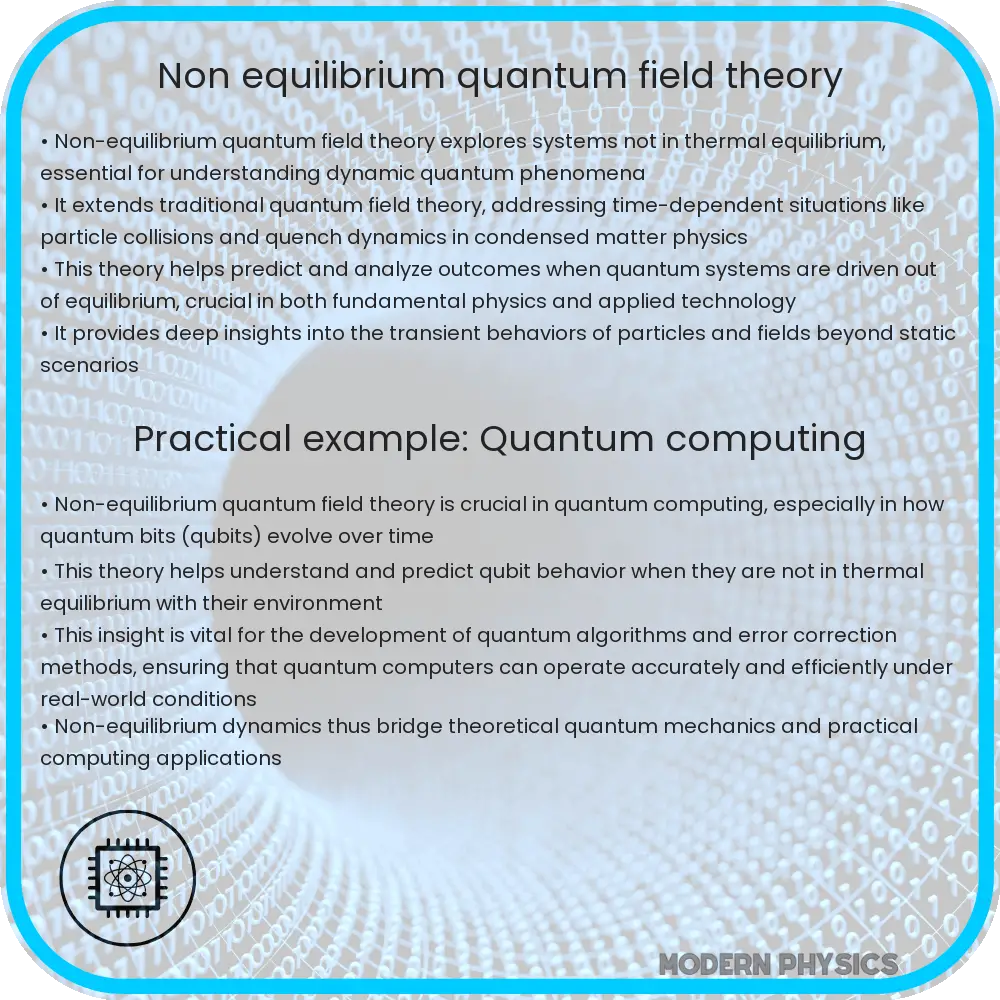
The realm of Non-Equilibrium Quantum Field Theory (NEQFT) represents a cutting-edge area in contemporary physics, intertwining the intricacies of quantum mechanics with the dynamism of systems not in equilibrium. This field sheds light on phenomena that traditional quantum field theories, often focused on equilibrium states, do not adequately explain. NEQFT’s applications extend across various disciplines, from condensed matter physics to cosmology, offering profound insights into the universe’s most fundamental processes.
Current Trends in NEQFT
Recent trends in NEQFT research have been driven by technological advancements in computing and experimentation. One significant trend is the exploration of quantum entanglement in non-equilibrium systems. Studies delve into how particles interact and entangle over time in systems far from equilibrium, offering new perspectives on quantum information theory and quantum computing.
Another emerging area is the study of topological phases of matter under non-equilibrium conditions. Researchers are examining how exposing materials to external stimuli like electric fields or light can result in new and exotic phases, which could have implications for future electronic and photonic devices.
Applications of NEQFT
One of the most exciting applications of NEQFT lies in the development of quantum technologies. For instance, understanding non-equilibrium dynamics is crucial in designing more efficient quantum computers and communication systems. Additionally, NEQFT is pivotal in the study of high-temperature superconductors, where electrons behave in non-traditional ways, potentially leading to breakthroughs in energy transmission.
In astrophysics, NEQFT provides insights into the early universe’s conditions, particularly during the inflationary period. By examining how quantum fields behave under extreme non-equilibrium conditions, scientists can gain a better understanding of the universe’s birth and evolution.
Key Insights from NEQFT
One of the foundational insights from NEQFT is the recognition of the role of time’s arrow in quantum processes. Unlike traditional quantum field theories, where time often plays a symmetric role, NEQFT acknowledges the irreversibility of time in evolving systems. This insight has profound implications for understanding entropy and the thermodynamics of quantum systems.
Another key insight is the concept of quantum criticality in non-equilibrium systems. This involves studying phase transitions at zero temperature, where quantum fluctuations dominate. Understanding these transitions can lead to the discovery of new materials and phenomena, furthering our grasp of the quantum world.
In conclusion, Non-Equilibrium Quantum Field Theory stands as a vibrant field of study, pushing the boundaries of our understanding of quantum mechanics and its applications. Its interdisciplinary nature and potential for groundbreaking discoveries make it an exciting area for ongoing research and exploration.
Advancements and Challenges in NEQFT
The advancements in NEQFT have been significant, yet they come with their own set of challenges. On the experimental front, creating and maintaining non-equilibrium conditions at quantum levels is complex and requires highly sophisticated equipment. This challenge is coupled with the difficulty in accurately measuring quantum phenomena without disturbing the system. Theoretical challenges also abound, as NEQFT demands a departure from traditional equilibrium theories and calls for the development of new mathematical tools and models.
Interdisciplinary Impacts of NEQFT
NEQFT’s impact extends beyond physics, influencing other disciplines like chemistry and biology. For instance, understanding quantum processes in non-equilibrium states has implications for chemical reactions at the quantum level, potentially revolutionizing synthetic chemistry. In biology, NEQFT could offer insights into quantum biological processes, like photosynthesis and enzyme activity, which may occur in non-equilibrium conditions.
Future Directions in NEQFT Research
Looking ahead, NEQFT research is poised to explore more complex systems and interactions. One area of future research is the application of NEQFT to quantum gravity, potentially offering insights into how gravity behaves at quantum scales. Another promising direction is the integration of machine learning and AI techniques to solve complex non-equilibrium quantum problems, potentially accelerating discoveries in this field.
Furthermore, as quantum technology continues to advance, NEQFT will play a crucial role in developing new materials and technologies, such as quantum sensors and more efficient energy systems. The synergy between theoretical research and practical applications is likely to drive much of the future progress in this field.
Conclusion: The Transformative Potential of NEQFT
In conclusion, Non-Equilibrium Quantum Field Theory stands at the forefront of modern physics, offering a window into the complex and dynamic nature of the quantum world. Its ability to bridge theoretical concepts with practical applications makes it a pivotal field for future technological advancements. The insights gained from NEQFT are not only deepening our understanding of the quantum universe but also paving the way for innovations across various scientific and technological domains. As research in this area continues to evolve, NEQFT promises to be a key driver of scientific discovery and innovation in the 21st century and beyond.