
Isoscalar Giant Resonances (IGR) are high-energy, short-lived states in atomic nuclei, involving coherent nucleon oscillations, crucial for understanding nuclear matter properties.
Understanding Isoscalar Giant Resonances
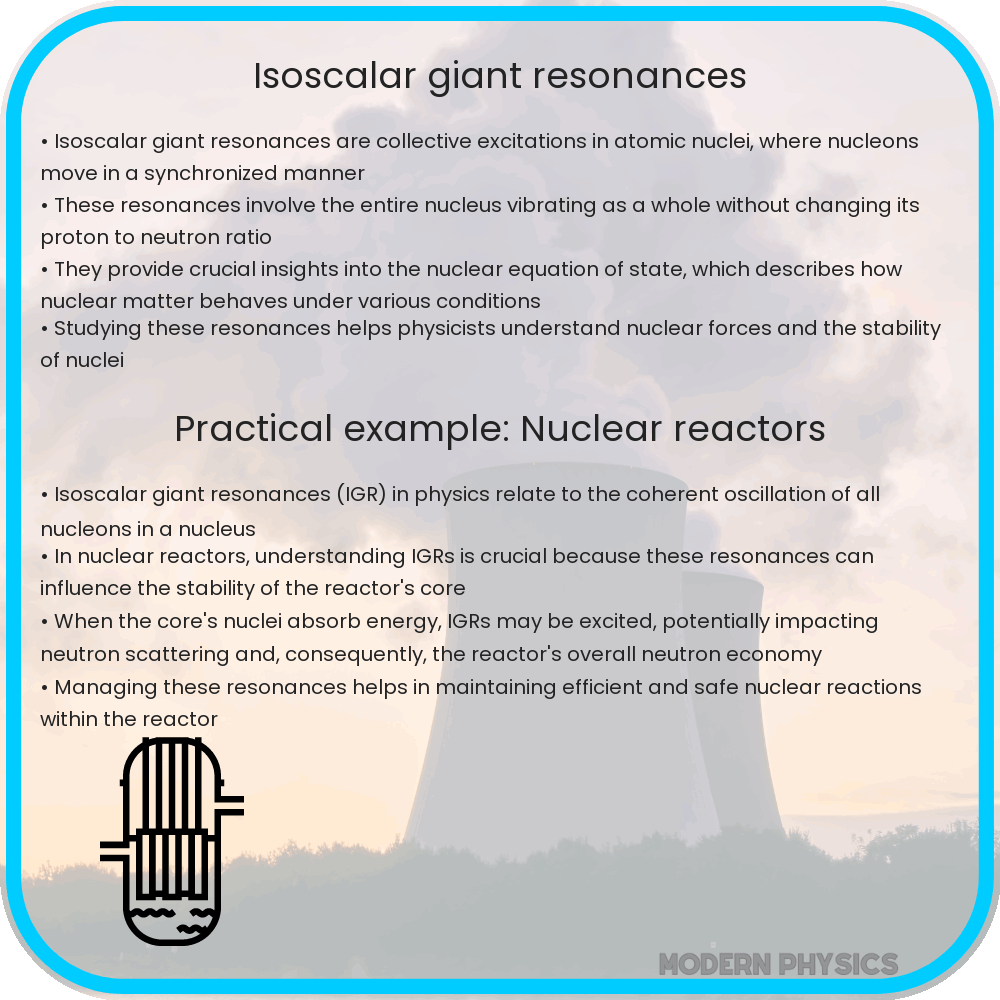
In the fascinating world of nuclear physics, isoscalar giant resonances (IGR) stand out as crucial phenomena for exploring the properties and behaviors of atomic nuclei. These are collective excitations within the nuclei where nucleons (neutrons and protons) oscillate coherently relative to each other. Understanding IGRs can offer profound insights into the nuclear equation of state, which describes how nuclear matter behaves under different conditions.
Basics of Isoscalar Giant Resonances
The term ‘isoscalar’ signifies that the number of neutrons remains balanced with the number of protons during the excitation process. A giant resonance indicates that this is a high-energy, short-lived state. Essentially, IGRs involve the majority of nucleons within the nucleus moving in a coherent way, either compressing or expanding the nuclear volume.
The most commonly studied type of IGR is the Isoscalar Giant Monopole Resonance (IGMR), often referred to as the “breathing mode. This mode involves the spherically symmetric radial oscillation of the nucleus where all nucleons expand and contract uniformly without changing the shape of the nucleus.
Detecting Isoscalar Giant Resonances
IGRs are typically excited in nuclear reactions involving the bombardment of nuclei with particles such as protons, alpha particles, or heavy ions. These experiments can measure various observables like cross-sections and gamma emissions, providing insights into the resonance characteristics. The energy and width of the resonance reveal critical information about the incompressibility of nuclear matter—a fundamental property influencing our understanding of atomic nuclei to neutron stars.
Impact of Isoscalar Giant Resonances
The study of IGRs plays a pivotal role in nuclear physics and has broader implications across various fields. Firstly, the measurement and analysis of IGRs, particularly the IGMR, provide a method to gauge the nuclear incompressibility. This property is crucial for modeling various astrophysical phenomena such as the mechanics of supernova explosions and the structure of neutron stars.
Furthermore, understanding IGRs aids in refining models of the atomic nucleus and contributes to more accurate projections of nuclear reactions in power generation and medical imaging techniques. The knowledge gleaned from studying these resonances enhances the safety and efficiency of nuclear facilities, contributing to more sustainable energy solutions.
The investigation of isoscalar giant resonances also intersects with other areas of research, like nuclear astrophysics and the study of exotic nuclei. By probing the dynamics of nuclei under extreme conditions, scientists can extrapolate these findings to predict the behavior of matter under similarly extreme conditions in astrophysical contexts.
Challenges in Studying Isoscalar Giant Resonances
While the study of IGRs offers substantial insights into nuclear physics, it also presents significant challenges. One of the primary difficulties is the need for highly sensitive equipment capable of detecting the minute details of nuclear excitation patterns. Moreover, conducting experiments that can accurately initiate and measure these resonances requires precise control over the energy and type of incident particles.
Another challenge arises from the complex theoretical models needed to interpret the data obtained from these experiments. Theoretical physicists must continually refine these models to ensure they accurately represent the underlying physics. This ongoing refinement involves sophisticated computational techniques and deep understanding of nuclear interactions.
Future Prospects in IGR Research
Advancements in technology and theory promise to push the boundaries of what is currently achievable in IGR research. Improved detectors and particle accelerators will enable more precise and detailed studies. Additionally, advancements in computational power and algorithms will provide more accurate models for interpreting experimental data.
Looking ahead, the integration of quantum computing and machine learning may revolutionize how scientists analyze and predict nuclear phenomena. These technologies could lead to breakthroughs in our understanding of the fundamental properties of matter and energy and open new pathways in the application of nuclear physics in medicine, energy, and beyond.
Conclusion
Isoscalar Giant Resonances are not only a window into the intrinsic properties of nuclei but also a bridge to understanding vast, complex systems like stars and supernovae. By illuminating the characteristics of nuclear matter, studies on IGR contribute to our broader knowledge of the universe. Despite the challenges involved, the continued exploration of these resonances holds the potential to significantly advance our understanding of both theoretical and applied physics. As we refine our experimental and theoretical tools, the future of nuclear physics looks promising, with IGRs playing a pivotal role in that journey.