
Infrared thermography is a technology used in ecology for monitoring wildlife health, behavior, and habitat suitability through thermal imaging.
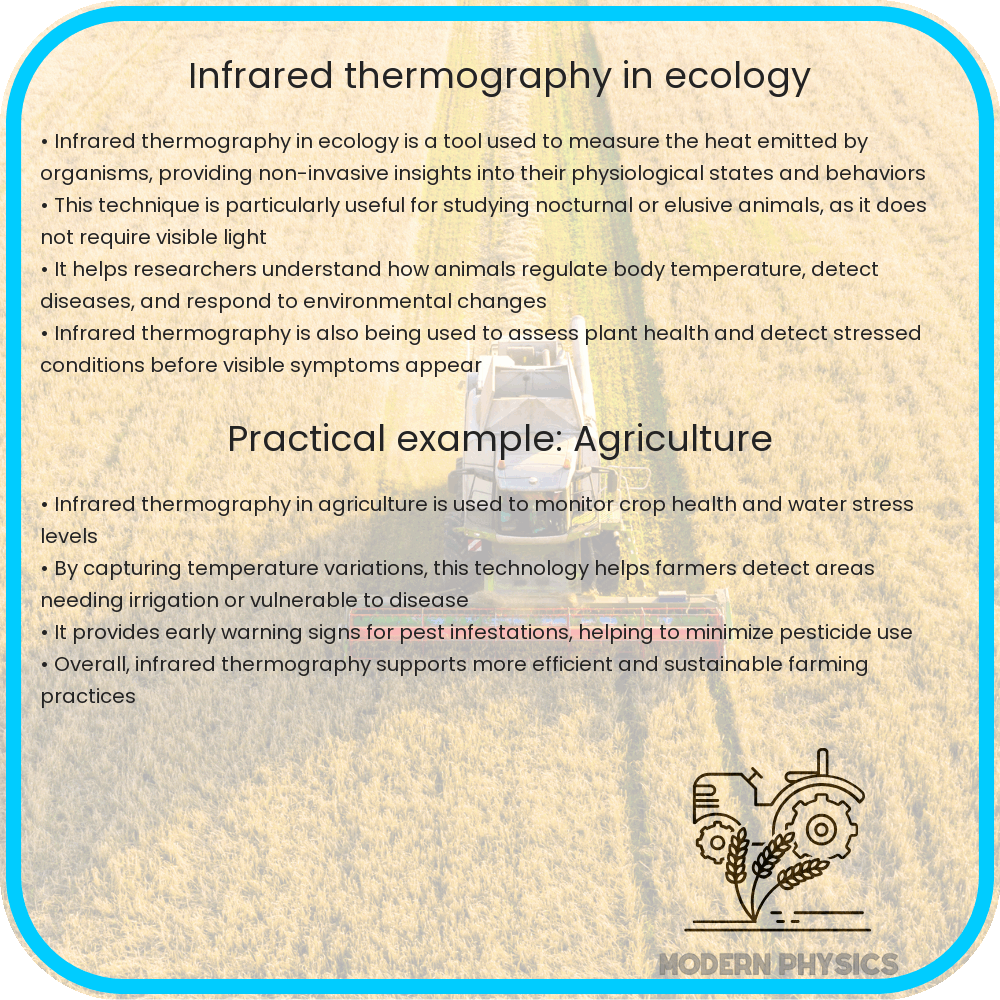
Infrared Thermography in Ecology: Precision, Conservation & Habitat Analysis
In the study of ecology, understanding and monitoring the conditions of wildlife and habitats is crucial. One increasingly popular tool used in this domain is infrared thermography. This technology leverages infrared imaging to detect and measure the thermal energy emitted by objects. This article explores how infrared thermography is applied in ecology, emphasizing its use in precision conservation efforts and habitat analysis.
The Basics of Infrared Thermography
Infrared thermography (IRT) captures the invisible infrared light emitted by all objects with temperatures above absolute zero (-273.15°C). All living organisms and environmental features naturally emit heat, which can be captured and translated into a visible thermal image using IRT. The intensity of this heat radiation is directly proportional to the surface temperature of the object, making thermography an excellent tool for ecological studies without the need for physical contact, thus minimally disturbing the observed subjects.
Applications in Ecology
- Wildlife Monitoring: IRT is extensively used to monitor the health and behavior of various wildlife species, particularly in nocturnal and crepuscular animals, whose active periods coincide with cooler parts of the day when thermal contrast with the environment is more pronounced.
- Habitat Analysis: Ecologists employ thermal imaging to assess habitat suitability by mapping the distribution of temperature variations across a landscape. This pinpointing helps in identifying areas that provide critical resources for thermal regulation to wildlife.
- Plant Physiology Studies: Thermography can detect subtle changes in plant temperatures, which are indicative of phenomena such as disease presence, water stress, and photosynthetic activity.
Precision in Conservation Efforts
In conservation efforts, the precision provided by infrared thermography is invaluable. For endangered species, the ability to remotely examine the health and number of individuals without direct interaction reduces stress on the animals and the risk of human impact. For example, researchers use thermal cameras mounted on drones to monitor nesting birds in remote locations, enabling the study of their breeding patterns without disturbing the site directly.
Habitat Suitability and Climate Change
Habitat analysis using IRT contributes significantly to understanding how different species adapt to changing climates. By monitoring how landscape temperatures affect wildlife behaviors and distribution, ecologists can make informed predictions and management plans that accommodate the shifting needs of ecosystems. For instance, as global temperatures rise, identifying increasingly scarce cool refuges becomes crucial for the survival of many temperature-sensitive species.
Improving Ecological Research and Conservation Practices
Infrared thermography not only enhances current ecological research and conservation strategies but also opens the door to innovative approaches. By providing a non-invasive method to monitor the physiological states and thermal profiles of species and habitats, researchers can gain insights into ecological dynamics that were previously difficult or impossible to observe. This technology can show how species interact with their environment and each other, offering a more comprehensive understanding of biodiversity and ecosystem health.
- Detection of Invasive Species: Quick identification and management of invasive species are crucial for protecting biodiversity. IRT helps in detecting unusual thermal patterns caused by the activities of invasive species, enabling quicker response strategies.
- Assessment of Fire Damage: Post-wildfire recovery efforts benefit from IRT by assessing the extent of damage and monitoring the regeneration of plant life. This aids in the evaluation of ecosystem resilience and recovery processes.
- Enhanced Field Safety: Thermal imaging can improve safety in field research, especially in regions with potential threats from wildlife or challenging terrain, by providing real-time thermal maps that guide ecological teams more safely.
Challenges and Future Directions
Despite its advantages, the application of infrared thermography in ecology faces challenges such as high equipment costs, the need for specialized training to interpret thermal images accurately, and the technological limitations in different weather conditions. However, as technology advances, these hurdles are likely to diminish, increasing accessibility for a wider range of research applications. Future developments in IRT could lead to more portable, user-friendly, and cost-effective solutions that could revolutionize ecological monitoring and conservation practices further.
Conclusion
Infrared thermography has proven to be a powerful tool in ecology, offering detailed insights into the thermal landscape of wildlife and their habitats. Its ability to provide precise, real-time data without disrupting the natural behaviors of wildlife makes it indispensable for both conservation efforts and in-depth ecological studies. As technology continues to evolve, the potential applications of IRT in ecology will expand, promising not only to improve our understanding of ecological processes but also to strengthen conservation strategies worldwide. Embracing these advancements will be crucial in the ongoing effort to conserve our planet’s diverse ecosystems in the face of environmental changes and human impacts.