
Explore the intriguing Inflationary Universe Models, linking relativity and quantum theory to explain the cosmos’ expansion and early state.
Understanding Inflationary Universe Models
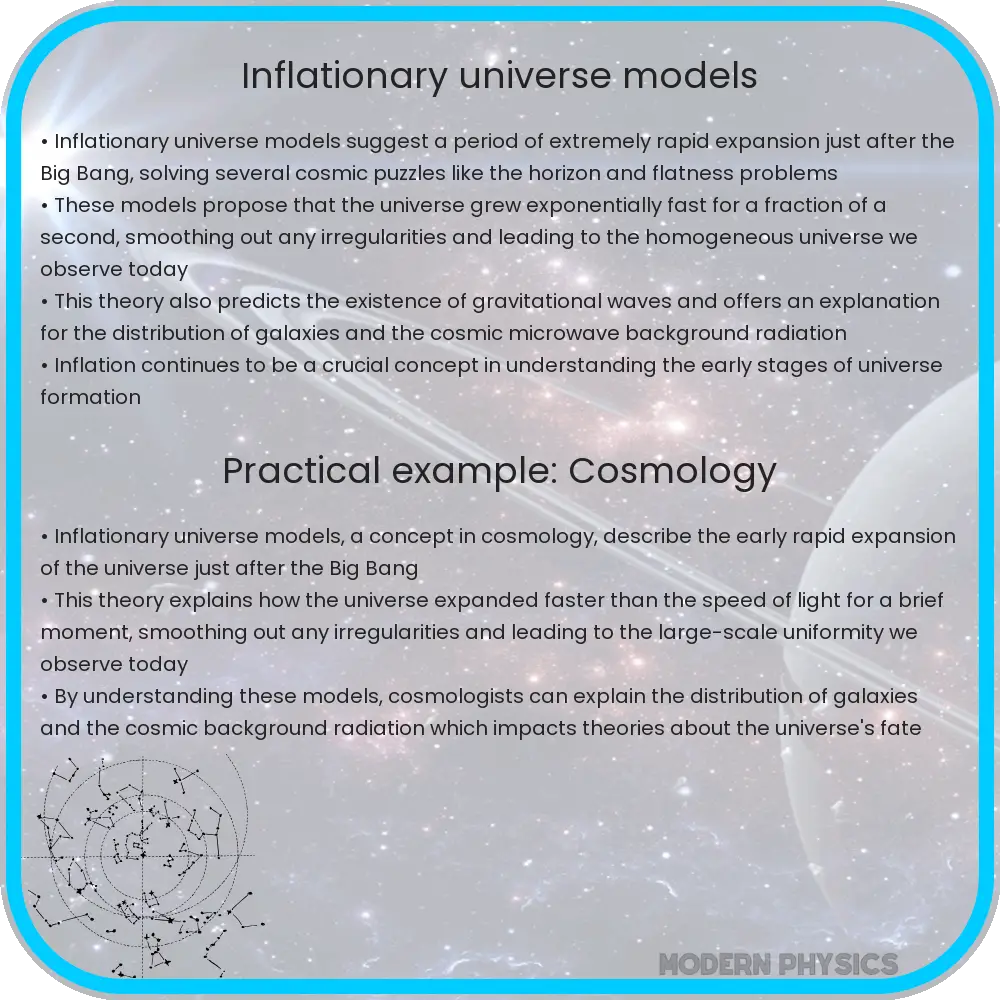
The concept of the Inflationary Universe is a groundbreaking theory in modern cosmology, offering a compelling explanation for the initial conditions of our universe. This model, deeply rooted in the principles of relativity and quantum theory, provides insights into the rapid expansion of the cosmos following the Big Bang.
Exploring the Early Universe
The Big Bang Theory posits that the universe began as an incredibly hot, dense point approximately 13.8 billion years ago. However, early observations of the universe’s large-scale structure and homogeneity presented challenges to the Big Bang model. The Inflationary Universe theory, introduced by Alan Guth in 1981, addresses these issues by suggesting a period of exponential expansion during the universe’s first fractions of a second.
Role of Quantum Theory in Cosmic Inflation
Quantum theory plays a crucial role in explaining the mechanics of inflation. In this framework, quantum fluctuations in the early universe could have been stretched to macroscopic scales by inflation, seeding the formation of galaxies and large-scale structures. These fluctuations, observable today as the Cosmic Microwave Background Radiation (CMBR), provide a window into the conditions of the early universe.
Relativity and the Expanding Universe
Einstein’s theory of general relativity is fundamental to our understanding of cosmological expansion. According to relativity, the dynamics of space-time are influenced by the mass-energy content of the universe. Inflationary models suggest that a hypothetical form of energy, known as the inflaton field, drove the rapid expansion of space in the early universe. This expansion is consistent with the predictions of general relativity, further cementing the theory’s importance in cosmology.
Implications and Observations
Inflationary models have profound implications for our understanding of the universe. They not only explain the large-scale uniformity of the cosmos but also predict variations in the CMBR, which have been confirmed by observational evidence. Additionally, these models provide a mechanism for the generation of primordial gravitational waves, a prediction yet to be confirmed but central to ongoing research in cosmology.
Challenges and Future Directions in Inflationary Cosmology
Despite its successes, the inflationary model faces several challenges. One of the primary issues is the lack of a definitive theory for the inflaton field. The nature and properties of this field remain speculative, with various models proposed but none universally accepted. Moreover, the theory of inflation, while elegantly solving several cosmological puzzles, also leads to the concept of a multiverse. This idea, while fascinating, raises questions about the testability of the inflationary model, as it suggests numerous other universes beyond our observational capacity.
Integrating Inflation with Quantum Gravity
Another frontier in inflationary cosmology is its reconciliation with quantum gravity. The conditions of the early universe, particularly at the onset of inflation, are believed to be such that both quantum mechanics and general relativity are significant. Developing a theory of quantum gravity, which merges these two pillars of modern physics, is crucial for a deeper understanding of the inflationary epoch. Current approaches like string theory and loop quantum gravity offer potential frameworks, but a definitive theory remains elusive.
Empirical Tests and Observational Evidence
Empirical tests are vital for the advancement of inflationary cosmology. Observations of the cosmic microwave background, large-scale structure of the universe, and potential detection of primordial gravitational waves are key areas of focus. Upcoming missions and observatories, such as the James Webb Space Telescope and the European Space Agency’s Euclid mission, are expected to provide data that could either bolster the inflationary model or challenge its premises.
Conclusion
In conclusion, the inflationary universe models represent a significant leap in our understanding of the cosmos. By integrating concepts from relativity and quantum theory, these models offer a comprehensive explanation for the state of the early universe and its subsequent evolution. Despite challenges and unanswered questions, the inflationary model continues to be a focal point in cosmological research. Its future, intertwined with advancements in theoretical physics and astronomical observations, holds the promise of unraveling deeper mysteries about the origins and fate of our universe. As we stand at the frontier of cosmological exploration, the inflationary universe theory remains a guiding beacon in our quest to comprehend the vast, ever-expanding cosmos.