
Explore the concepts of reheating in cosmology, the transition from the Big Bang and inflation to a universe filled with matter and radiation.
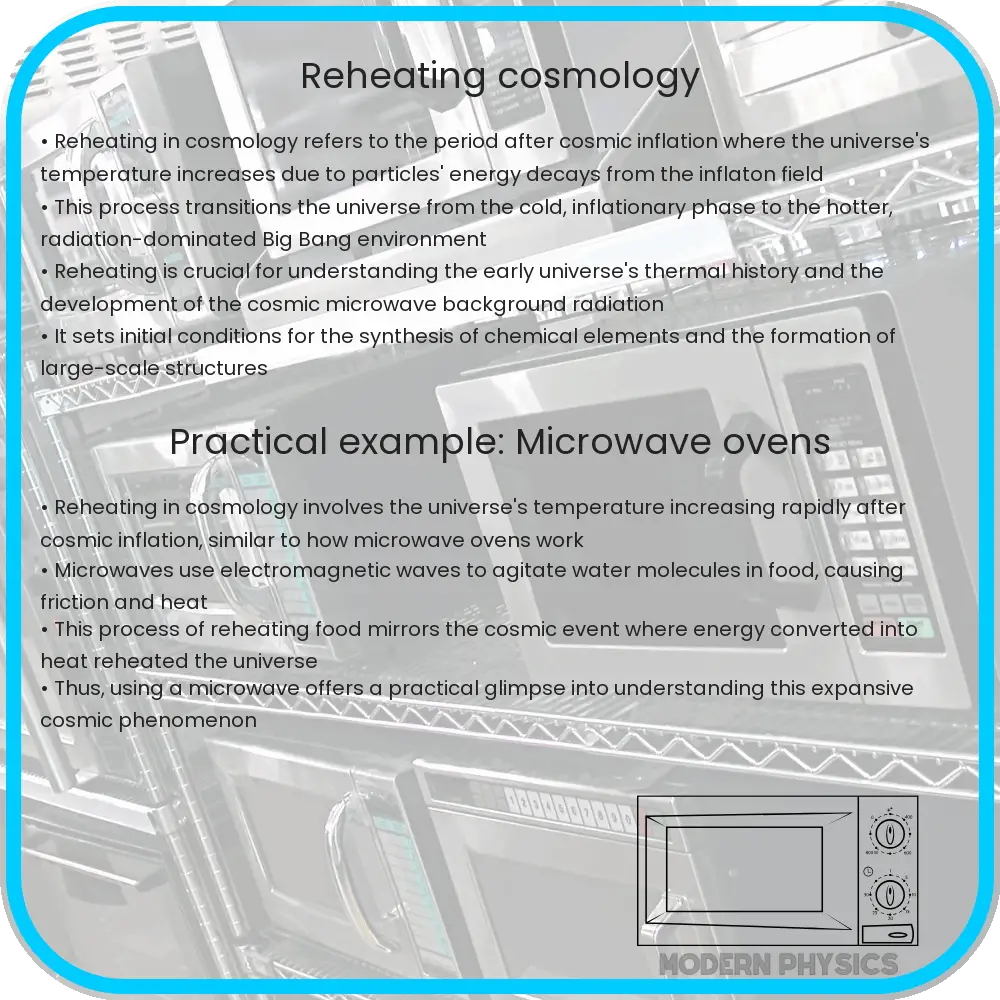
Understanding Reheating in Cosmology
Reheating is a significant phase in the cosmological model of the early universe, acting as a bridge between the period of inflation and the radiation-dominated era. This concept is crucial for understanding how the universe evolved from its initial conditions into a state filled with particles and radiation that we observe today.
The Big Bang and Cosmic Inflation
The Big Bang theory posits that the universe began as an extremely hot, dense point approximately 13.8 billion years ago, then rapidly expanded and cooled. However, this theory alone could not explain several observed phenomena, such as the uniformity of cosmic microwave background (CMB) radiation or the flatness problem. This led to the development of the inflationary theory.
Inflationary theory suggests that, a fraction of a second after the Big Bang, the universe experienced an exponential expansion. This rapid inflation smoothed out any irregularities and distributed energy evenly across the cosmos. Yet, this model left unanswered how the universe transitioned from this smooth, expanded state into a hot, dense state filled with particles.
Role of Reheating
Reheating is theorized to occur immediately following inflation. During this phase, the potential energy stored in the inflationary field, often conceptualized as a scalar field called the inflaton, is converted into standard particles and radiation. This process heats up the universe, effectively restarting the thermal history of the cosmos and leading to the conditions necessary for the Big Bang nucleosynthesis.
The reheating period is characterized by complex interactions and particle physics processes, including the decay of the inflaton field into various particles. These particles interact, collide, and eventually thermalize, leading to a universe filled with a hot, dense plasma of radiation and matter. Understanding reheating is fundamental not only for cosmology but also for connecting the physics of the early universe with high-energy particle physics experiments.
As the universe continues to expand and cool after reheating, it transitions into the radiation-dominated era, setting the stage for the formation of atoms, stars, and eventually galaxies.
Transition to the Radiation-Dominated Era
Following reheating, the universe enters the radiation-dominated era. During this time, the energy of the universe is primarily contained in radiation, such as photons and neutrinos. This era is crucial for the development of the universe’s large-scale structure. As the universe expands, it cools, allowing protons and neutrons to combine and form the first nuclei in a process known as nucleosynthesis.
Several minutes after the Big Bang, the temperature and density of the universe fall sufficiently for nucleosynthesis to begin, leading to the formation of light elements like hydrogen, helium, and traces of lithium. This period marks the end of the radiation-dominated era and the beginning of the matter-dominated era, where the gravitational effects of matter start to influence the universe’s expansion dynamics more significantly.
Implications of Reheating on Modern Physics
The study of reheating provides critical insights into the connection between the early universe’s quantum fluctuations and the large-scale structures observed today, such as galaxies and galaxy clusters. Additionally, it offers a unique window into understanding fundamental physics at energies that are unattainable in earth-bound laboratories. The parameters of reheating, such as its duration and energy scale, can significantly affect the formation of the CMB and the distribution of dark matter, thus influencing the universe’s evolution.
Moreover, advancements in particle physics and cosmology, such as the precise measurements of the CMB by space observatories, continue to refine our understanding of reheating. These observations help constrain theoretical models and provide a more detailed picture of the universe’s earliest moments.
Conclusion
Reheating is a pivotal event in the history of the universe, connecting the period of cosmic inflation with the hot, dense conditions necessary for the Big Bang nucleosynthesis. This process not only explains how the early universe transitioned into a state filled with particles and radiation but also offers profound implications for both cosmology and high-energy physics. As we enhance our understanding of reheating, we move closer to unraveling the mysteries of the universe’s origins, its initial conditions, and the fundamental laws governing its evolution. Future observations and theoretical developments will undoubtedly provide deeper insights into this fascinating era of cosmic history.