
Explore the unique properties of Indium Tin Oxide (ITO), including its conductivity, transparency, and flexibility, and its applications in modern technology.
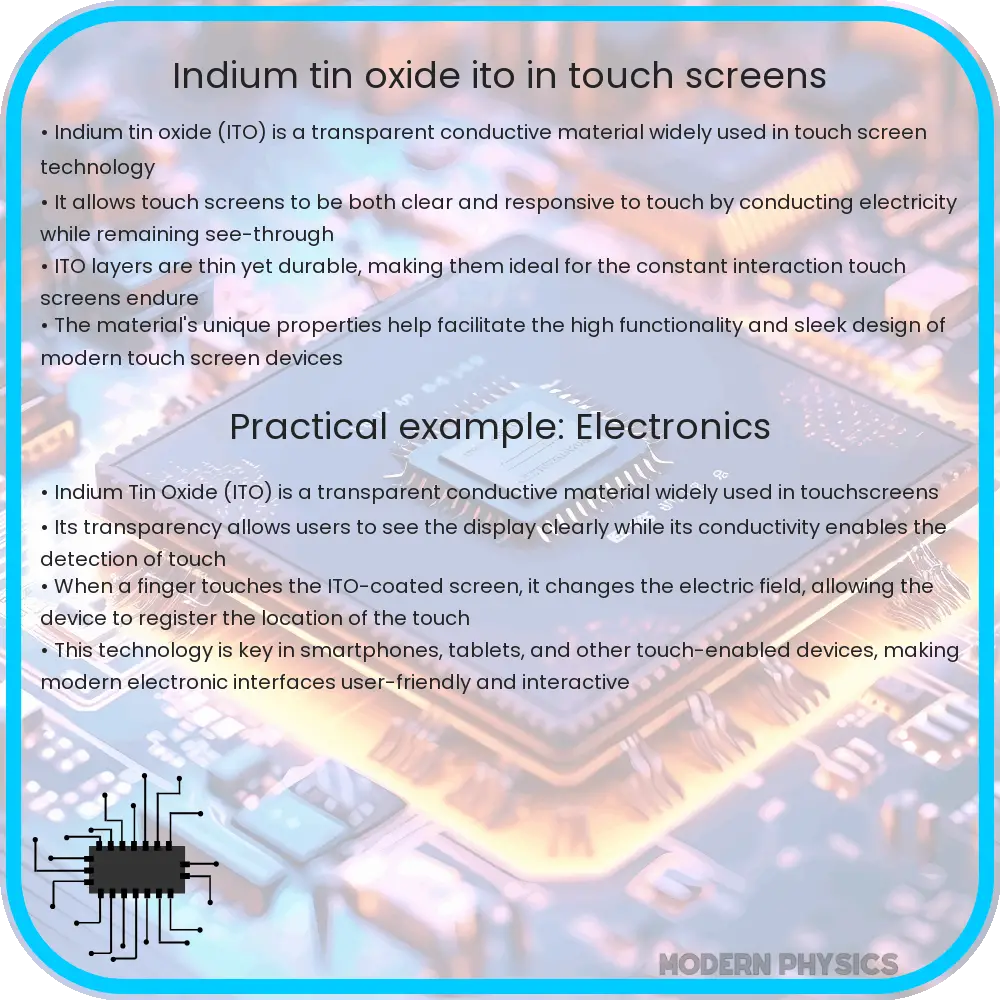
Understanding Indium Tin Oxide (ITO)
Indium Tin Oxide, commonly referred to as ITO, is a transparent conducting material widely used in various applications, from flat-panel displays and touch screens to solar cells and LED lights. The compound consists of indium oxide (In2O3) and tin oxide (SnO2), typically in a 90:10 ratio. This unique blend gives ITO its essential properties: conductivity, transparency, and flexibility.
Conductivity of ITO
ITO’s primary feature is its excellent electrical conductivity. Despite being an oxide, which are usually insulators, the addition of tin to indium oxide creates charge carriers, making it conductive. This conductivity arises from the free electrons generated by the substitution of Sn4+ ions for In3+ ions in the crystal lattice, introducing a donor level within the band gap. This makes ITO an excellent material for applications requiring transparent conductive layers.
Transparency in the Visible Spectrum
Transparency is another critical attribute of ITO. It allows over 90% of visible light to pass through, which is why it is so valuable in the manufacture of devices like smartphones, tablets, and televisions. The high transparency is a result of the wide band gap of indium oxide, which prevents the absorption of light in the visible part of the spectrum. Consequently, when applied as a thin film, ITO does not obstruct the view but maintains its conductive properties.
Flexibility and Applications
Flexibility is the third essential property of ITO. When deposited on flexible substrates like plastic, ITO film can be bent or rolled without losing conductivity. This flexibility has paved the way for innovative uses in flexible electronics and foldable displays. However, it’s worth noting that while ITO can be flexible, excessive bending can lead to cracks and decreased conductivity, which is a significant consideration in product design and application.
The unique combination of conductivity, transparency, and flexibility makes ITO indispensable in modern technology. Its applications range from consumer electronics to energy generation and storage devices, highlighting its role in the advancement of current and future technologies.
Unique Properties of Indium Tin Oxide (ITO)
Indium Tin Oxide (ITO) is a transparent conducting oxide primarily used in thin film coatings for various technological applications. Composed of indium (In), tin (Sn), and oxygen (O), ITO’s chemical formula is represented as In2O3(SnO2). The unique combination of transparency, conductivity, and flexibility makes ITO an indispensable material in the field of electronics and optics.
Conductivity of ITO
One of the standout properties of ITO is its excellent electrical conductivity. This is mainly attributed to the presence of tin dopants within the indium oxide matrix, which introduce free electrons into the system. These free electrons facilitate the flow of electric current, making ITO an ideal material for applications requiring transparent conductive films, such as in touch screens, LCDs, and solar panels.
Transparency of ITO
Despite its conductivity, ITO remains highly transparent to visible light, with a transparency rate typically above 90%. This rare combination allows for the development of devices that require both transparency and electrical conduction. The transparency of ITO films can be attributed to their wide bandgap, which prevents the absorption of visible light while still allowing the flow of electrical current.
Flexibility of ITO
ITO’s flexibility is another critical attribute, particularly for flexible electronics and foldable displays. This flexibility is due to the thinness of the ITO coatings, which can be deposited on flexible substrates like plastic and fabric. While ITO is not as flexible as some purely organic materials, it offers a good compromise between conductivity, transparency, and mechanical flexibility for many applications.
Applications and Considerations
ITO’s unique properties make it suitable for a wide range of applications. Beyond the already mentioned uses, ITO is also employed in electrochromic windows, gas sensors, and antistatic coatings. However, the application of ITO must consider its brittleness and the limited supply of indium, which can affect the material’s cost and availability. Despite these challenges, ongoing research and development efforts continue to optimize ITO’s performance and explore alternatives.
Conclusion
Indium Tin Oxide stands out in the material science landscape for its exceptional blend of conductivity, transparency, and flexibility. Its application in various high-tech fields underscores its importance in modern technology. Despite the challenges related to its brittleness and the scarcity of indium, ITO remains a preferred material for transparent conductive layers. As the demand for more sophisticated electronic devices grows, the role of ITO is expected to expand, further cementing its position as a critical material in the advancement of electronic and optical technologies.