
Learn how the Impulse Response Function in acoustics analyzes how sounds change in environments, impacting sound quality across various applications.
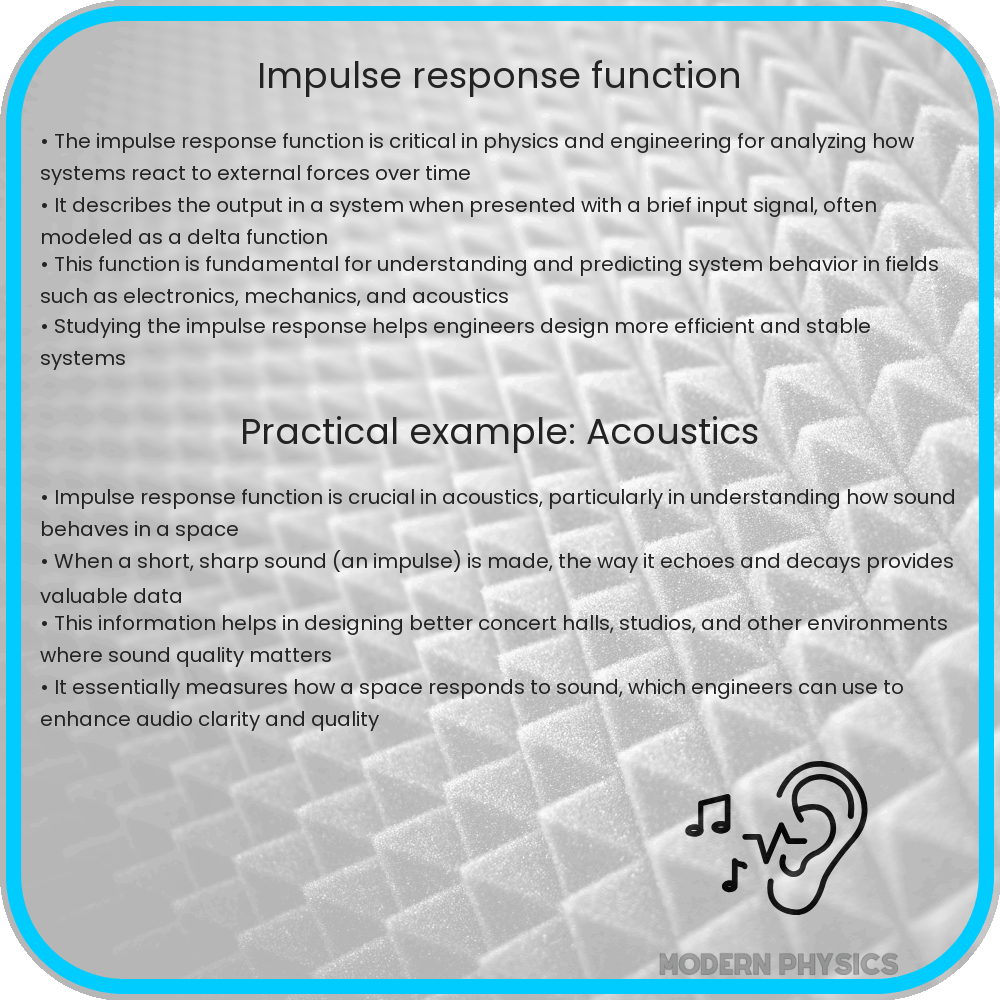
Understanding the Impulse Response Function in Acoustics
The Impulse Response Function (IRF) is a fundamental concept in acoustics that helps us understand how sound behaves in a particular environment. When a short, sharp sound (the “impulse”) is emitted in a space, the way in which this sound changes over time as it reflects off surfaces and objects provides critical insights into the acoustic properties of the space. This response can be analyzed to improve sound quality in various applications ranging from architectural design to audio engineering.
What is an Impulse Response Function?
An Impulse Response Function is essentially the recording of all the echoes that occur after an impulse, such as a clap or a gunshot, is generated in an environment. This response encapsulates the reflection, absorption, and diffusion of sound waves against the boundaries and objects within the space. The IRF is typically represented as a waveform which shows the variation of sound pressure with time after the emission of the impulse.
The Physics Behind IRF
From a physics perspective, when an impulse of sound is generated, it propagates as a wave through the medium (typically air). As it encounters surfaces, some of its energy is reflected, some is absorbed, and some is transmitted. The pattern and nature of these interactions depend crucially on the properties of the surfaces and the medium.
- Reflection: This occurs when sound waves bounce off a surface, returning into the medium. Hard, flat surfaces reflect more sound, while soft, textured materials absorb more sound.
- Absorption: This involves the conversion of sound energy into other forms, usually heat, as the waves interact with materials. Absorption reduces the amount of sound reflected back into the medium, influencing the clarity and reverberation of sound in the space.
- Diffusion: This is the process by which sound energy is spread out as a result of hitting irregular surfaces or objects, leading to a more uniform distribution of sound.
The total impulse response is the sum of all these interactions over a period until the sound energy eventually dissipates. Mathematically, the IRF is often described by its time-domain representation, \( h(t) \), which can be mathematically modeled using the equation:
\[ h(t) = \sum_{i=1}^n A_i \cdot e^{-\alpha_i \cdot t} \cdot \cos(\omega_i \cdot t + \phi_i) \]
Where:
- \( A_i \) represents the amplitude of the ith echo,
- \( \alpha_i \) is the attenuation factor,
- \( \omega_i \) is the angular frequency,
- \( \phi_i \) is the phase,
- \( t \) denotes time.
This equation captures the decay of sound energy over time due to each echo, providing a mathematical framework to analyze and synthesize the acoustic environments.
Applications of IRF in Real-World Settings
The practical applications of the Impulse Response Function are diverse and influential. Here are some typical uses:
- Room Acoustics: By analyzing the IRF, acousticians can design rooms to enhance sound clarity and reduce echoes, which is crucial in concert halls, theaters, and studios.
- Sound Engineering: In audio production, IRFs are used to create digital effects that mimic the sound characteristics of different spaces.
- Architectural Design: Understanding the acoustic profile of a building helps architects optimize materials and structural elements to achieve desired acoustic outcomes.
- Noise Control: The IRF can aid in identifying problematic reflections and frequencies, informing decisions about the placement of sound absorptive materials.
This foundational understanding of IRF sets the stage for exploring specific details and examples that highlight the practical implications and technical applications in varied acoustic environments.
Exploring Specific Cases of IRF Application
To further understand the impact of IRF, let’s examine a couple of specific cases:
- Home Theater Systems: For a home theater, the IRF can help in arranging speakers and sound-absorbing panels to minimize echoes and optimize sound quality. Each component of the room’s architecture contributes to the overall acoustic experience.
- Open-plan Offices: In these environments, IRF analysis can help reduce noise distractions by strategically placing sound-absorbing materials and furniture to disrupt sound paths and reduce the overall noise level.
These examples show how IRF considerations are integral to achieving the desired audio outcomes in different settings.
Challenges in Implementing IRF
While understanding and implementing IRF can provide numerous benefits, there are challenges that professionals face:
- Complexity of Calculations: The mathematical modeling of IRFs can be computationally intensive, especially in irregularly shaped spaces with a variety of surface materials.
- Accuracy of Measurements: Obtaining precise IRF measurements requires high-quality recording equipment and controlled conditions, which may not always be feasible.
- Changing Environments: Modifying any aspect of a space, such as furnishings or wall materials, can alter its IRF, necessitating reevaluation to maintain sound quality.
Conclusion
The Impulse Response Function (IRF) is a powerful tool in acoustics, providing essential insights into how sound interacts within different environments. By understanding and applying IRF, professionals can dramatically enhance audio quality in a range of applications, from architectural acoustics to sound engineering. Despite the challenges involved in precisely measuring and modeling IRF, the benefits it brings to acoustic design and noise control are indispensable. As technology advances, and our understanding of acoustic physics deepens, the potential to further harness the capabilities of IRF continues to grow, promising even better soundscapes in our everyday environments. Whether tweaking a home theater setup or designing a new concert hall, the principles of IRF remain a fundamental part of achieving optimal acoustic outcomes.