
Hydrology examines Earth’s water movement, distribution, and management, involving the water cycle and vital roles in water resources.
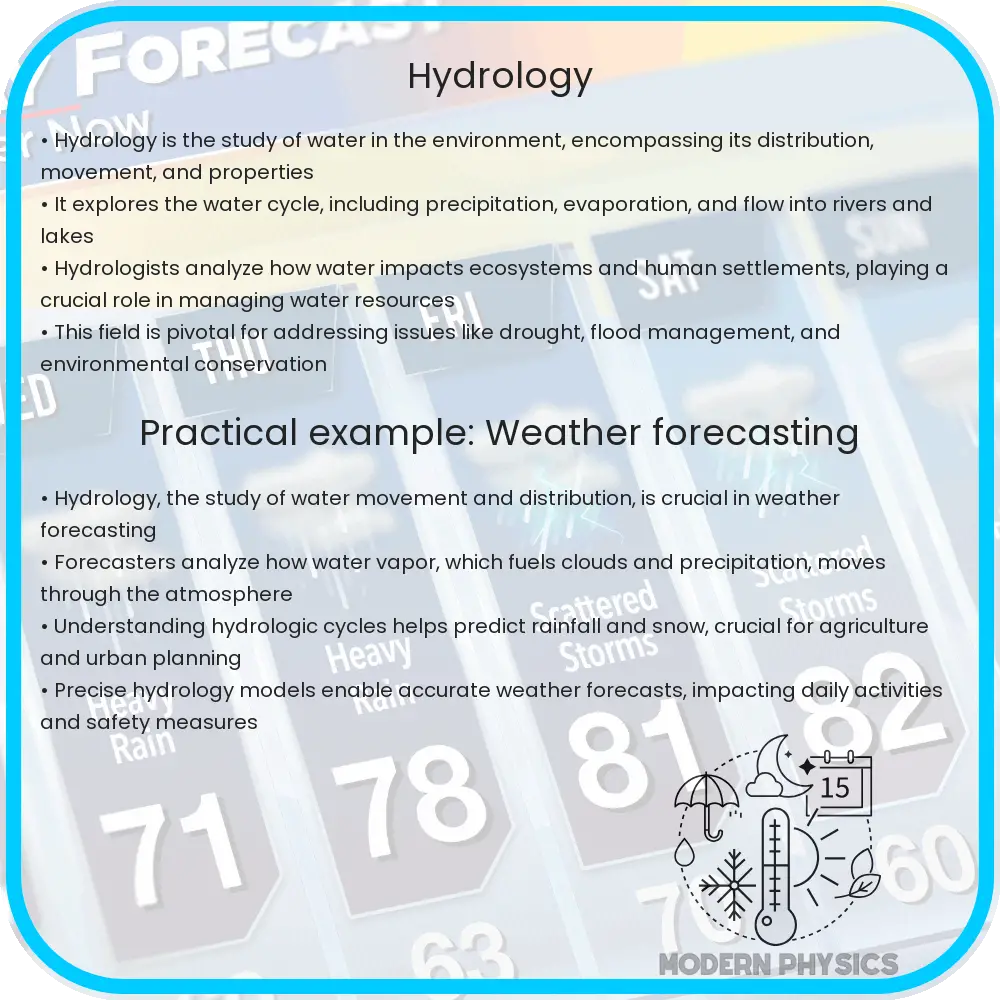
Understanding Hydrology: The Science of Water
Hydrology is the scientific study of the movement, distribution, and management of water on Earth. It encompasses the water cycle, which is vital for supporting all forms of life and has significant impacts on our weather patterns. For countless years, hydrologists have also played crucial roles in water management and forecasting, aiding in everything from agriculture to urban planning.
The Water Cycle Explained
The water cycle, also known as the hydrological cycle, is a continuous process by which water is circulated throughout the Earth and its atmosphere. This process involves several key stages:
- Evaporation: Water from oceans, rivers, lakes, and other bodies convert into vapor due to the sun’s heat.
- Condensation: As water vapor rises and cools in the atmosphere, it transforms back into liquid droplets, forming clouds.
- Precipitation: Accumulated droplets eventually become too heavy and fall to the Earth as rain, snow, sleet, or hail.
- Collection: Precipitated water collects in bodies of water, infiltrates the ground, or runs off the surface, eventually finding its way back to oceans or continuing the cycle anew.
Water Management
Effective water management is crucial for sustainable development. It involves the planning, developing, distributing, and optimizing water resources to meet current and future human and ecological demands. Here are some components key to water management:
- Water Resource Assessment: Understanding the quantity and quality of available water is fundamental. This involves analyzing hydrological data to evaluate surface and groundwater supplies.
- Demand Management: Balancing water usage with supply involves improving water efficiency and reducing waste through technologies and practices such as irrigation management and water recycling.
- Risk Management: Addressing potential risks such as floods and droughts by forecasting and implementing preventive measures helps safeguard water resources and the populations that depend on them.
Forecasting in Hydrology
Water forecasting is an essential aspect of hydrology, providing predictions about water availability, river flows, and flood or drought conditions. These forecasts help in making informed decisions for agriculture, disaster management, and city planning. Hydrologists use various methods for forecasting including:
- Statistical Models: These models use historical data to predict future conditions.
- Physical Models: These involve simulations based on physical laws governing flow and water movement, often aided by complex computer software.
- Remote Sensing: Technologies like satellites and drones collect data about snowpack, soil moisture, and terrain changes, which are used in predictive models.
Through the integration of these methodologies, hydrologists strive to provide accurate water forecasts that can lead to effective management strategies and mitigate potential water-related hazards.
The Role of Technology in Modern Hydrology
Advancements in technology have revolutionized the field of hydrology, enhancing the accuracy and efficiency of studies and water management. Some technological tools and methods commonly used include:
- GIS (Geographic Information Systems): GIS technology is used to analyze and display spatial data related to water sources. This helps in understanding patterns and trends over geographic regions.
- Isotope Hydrology: This method uses stable and radioactive isotopes to trace movements of water through the hydrological cycle, providing insights into sources and history of water.
- Sensors and Automated Monitoring Systems: Sensors placed in various water bodies continuously monitor parameters like temperature, pH, and pollution levels, sending real-time data to central systems for analysis.
Environmental Impact and Hydrology
Hydrology not only influences but is also influenced by environmental changes. Factors such as deforestation, urbanization, and climate change all impact the natural water cycle, leading to significant hydrological changes and challenges worldwide.
- Climate Change: This leads to alterations in precipitation patterns and water availability, thus affecting everything from agriculture to water supply for urban areas.
- Land Use: As land is developed or changed, the way water is absorbed, stored, and runs off is significantly altered, often leading to increased flooding and reduced groundwater recharge.
Conclusion
Hydrology plays a pivotal role in the sustainability and development of our modern world. Understanding the water cycle and being able to manage and predict water resources are imperative to meet the increasing demands of a growing population while dealing with the challenges of climate change. By integrating advanced technology and comprehensive management strategies, hydrologists continue to safeguard our water resources, ensuring a sustainable environment for future generations. The study and practice of hydrology, therefore, not only shed light on our natural world but also pave the way for informed and strategic environmental planning and conservation.