
Explore Huygens’ Principle in optics, a cornerstone of wave theory and light propagation, shaping modern physics, technology, and quantum mechanics.
Understanding Huygens’ Principle in Optics
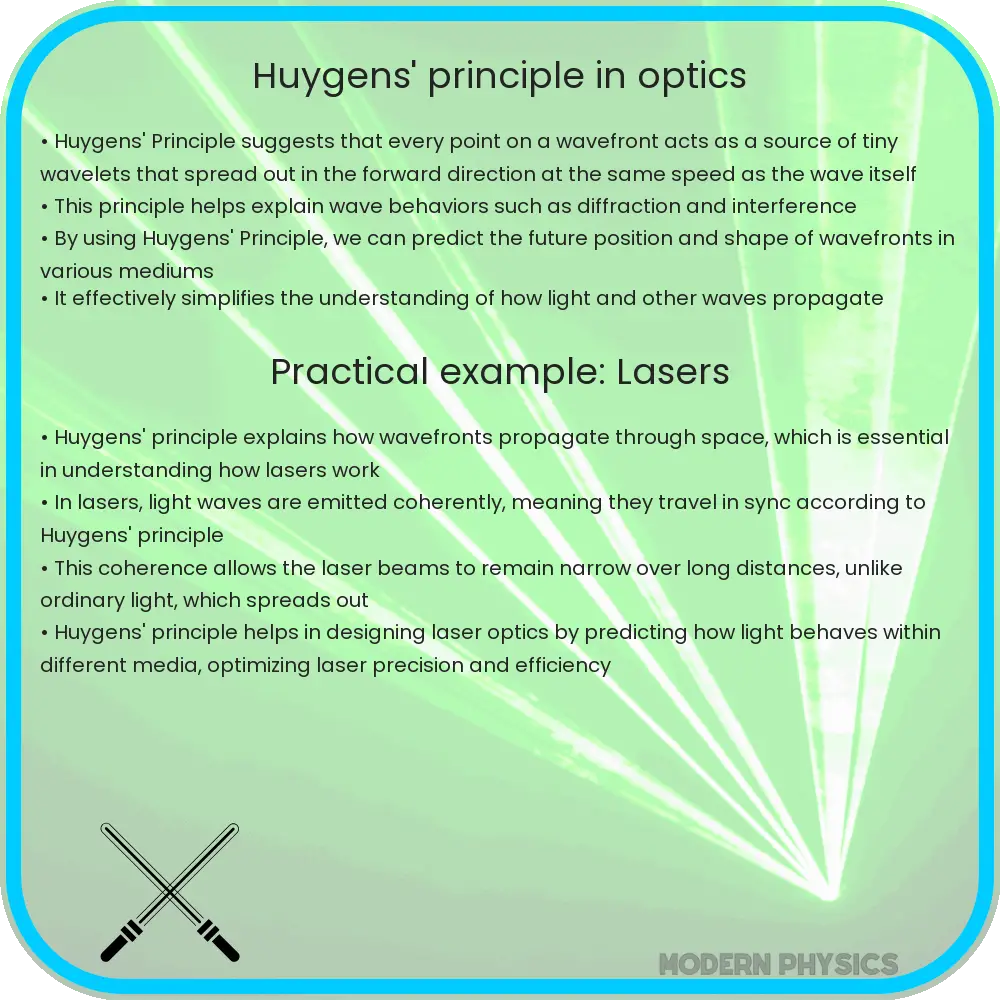
At the heart of wave theory and light propagation lies Huygens’ Principle, a fundamental concept that offers deep insights into how waves, including light waves, move through various media. Proposed by Dutch physicist Christiaan Huygens in the 17th century, this principle has become a cornerstone in the study of optics and wave phenomena. It describes how every point on a wavefront can be considered a source of secondary wavelets that spread out in the wave’s forward direction at the same speed. The new wavefront is then found by constructing a surface tangent to these secondary wavelets.
The Essence of Huygens’ Principle
Huygens’ Principle not only elucidates the straight-line propagation of light in homogeneous media but also explains phenomena such as reflection, refraction, and diffraction. In reflection, it shows how wavefronts change direction to maintain the angle of incidence equal to the angle of reflection. During refraction, as light passes from one medium into another, Huygens’ Principle helps in understanding how the change in wave speed leads to a change in the direction of the wavefront, adhering to Snell’s Law.
Application in Understanding Diffraction
One of the most fascinating applications of Huygens’ Principle is in explaining diffraction, the bending of waves around obstacles and the spreading out of waves through small openings. This phenomenon is crucial in understanding the limitations of optical systems and the nature of light’s interaction with objects. By considering each point of a wavefront encountering an obstacle as a source of new wavelets, Huygens’ Principle provides a framework to predict how light waves propagate in complex scenarios, illustrating the wave-like behavior of light.
Mathematical Formulation
The mathematical formulation of Huygens’ Principle involves integrating the effects of these secondary wavelets to construct new wavefronts. This approach has been refined and extended by subsequent developments in wave theory, including the Fresnel and Fraunhofer approximations for diffraction. These extensions have made it possible to predict the behavior of light with remarkable precision, further solidifying the principle’s relevance in modern optics and physics.
Through its ability to explain and predict the behavior of waves as they encounter various obstacles, Huygens’ Principle remains a fundamental element in the toolbox of physicists and engineers alike. Its implications stretch beyond mere theoretical interest, influencing the design of optical instruments, the study of sound waves, and even the understanding of quantum mechanics phenomena.
Implications in Modern Physics and Technology
The implications of Huygens’ Principle extend far beyond its original application to light waves. In modern physics, it has played a pivotal role in the development of wave mechanics and quantum theory, illustrating the dual nature of particles and waves. This principle has been instrumental in understanding the behavior of electrons, photons, and other quantum entities, highlighting their ability to exhibit wave-like characteristics under certain conditions.
Furthermore, Huygens’ Principle is crucial in the field of acoustics, where it helps in analyzing sound wave propagation, interference, and the formation of standing waves. Its applications are evident in designing architectural spaces with optimal acoustics and in developing sophisticated sonar and ultrasound imaging technologies.
Technological Advancements Inspired by Huygens’ Principle
In technology, the principle’s influence is profound in the realm of optical engineering and design. It underpins the operation of lenses, mirrors, and other optical components, guiding the creation of telescopes, microscopes, and cameras with enhanced imaging capabilities. The principle also informs the development of sophisticated optical systems for laser technology, fiber optics communications, and holography, pushing the boundaries of how light can be manipulated and utilized.
Moreover, Huygens’ Principle has inspired innovative solutions in wave control and manipulation, such as the development of metamaterials. These engineered materials are designed to have properties not found in nature, enabling extraordinary control over wave propagation, leading to the emergence of “invisibility cloaks” and advanced optical devices that can bend light in unusual ways.
Conclusion
Huygens’ Principle has stood the test of time, evolving from a conceptual tool for understanding the nature of light to a fundamental principle that underpins many of the cutting-edge technologies in optics and beyond. Its versatility and power lie in its simplicity and the intuitive approach it offers for explaining complex wave phenomena. As we continue to explore the limits of wave manipulation and the nature of light, Huygens’ Principle remains a beacon of insight, guiding us through the complexities of wave theory and its myriad applications in science and technology. This enduring principle not only enriches our understanding of the physical world but also inspires continuous innovation in tackling the challenges of the future.