
Explore the intriguing world of Fresnel Zone Plates, focusing on their precision, diffraction-based operation, and efficiency in light manipulation.
Understanding Fresnel Zone Plates: Precision, Diffraction, and Efficiency
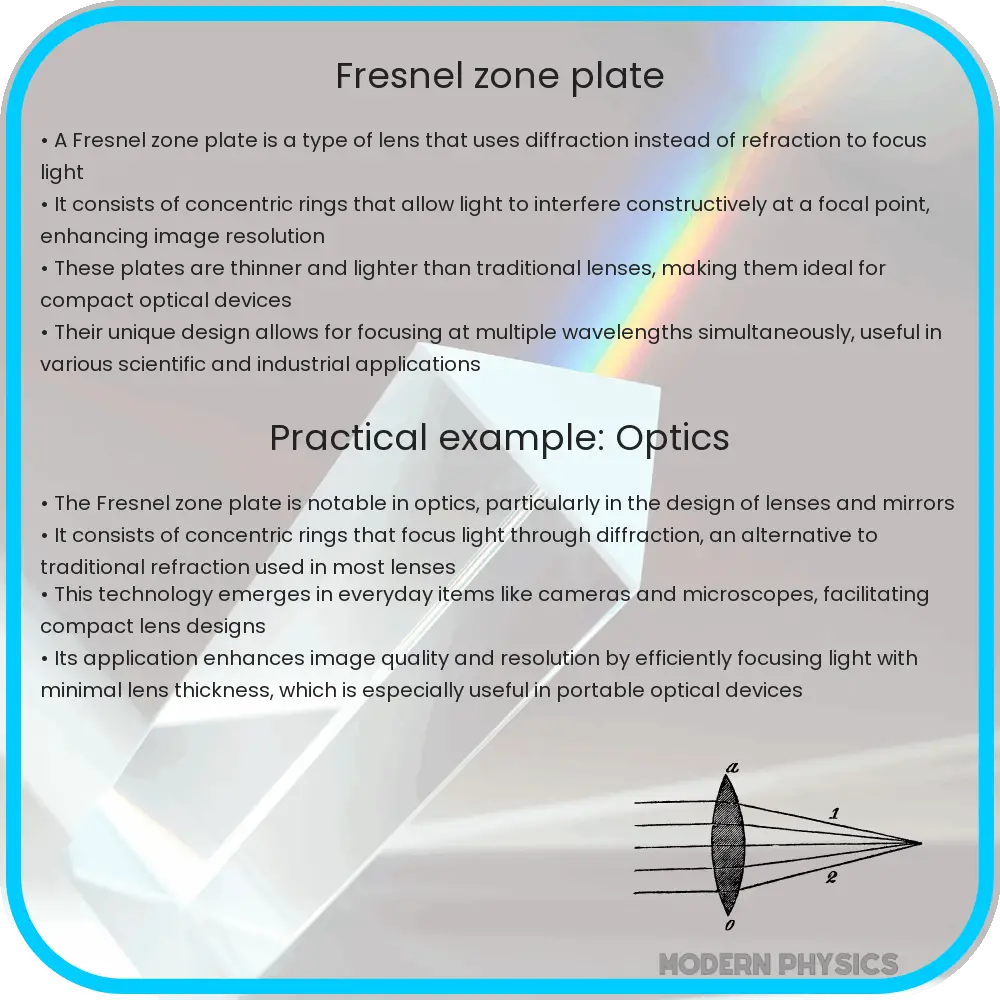
The concept of a Fresnel Zone Plate (FZP) is a fascinating intersection of physics and engineering, offering a unique approach to manipulating light. Named after the French physicist Augustin-Jean Fresnel, this device exploits the principles of diffraction to focus or diverge light. Unlike conventional lenses, which rely on refraction and curvature, Fresnel zone plates consist of concentric rings that either block or transmit light, creating an interference pattern that can focus light with remarkable precision.
Precision in Fresnel Zone Plates
The precision of a Fresnel zone plate is determined by the number of zones or rings it contains. Each zone contributes to the focusing ability of the plate, with more zones allowing for finer control over the light’s path. The width of these zones decreases with increasing distance from the center, a design that is calculated based on the wavelength of the light it is intended to manipulate. This intricate arrangement allows for the precise focusing of light, making FZP an invaluable tool in applications requiring high spatial resolution, such as microscopy and lithography.
Diffraction and Its Role
Diffraction is the core principle behind the operation of Fresnel zone plates. When light encounters the edges of the FZP’s zones, it bends or diffracts, creating constructive and destructive interference patterns. Constructive interference occurs at the focus point, where the light waves amplify each other, while destructive interference minimizes unwanted light, enhancing the plate’s efficiency. The ability to engineer these patterns allows for the manipulation of light in ways that traditional lenses cannot achieve, opening up new possibilities in optical design.
Efficiency Considerations
The efficiency of a Fresnel zone plate is a measure of how effectively it focuses light, typically quantified by the percentage of incident light that contributes to the desired interference pattern. This efficiency is influenced by factors such as the material’s transparency, the accuracy of the zone boundaries, and the wavelength of the light being used. While FZPs can achieve high levels of precision, their efficiency is generally lower than that of traditional lenses due to energy loss in diffraction orders not contributing to the focus. Advances in fabrication techniques, however, are continually improving the efficiency of these optical devices.
Advancements in Fresnel Zone Plate Technology
Recent advancements in nanofabrication and materials science have led to significant improvements in the performance of Fresnel zone plates. Innovations such as the use of electron beam lithography and deep ultraviolet (DUV) photolithography have enabled the creation of zone plates with extremely fine feature sizes, down to the nanometer scale. This has dramatically increased the resolving power of FZPs, making them more competitive with traditional optical elements in a variety of applications, including X-ray microscopy, where their ability to focus high-energy photons is unparalleled.
Applications of Fresnel Zone Plates
The unique properties of Fresnel zone plates have found applications in a wide range of fields. In optics, they are used to create compact lens systems where space and weight are at a premium, such as in portable imaging devices and drones. In scientific research, FZPs play a crucial role in high-resolution microscopy and spectroscopy, allowing scientists to observe phenomena at the atomic level. Moreover, their ability to focus X-rays and ultraviolet light opens up new avenues in medical imaging and semiconductor lithography, respectively.
Challenges and Future Directions
Despite their advantages, Fresnel zone plates face challenges related to fabrication complexity and efficiency. The precision required in creating the concentric zones can be difficult to achieve, especially for higher frequency applications. Additionally, improving the efficiency of FZPs remains an ongoing area of research, with efforts focused on optimizing the design and materials to reduce losses and enhance the focus. Future developments in nano-optics and computational design are expected to address these challenges, further expanding the utility and performance of Fresnel zone plates.
Conclusion
Fresnel zone plates stand as a testament to the power of optical engineering, blending fundamental principles of physics with cutting-edge technology to manipulate light in novel ways. Their precision, based on the meticulous arrangement of concentric zones, leverages diffraction to achieve focusing capabilities beyond the reach of traditional lenses. Despite efficiency challenges, advancements in fabrication techniques and materials science are enhancing their performance and expanding their application range. As research continues to push the boundaries of what is possible with Fresnel zone plates, their role in advancing optical science and technology is undeniably growing, promising exciting developments in imaging, microscopy, and beyond.