
Explore the essentials of holography components, focusing on optics, precision, and innovation. Learn how advanced techniques shape the future of imaging.
Holography: A Fusion of Optics, Precision, and Innovation
Holography, a sophisticated form of photography that allows an image to be recorded and later reconstructed in three dimensions, has revolutionized the way we capture and display images. Its applications span from security and authentication to art and data storage, demonstrating its versatility and importance in modern technology. At the heart of holography are its components, which are grounded in optics, precision, and innovation. Understanding these components is crucial for anyone looking to delve into the field of holography or to appreciate the science behind this fascinating technique.
Key Components of Holography
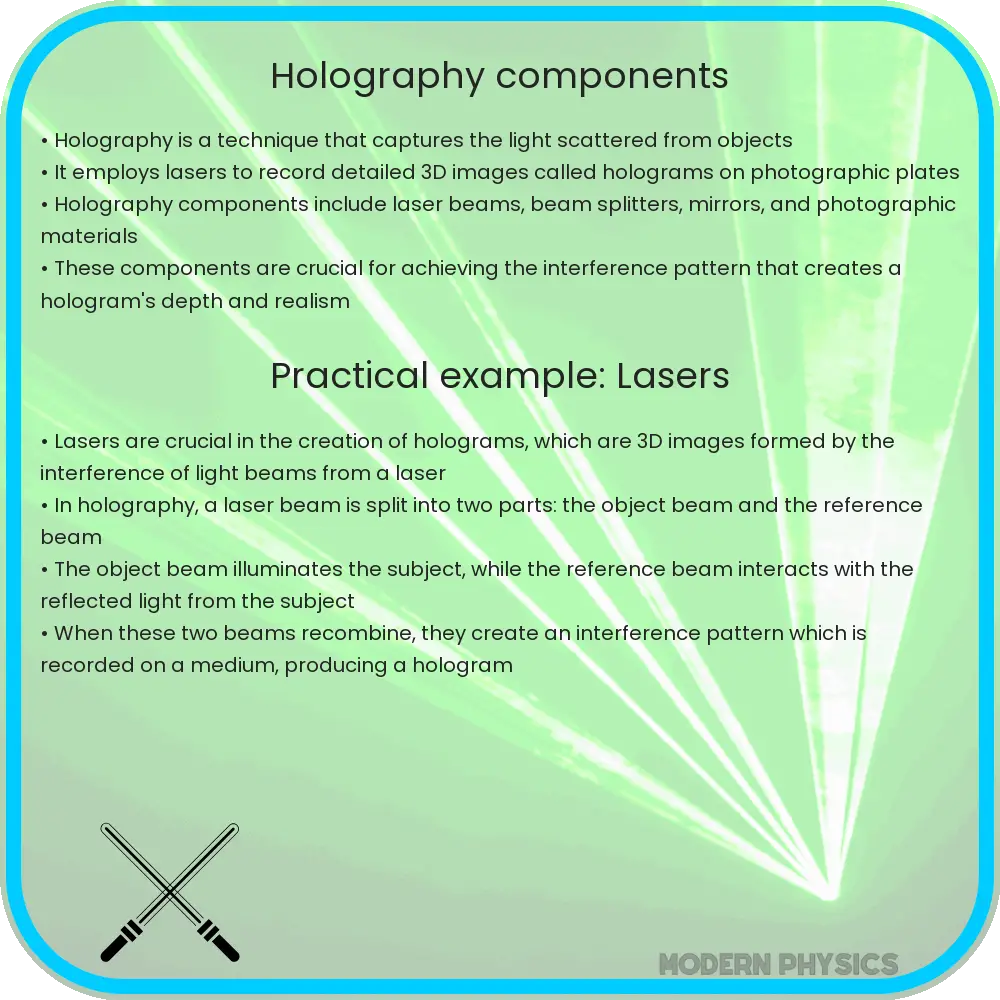
The creation of a hologram involves several critical components, each serving a unique purpose in the holographic process. These components include:
- Laser Light Source: The coherent light source is fundamental in holography. Lasers, with their ability to emit light that is highly monochromatic and coherent, are ideal for creating the interference pattern necessary for holography.
- Beam Splitter: This optical device divides the laser light into two paths: one that illuminates the object (object beam) and another that serves as a reference (reference beam). The interaction between these two beams creates the hologram.
- Object: The subject of the hologram. It can be almost anything, from a physical object to a model or a set of data points that represent three-dimensional information.
- Photosensitive Material: This material records the interference pattern created by the interaction of the object and reference beams. Traditional materials include photographic emulsions, but modern advancements have introduced more sensitive and versatile materials like photopolymers.
Each component must be handled with utmost precision to ensure the quality and accuracy of the hologram. The alignment of the laser, the stability of the environment, and the quality of the photosensitive material all play crucial roles in the holographic process.
Innovations in Holographic Technology
The field of holography is continually evolving, with new technologies enhancing the precision and capabilities of holographic imaging. Advances in laser technology, photosensitive materials, and digital processing have expanded the possibilities of holography, making it more accessible and applicable in various fields. Innovations such as digital holography, which allows for the electronic recording and processing of holograms, are paving the way for more practical and widespread use of holography in industries ranging from healthcare to entertainment.
Holography: A Convergence of Optics, Precision, and Innovation
Holography stands at the forefront of modern optical technologies, showcasing the incredible potential when precision and innovation intersect. This sophisticated technique allows for the recording and reconstruction of light fields, enabling the creation and visualization of three-dimensional images. The intricate process of holography is not just a marvel of optical science but also a testament to the relentless pursuit of accuracy and creativity in the field.
Central to the process of holography are its components, each playing a pivotal role in capturing and reproducing the complex interplay of light waves. The journey of creating a hologram begins with a coherent light source, typically a laser. Lasers emit light that is monochromatic and coherent, properties essential for creating the interference pattern necessary for holography. The choice of laser—be it helium-neon (He-Ne) for red holograms or argon-ion lasers for a broader spectrum of colors—depends on the desired outcome and application.
The next critical component is the beam splitter. This device divides the laser beam into two distinct paths: one towards the object and the other towards the recording medium directly. This splitting is crucial for setting up the interference pattern, the heart of holography, where the two beams meet and interact.
Mirrors and lenses also play a significant role, directing and focusing the beams precisely. Their quality and arrangement determine the clarity and detail of the resulting hologram. The recording medium, whether it be photopolymeric materials or silver halide emulsions, captures the final interference pattern. This medium’s sensitivity and resolution capabilities are paramount, as they must accurately register the intricate pattern of light.
Moreover, holography’s reliance on precision extends beyond the optical components. Environmental control is essential, as even minute vibrations or changes in temperature can disrupt the interference pattern. Thus, creating a hologram requires not just sophisticated equipment but also a controlled setting to ensure the stability of the light paths.
In conclusion, holography is a field where optics, precision, and innovation converge to create something truly remarkable. The components involved in the process—from lasers and beam splitters to mirrors, lenses, and recording media—each contribute to the magic of holography. The precision in their design and application reflects the meticulous nature of this optical art form. As technology advances, the potential applications of holography continue to expand, promising ever more innovative uses in data storage, art, education, and beyond. This exciting frontier of optics not only showcases the power of light but also the limitless possibilities when human ingenuity and precision engineering come together.
Is this conversation helpful so far?