
In-depth exploration of holographic methods used in atomic physics to study and visualize atomic structures with high resolution, enhancing material technology.
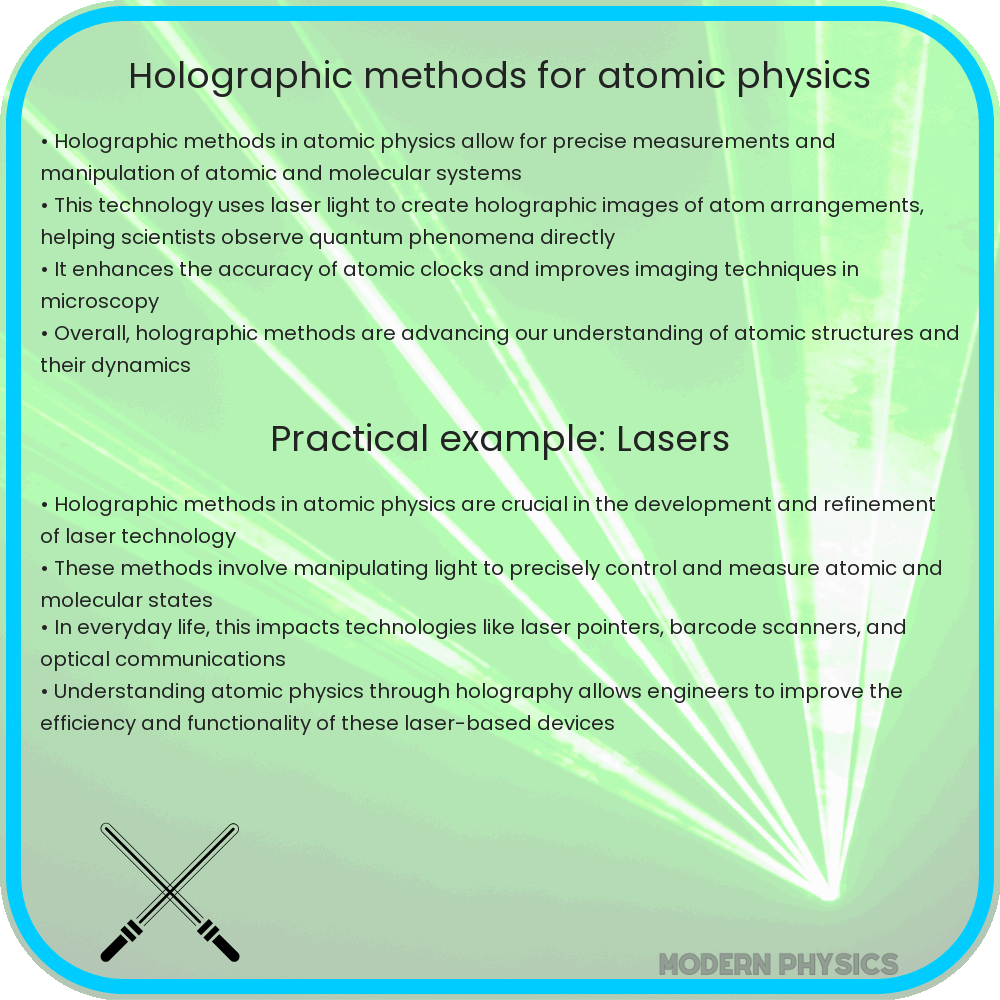
Exploring Holographic Methods in Atomic Physics
Atomic physics, a subfield of quantum mechanics, deals with the properties and behaviors of atoms. As atoms are the basic units of matter, understanding them is crucial for advancements in various technologies. One intriguing technique used in this field is holography, which is not just for creating impressive 3D visuals, but is also a powerful tool for gaining insights into atomic and subatomic particles.
Holography, originally developed for optical purposes, involves recording the interference pattern between two waves—the object wave and the reference wave. This technique has been adapted for use in atomic physics to study the properties of atoms including their electronic states and interactions.
Holography in Atomic Physics
In atomic physics, holographic methods involve using electron or photon beams instead of light waves. These methods allow scientists to visualize atomic structures with high resolution. The concept is based on the interference pattern formed when an electron or photon wave interacts with the waves emitted by the atoms themselves. This pattern is then used to reconstruct a three-dimensional image of the atomic or subatomic particles.
Applications of Holographic Methods
- Electron Holography: This technique has been particularly useful in the visualization of magnetic fields within materials. Electron holography uses the phase shift that electrons undergo as they pass through different magnetic fields to create a detailed map of the internal magnetic properties.
- Photon Holography: Often used in X-ray imaging, photon holography can help visualize atomic distributions and displacements. This method is extremely beneficial in materials science, particularly in the examination of nano-scale materials.
Both these applications not only enhance our understanding of atomic structures but also enable the development of better materials and technologies.
Technical Insight: The Principle of Holographic Imaging
At its core, holographic imaging in atomic physics involves diffracting a beam of particles (like electrons or photons) off a target atom. The resultant wave interference pattern is captured on a detector. The critical aspect of interpreting this pattern lies in understanding how the phase and amplitude of the waves change after interacting with the target. The mathematical reconstruction of these wavefronts enables researchers to build a 3D image of the electronic and sometimes nuclear configuration of the atoms.
Mathematically, if A(x,y) represents the amplitude of the wave at any point (x, y) and φ(x,y) its phase, the intensity of the interference pattern I can be described as:
I(x,y) = |A(x,y) + A0|2 = A2(x,y) + A02 + 2A(x,y)*A0cos(φ(x,y) – φ0)
where A0 and φ0 are the amplitude and phase of the reference wave, respectively. This equation indicates that holographic imaging doesn’t just capture the intensity of the interaction but also the phase differences, which are key to creating depth in the reconstructed image.
Challenges and Current Research
The use of holography in atomic physics does come with challenges such as the need for ultra-high precision in wavefront generation and detection, and the computational demand of reconstructing complex interference patterns. Currently, significant research is underway to improve the resolution and temporal capabilities of holographic methods, to push the boundaries of what we can visualize at the atomic scale.
Advancements in computational algorithms and detector technologies hold the promise of making holographic atomic imaging more accessible and detailed. As researchers overcome these challenges, the scope of holographic methods continues to expand, opening new vistas in atomic physics and related disciplines.
Future Prospects and Ethical Considerations
Looking ahead, the potential for holography in atomic physics extends beyond current applications. Innovators are exploring the idea of using holographic techniques in quantum computing and information storage, which could revolutionize our technology landscape even further. Additionally, the improvement in holographic methodologies might enable us to observe not just static atomic structures, but also dynamic atomic events in real-time.
Alongside technical advancements, there is a parallel discussion about the ethical implications of advanced surveillance and imaging technologies. As holographic techniques become more intricate, they could potentially be used in ways that raise privacy concerns, necessitating a balance between innovation and ethical responsibility.
The Impact on Education and Knowledge Sharing
The development of holographic methods in atomic physics also has significant implications for education. As these technologies become more refined, they can provide unparalleled visualization of atomic and molecular structures, making the abstract principles of quantum mechanics more tangible and comprehensible for students. This could inspire a new generation of scientists, equipped with a deeper understanding and fresh perspectives, ready to tackle the yet-unanswered questions in physics.
Conclusion
The integration of holography into atomic physics is a prime example of how creative technical thinking can transform a traditional discipline. As we have explored, the use of holographic methods not only improves our understanding of atomic structures but also broadens the applications of this knowledge in technology and materials science. However, the journey of holography from a concept used in optical imaging to a crucial tool in atomic research has been fueled by continuous innovation and the determination to overcome practical challenges. The ongoing improvements in techniques and technology promise to unlock even more detailed vistas of the atomic world, promising exciting possibilities for future research and application. Holography, thus, stands not just as a method but as a testament to the relentless progress of science and its profound impact on society.