
Explore the fusion of high-speed simulations, accuracy, and relativity theory, and their impact on scientific research and technological advances.
Understanding the Intersection of High-Speed Simulations, Accuracy, and Relativity Theory
In the realm of computational physics and engineering, high-speed simulations represent a critical tool for exploring complex systems where traditional experimental methods fall short. The integration of accuracy and the principles of relativity theory in these simulations is paramount, particularly in fields such as aerospace engineering, astrophysics, and high-energy physics. This article delves into how high-speed simulations harmonize these elements to provide insights into phenomena that occur at velocities approaching the speed of light.
The Crucial Balance: Speed vs. Accuracy in Simulations
At the heart of high-speed simulations is the balance between computational speed and accuracy. Faster simulations enable researchers to explore more scenarios within a limited time frame, which is crucial for time-sensitive projects. However, the quest for speed must not compromise the accuracy of the results. Advanced algorithms and high-performance computing resources play a key role in achieving this balance. By optimizing computational techniques, scientists can conduct simulations that are both swift and precise, ensuring that the outcomes are reliable and applicable to real-world scenarios.
Integrating Relativity Theory in High-Speed Simulations
When dealing with velocities that are significant fractions of the speed of light, the principles of Einstein’s relativity theory become indispensable. Special relativity, with its core concepts of time dilation and length contraction, must be incorporated into simulations to ensure realistic modeling of high-speed phenomena. For instance, in astrophysical simulations involving neutron stars or black holes, neglecting relativistic effects would lead to significant inaccuracies.
Implementing relativity theory in simulations is not straightforward. It requires sophisticated mathematical models and numerical methods to solve the Einstein Field Equations, which describe the fundamental interaction of gravitation as a result of spacetime being curved by matter and energy. This integration allows for accurate predictions of events such as gravitational waves and the behavior of light near massive objects.
One notable challenge is the representation of spacetime curvature and the propagation of effects at the speed of light. In simulations, this involves discretizing spacetime into a computational grid, a process that must be carefully managed to preserve the integrity of the physical laws being modeled. Techniques like adaptive mesh refinement are often employed to enhance the resolution in regions of high curvature, such as near a black hole’s event horizon.
Advancements in Computational Techniques for Enhanced Accuracy
To further refine the accuracy of high-speed simulations, researchers continually develop and implement advanced computational techniques. One such advancement is the use of parallel computing, which distributes the computational workload across multiple processors. This approach not only accelerates the simulation process but also allows for more detailed and complex models. Additionally, machine learning algorithms are increasingly being integrated into simulations to predict and adjust for potential inaccuracies in real-time, further enhancing the reliability of the results.
The Role of High-Speed Simulations in Future Scientific Endeavors
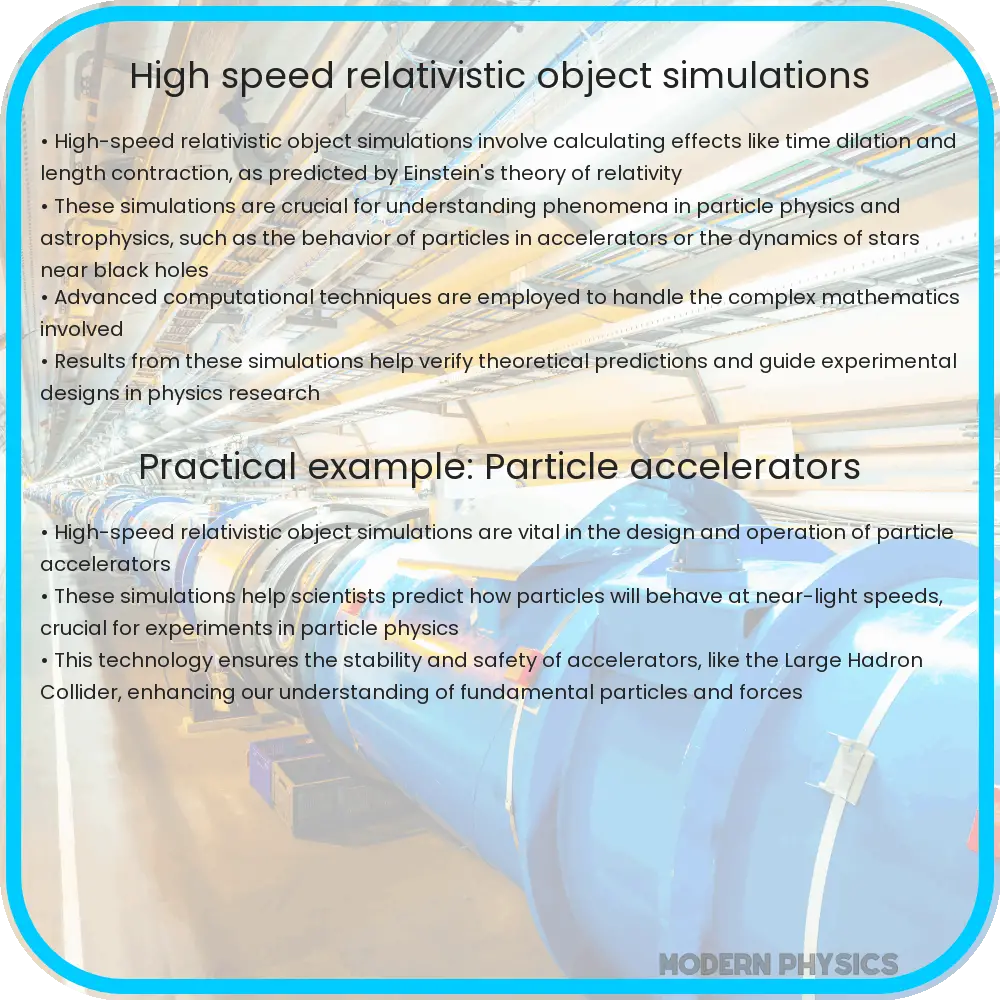
The future of scientific research, particularly in fields like particle physics, cosmology, and aerospace engineering, is inextricably linked to the evolution of high-speed simulations. As we push the boundaries of our understanding of the universe, simulations that accurately incorporate relativistic effects will become increasingly crucial. They will not only aid in the validation of theoretical models but also in the design of experiments and technologies, such as particle accelerators and spacecraft propulsion systems.
Moreover, the interdisciplinary nature of high-speed simulations, blending physics, computer science, and mathematics, paves the way for innovative solutions to longstanding scientific challenges. Collaborations across these fields are essential for the continued advancement of simulation techniques and the extraction of meaningful insights from the vast amounts of data generated.
Conclusion
In conclusion, the intersection of high-speed simulations, accuracy, and relativity theory represents a significant stride in modern scientific research. The balance between speed and accuracy in simulations is crucial for the realistic modeling of phenomena at high velocities. Incorporating the principles of relativity theory is essential in this context, ensuring that simulations reflect the true nature of the universe as we understand it. As computational resources and techniques continue to evolve, the potential for these simulations to unravel mysteries of the cosmos and advance technological frontiers is immense. This synergy of speed, accuracy, and advanced physical theories not only underpins current scientific progress but also lays the groundwork for the next generation of discoveries and innovations.