
Explore the dynamics and structure of the heliosphere, its role in protecting our solar system from cosmic rays, and the impact of space weather on Earth.
Understanding the Heliosphere: Dynamics and Protection
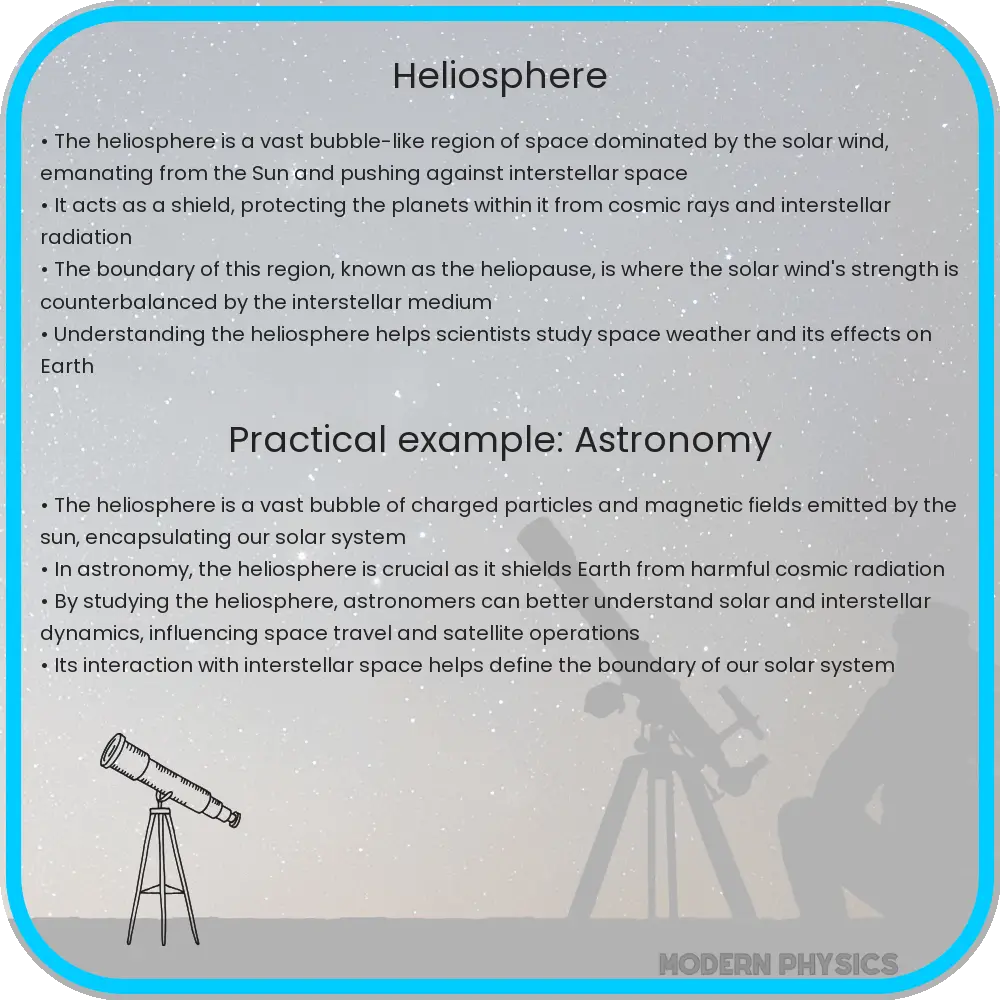
The heliosphere represents a vast bubble-like region of space dominated by the solar wind emitted from the Sun. This phenomenon extends well beyond the orbit of Pluto, shaping the environmental conditions in the interstellar medium (ISM) that surrounds our solar system. Understanding its dynamics is crucial for comprehending the Sun’s influence on space weather and the overall protection it provides to the planets within its bounds.
Structure of the Heliosphere
The heliosphere is structured into several key components: the solar wind, the termination shock, the heliosheath, and the heliopause. The solar wind, a stream of charged particles emitted by the Sun, travels outward in all directions at speeds of about 400 to 700 km/s. This wind creates a protective bubble that shields the solar system from cosmic rays and interstellar radiation.
- Solar Wind: Comprised primarily of electrons, protons, and alpha particles, the solar wind varies in speed and density, influencing the heliosphere’s size and shape.
- Termination Shock: This is where the speed of the solar wind dramatically decreases as it collides with the interstellar medium, causing a shock wave.
- Heliosheath: Beyond the termination shock, the solar wind slows, heats up, and mixes with the interstellar medium, forming a turbulent region.
- Heliopause: The outer boundary of the heliosphere, where the pressure from the solar wind balances with the interstellar medium, marking the end of the Sun’s influence.
Influence of the Heliosphere
The heliosphere plays a pivotal role in cosmic ray modulation. By acting as a shield, it significantly reduces the amount of high-energy particles from deep space reaching the inner solar system and, consequently, the Earth’s surface. This modulation varies with the solar cycle, affecting space weather conditions and the Earth’s magnetosphere. Understanding these dynamics helps in predicting space weather events, which can impact satellite operations, power grids, and astronaut safety.
The study of heliosphere dynamics is not only pivotal for protecting technology and life on Earth but also for understanding the fundamental processes that govern interstellar space interactions. The ongoing research and exploration by missions such as Voyager, Parker Solar Probe, and Interstellar Boundary Explorer (IBEX) continue to shed light on these complex interactions and the nature of the heliosphere’s boundary.
Research and Exploration of the Heliosphere
Advancements in space technology and research missions have significantly enhanced our understanding of the heliosphere. Notable missions include the Voyager probes, which have provided invaluable data on the outer boundaries of the heliosphere. The Parker Solar Probe, launched in 2018, aims to study the outer corona of the Sun and how the solar wind is accelerated, contributing further to our understanding of heliospheric dynamics. Additionally, the Interstellar Boundary Explorer (IBEX) maps the boundary of the heliosphere, providing insights into the interaction between solar wind and the interstellar medium.
Implications of Heliosphere Studies
The study of the heliosphere has profound implications for understanding space weather and its effects on Earth. By understanding how the solar wind interacts with the Earth’s magnetosphere, scientists can better predict geomagnetic storms and protect our technological infrastructure, such as power grids and communication networks. Moreover, this research is crucial for the safety of astronauts, particularly for missions outside the Earth’s magnetosphere, where exposure to cosmic rays and solar radiation is greater.
Furthermore, studying the heliosphere also has broader implications for astrophysics and the study of other star systems. By understanding our own heliosphere, we can make informed assumptions about the protective bubbles around other stars and their potential to harbor life.
Conclusion
The heliosphere represents a critical area of study within the field of astrophysics, offering insights into the protective mechanisms that shield our solar system from the harsh environment of space. Through the collective efforts of missions like Voyager, Parker Solar Probe, and IBEX, our understanding of the heliosphere and its dynamics continues to evolve. This knowledge not only aids in protecting Earth and future space explorers from space weather effects but also enhances our understanding of the universe, guiding the search for life beyond our solar system. As research progresses, we anticipate further revelations about the intricate balance between our solar system and the vast expanse of the cosmos, underlining the importance of the heliosphere in the cosmic ecosystem.