
Explore the fascinating world of Heavy Ion Collisions in Quantum Chromodynamics: insights into the early universe and quark-gluon plasma dynamics.
Understanding Heavy Ion Collisions and Their Role in Quantum Chromodynamics (QCD)
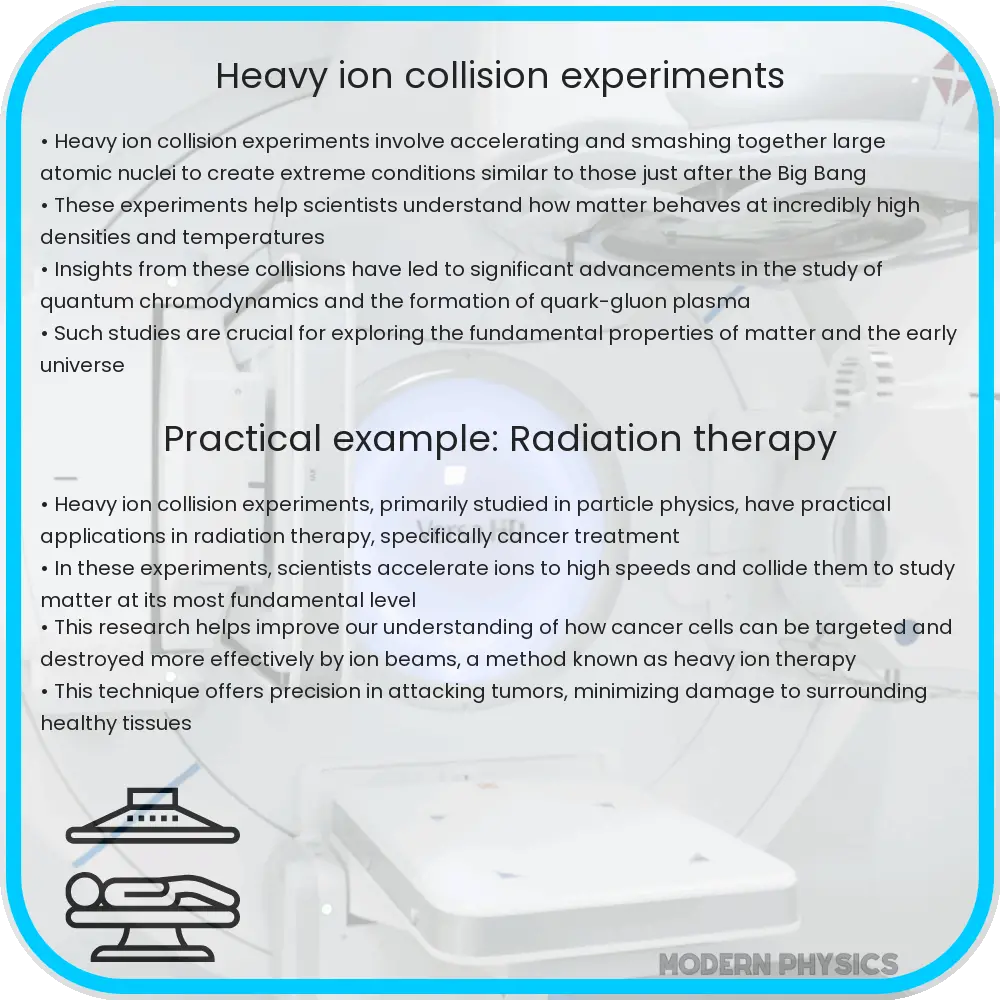
Heavy Ion Collisions (HIC) represent a cornerstone in exploring the fundamental properties of matter under extreme conditions. These high-energy collisions, involving nuclei of heavy atoms like gold or lead, create a unique state of matter known as Quark-Gluon Plasma (QGP). This plasma provides a critical window into Quantum Chromodynamics (QCD), the theory describing the strong interaction within nuclear physics.
Quark-Gluon Plasma: A Window into the Microcosmic World
The QGP is a state of matter where quarks and gluons, the basic constituents of protons and neutrons, are not confined within individual nucleons. Instead, they move freely in a hot, dense medium. This state is believed to resemble the conditions of the universe microseconds after the Big Bang, offering insights into how the universe evolved at its very early stages. In HICs, when heavy ions are accelerated to near-light speeds and collided, the energy densities and temperatures reach so high that protons and neutrons ‘melt,’ forming the QGP.
Data Acquisition and Analysis in Heavy Ion Collisions
Colliders like the Large Hadron Collider (LHC) at CERN and the Relativistic Heavy Ion Collider (RHIC) at Brookhaven National Laboratory are at the forefront of these investigations. These facilities accelerate heavy ions to high energies and collide them, allowing physicists to probe the properties of QGP. The data from these collisions is incredibly complex. Detectors surrounding the collision points capture myriad particles emanating from these events, providing a jigsaw puzzle that scientists piece together to understand the collision dynamics.
Advanced computational techniques play a crucial role in analyzing this data. Sophisticated algorithms help in identifying patterns and extracting meaningful information about the QGP properties like temperature, viscosity, and energy density. The data is then compared with theoretical predictions from QCD, aiding in refining our understanding of the strong force.
Key Insights from QCD and Heavy Ion Collisions
Research in HICs has led to several groundbreaking insights in QCD. One of the key findings is the confirmation of the existence of QGP. Experiments have also shed light on the phase transition between QGP and normal hadronic matter, which is crucial for understanding the early universe. Furthermore, these studies have helped refine the parameters of QCD, like the running coupling constant at high temperatures, which is pivotal for theoretical calculations in particle physics.
Moreover, the data from HICs has been instrumental in exploring the confinement property of quarks and gluons. Confinement, a unique feature of QCD, prevents quarks and gluons from existing freely under normal conditions. HIC experiments offer a rare glimpse into the deconfined state, deepening our grasp of this fundamental characteristic of the strong force.
Challenges and Future Directions in Heavy Ion Collision Research
Despite significant advances, heavy ion collision research faces numerous challenges. One of the primary challenges is the sheer complexity of the collisions. Each collision event generates thousands of particles, creating a daunting task for data analysis. Additionally, the transient nature of the QGP – existing only for a fraction of a second – adds to the difficulty in studying its properties directly.
Future research aims to overcome these challenges by employing more sophisticated detectors and computational models. Upcoming upgrades to facilities like the LHC and RHIC are expected to provide higher collision energies and luminosities, enabling more detailed studies of the QGP. Moreover, advancements in machine learning and data analysis techniques are anticipated to play a pivotal role in deciphering the complex data from these experiments.
The Interdisciplinary Impact of Heavy Ion Collision Studies
Heavy ion collision research extends its influence beyond nuclear physics, impacting various fields such as astrophysics and cosmology. The study of QGP provides insights into the behavior of neutron stars and the evolution of the early universe. Additionally, the technological advancements driven by this research, particularly in detector and accelerator technologies, have broad applications in other scientific areas and industries.
Conclusion
Heavy Ion Collisions offer an extraordinary glimpse into the fundamental nature of matter under extreme conditions. As a critical component of Quantum Chromodynamics research, these studies illuminate the behavior of quarks and gluons, shedding light on the universe’s earliest moments. The discoveries and advancements in this field not only deepen our understanding of the fundamental forces and particles but also have far-reaching implications across various scientific disciplines. Despite the challenges, the relentless pursuit of knowledge in heavy ion collision research continues to push the boundaries of our understanding, driving technological innovation and offering profound insights into the fabric of the cosmos.