
Explore the groundbreaking role of nanostructures in enhancing heat transfer efficiency and speed, and their innovative applications.
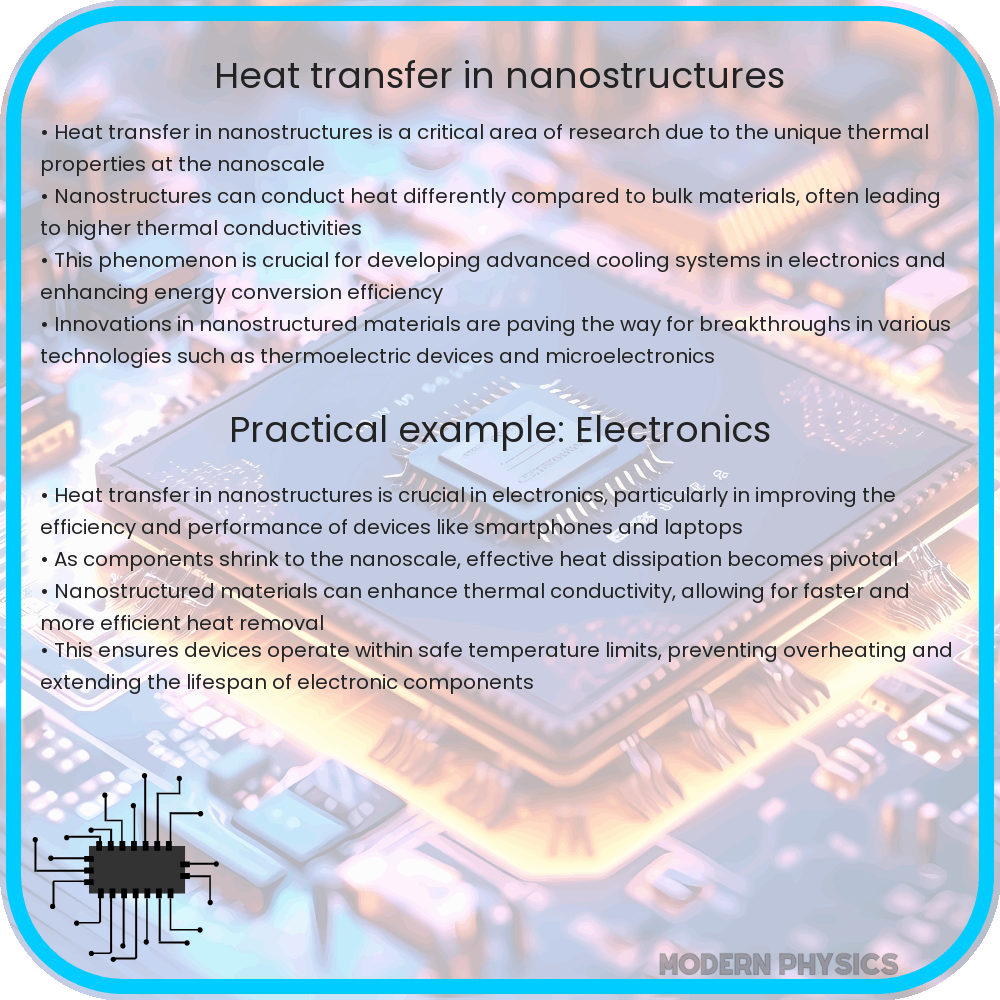
Understanding Heat Transfer in Nanostructures
Heat transfer in nanostructures represents a groundbreaking area in modern materials science, offering unprecedented efficiency and speed in a range of applications. This emerging field hinges on the unique thermal properties of materials at the nanoscale, where the conventional rules of heat transfer are significantly altered.
Nanostructured Materials and Enhanced Thermal Conductivity
Nanostructured materials, such as carbon nanotubes and graphene, exhibit exceptionally high thermal conductivity. The reason lies in their molecular structure, which enables efficient heat dissipation. For instance, the thermal conductivity of a single-layer graphene sheet can reach up to 5300 W/mK, far surpassing copper, a traditional heat conductor. This remarkable property is due to the strong covalent bonds and the phonon transport mechanism in these materials.
Speed of Heat Transfer in Nanostructures
At the nanoscale, heat transfer occurs at a much faster rate compared to bulk materials. The reduced size and high surface-to-volume ratio of nanostructures facilitate rapid heat dissipation. This property is critical in applications such as microelectronics, where efficient heat removal is essential to prevent overheating and ensure device longevity.
Innovative Applications of Nanostructured Heat Transfer
The unique thermal properties of nanostructured materials have led to innovative applications across various industries. In electronics, nanostructured thermal interfaces significantly improve heat dissipation in integrated circuits. In energy, nanofluids (fluids containing nanosized particles) enhance the efficiency of heat exchangers and solar cells. Furthermore, the use of nanostructures in textiles has created fabrics with improved thermal management properties.
Challenges and Future Directions
Despite these advancements, challenges remain in fully harnessing the potential of nanostructured heat transfer. One key issue is the difficulty in synthesizing and integrating these materials into existing systems. Additionally, there is a need for comprehensive understanding and modeling of heat transfer mechanisms at the nanoscale to optimize material design and application.
In conclusion, heat transfer in nanostructures offers a promising pathway for enhancing efficiency and speed in various technological applications. As research continues to unravel the complexities of thermal processes at the nanoscale, we can expect even more innovative solutions in the near future.
Advancements in Nanostructure Fabrication Techniques
The advancement in nanostructure fabrication techniques is pivotal in the progress of heat transfer applications. Techniques like electron beam lithography, chemical vapor deposition, and nano-imprint lithography have enabled precise control over nanostructure formation. This control is crucial for tailoring the thermal properties of materials to specific applications.
Modeling and Simulation in Nano Heat Transfer
Another significant aspect is the development of sophisticated modeling and simulation tools. These tools provide insights into the heat transfer mechanisms at the nanoscale, which are often counterintuitive and complex. Simulations using molecular dynamics and Monte Carlo methods are instrumental in predicting thermal conductivity and designing materials with optimal heat transfer characteristics.
Environmental Impact and Sustainability
The integration of nanostructured materials in heat transfer systems also has environmental implications. The increased efficiency can lead to reduced energy consumption in various applications, contributing to sustainability. However, the production and disposal of nanostructured materials raise concerns regarding environmental impact and toxicity, necessitating further research and regulation.
Future Trends and Potential
Looking ahead, the field of heat transfer in nanostructures is poised for significant growth. Potential future trends include the development of hybrid nanostructures, combining different materials to achieve superior thermal properties. The exploration of phase change materials at the nanoscale for thermal energy storage is another promising avenue. Additionally, the application of machine learning for material discovery and optimization could revolutionize the field.
Conclusion
In summary, heat transfer in nanostructures is a dynamic and evolving field with substantial implications for technology and sustainability. The extraordinary efficiency and speed offered by nanostructured materials open up new horizons in various industries, from electronics to energy to textiles. While challenges in material synthesis, integration, and environmental impact remain, ongoing research and technological advancements hold the promise of overcoming these hurdles. As the understanding of nanoscale heat transfer deepens, it is poised to be a cornerstone in the development of innovative and sustainable technologies.