
Explore the origins and importance of the Harrison-Zel’dovich Spectrum, its role in cosmology, and how it shapes our understanding of the universe’s structure.
Understanding the Harrison-Zel’dovich Spectrum
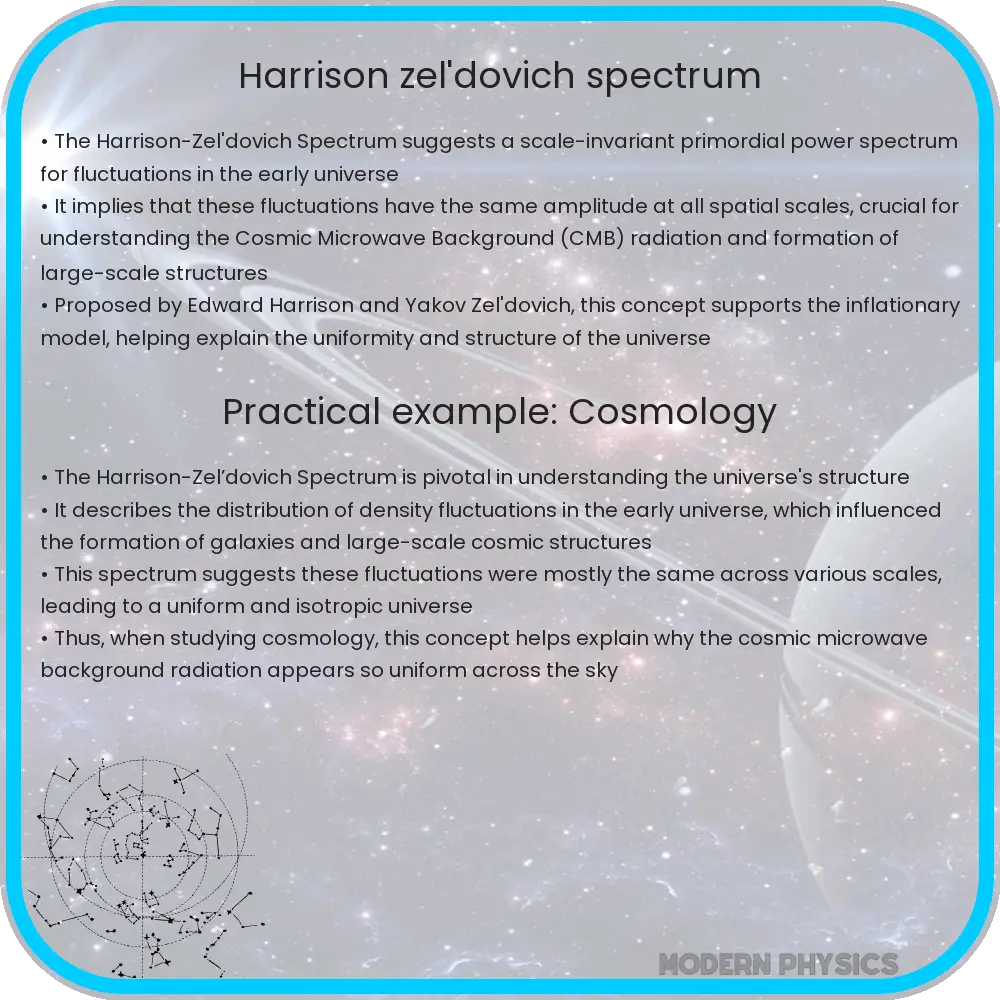
The Harrison-Zel’dovich Spectrum, a pivotal concept in cosmology, refers to the initial distribution of density fluctuations in the early universe. This spectrum is instrumental in the study of the cosmos, providing insights into the origins, structure, and evolution of the universe. It is based on the principle that the quantum fluctuations in the early universe became the seeds of all current cosmic structures, such as galaxies and clusters of galaxies.
Origins of the Spectrum
The concept was independently proposed by Edward R. Harrison and Yakov B. Zel’dovich in the early 1970s. They theorized a spectrum of primordial fluctuations with a specific mathematical characteristic: a flat, or scale-invariant, shape. This means that the initial quantum fluctuations had the same amplitude on all length scales, which is crucial for understanding the uniformity and structure of the cosmic microwave background radiation and the large-scale structure of the universe.
Importance in Modern Cosmology
The Harrison-Zel’dovich Spectrum is of paramount importance in cosmology for several reasons. Firstly, it provides a foundation for the inflationary theory, suggesting that the universe underwent a rapid expansion shortly after the Big Bang. This expansion explains the uniformity and flatness observed in the universe’s large-scale structure. Secondly, the spectrum’s scale-invariant feature is consistent with observations of the cosmic microwave background radiation, providing strong evidence for the Big Bang model.
Predictions and Observational Evidence
The spectrum predicts that the structures we observe today in the universe, from galaxies to the vast voids between them, originated from small initial fluctuations in density. These predictions have been confirmed by various astronomical observations, including studies of the cosmic microwave background radiation by satellites such as COBE, WMAP, and Planck. These observations have shown a remarkable consistency with the theoretical predictions of the Harrison-Zel’dovich Spectrum, reinforcing its role as a cornerstone in our understanding of the cosmos.
Challenges and Limitations
Despite its widespread acceptance and foundational role in cosmology, the Harrison-Zel’dovich Spectrum is not without its challenges and limitations. One of the main criticisms is the lack of a direct mechanism within the Big Bang theory itself to produce such a spectrum. This led to the development of inflationary theory, which provides a mechanism for generating the observed spectrum but also introduces new parameters and concepts that need to be tested. Additionally, there are ongoing debates and research into slight deviations from the exact scale-invariant spectrum predicted by Harrison and Zel’dovich, which could provide deeper insights into the physics of the early universe.
Future Directions
The study of the Harrison-Zel’dovich Spectrum and its implications continues to be a vibrant field of research. Future observations, particularly with next-generation telescopes and cosmic microwave background experiments, are expected to test the predictions of the spectrum and inflationary theory more precisely. This could lead to a better understanding of the early universe, the nature of dark matter and dark energy, and the fundamental physics governing our universe. Moreover, advancements in theoretical physics may provide new insights into the origin of the scale-invariant spectrum and its connection to the larger framework of cosmological models.
Conclusion
The Harrison-Zel’dovich Spectrum remains a cornerstone in the study of cosmology, offering profound insights into the structure and evolution of the universe. Its implications extend far beyond the early universe, influencing our understanding of the cosmic microwave background, the large-scale structure of the cosmos, and the fundamental laws of physics. While challenges and questions remain, the ongoing research and future discoveries promise to deepen our understanding of the cosmos, revealing the intricate tapestry of the universe woven from the primordial fluctuations encapsulated in the Harrison-Zel’dovich Spectrum.