
Explore the mysteries of star clusters, their formation, evolution, and significance in understanding the universe’s history and cosmic structure.
Star Clusters: Celestial Symphony of the Cosmos
Star clusters, the magnificent assemblies of stars, present an awe-inspiring spectacle in the night sky, offering invaluable insights into the mysteries of cosmic evolution. These clusters are not merely groups of stars; they are keys to understanding the lifecycle of stars, the formation of galaxies, and the intricate tapestry of the universe itself. In astrophysics, the study of star clusters is pivotal for piecing together the chronological saga of the cosmos.
Formation of Star Clusters
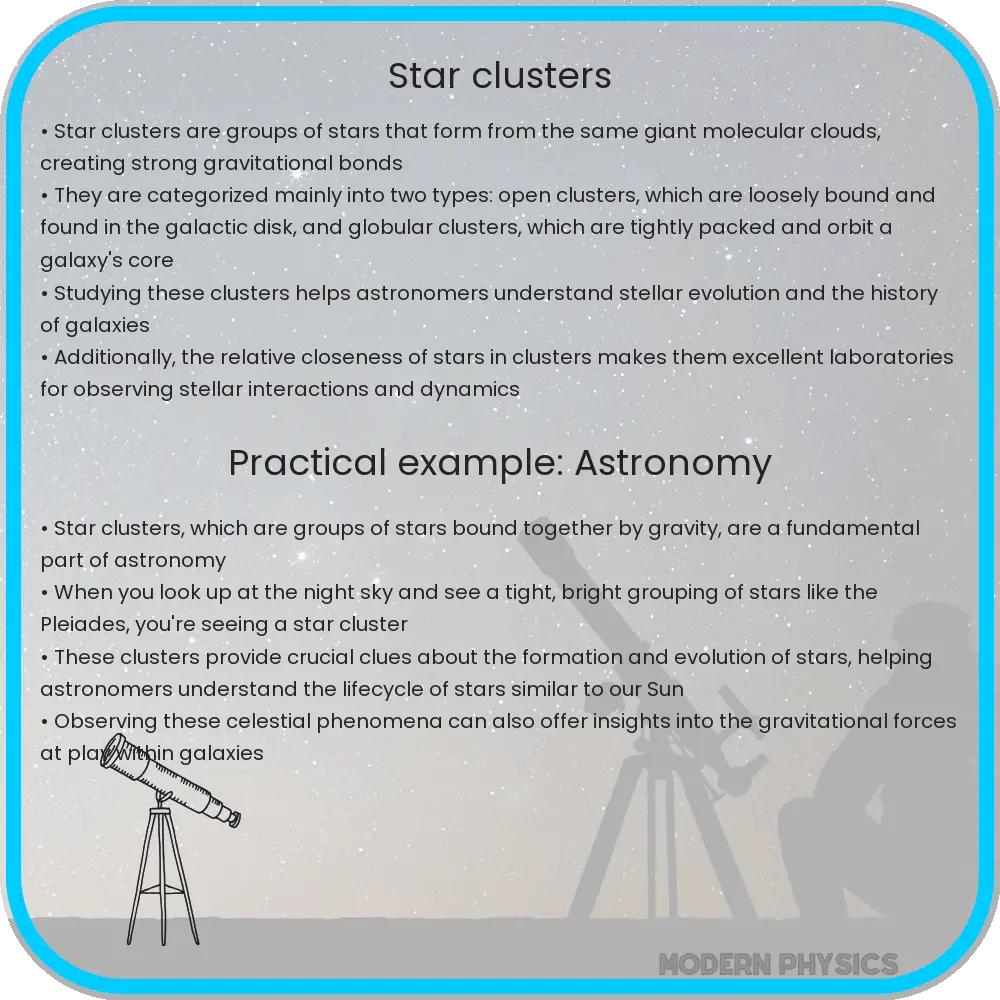
The birth of a star cluster is a monumental event in the cosmos, originating from colossal clouds of gas and dust known as molecular clouds. These clouds, primarily composed of hydrogen with traces of helium and other elements, collapse under their own gravity, leading to the formation of protostars. This process, known as ‘stellar nursery’ activity, is predominantly observed in two types of clusters: open (or galactic) clusters and globular clusters.
- Open Clusters: These are younger, containing hundreds to a few thousand stars. They are characterized by loose, irregular shapes and reside primarily in the spiral arms of galaxies. The Pleiades or the Seven Sisters is a classic example of an open cluster.
- Globular Clusters: These ancient clusters host tens of thousands to millions of stars, bound tightly by gravity. They possess a spherical shape and orbit the galactic core, serving as a window into the early universe.
During their formation, the intense gravitational forces within these clusters trigger nuclear fusion in the cores of protostars, marking the birth of new stars. This illuminating phase ushers in the main sequence stage of stellar evolution, where stars like our Sun spend the majority of their lifetimes.
Mysteries Surrounding Star Clusters
Despite their beauty and significance, star clusters harbor numerous unresolved mysteries. One of the most compelling is the discrepancy between the predicted and observed proportions of binary and multiple star systems within clusters. Additionally, the processes governing the dynamic evolution and eventual disbandment of star clusters, particularly open clusters, remain subjects of active research. The complex interplay of gravitational interactions, stellar evolution, and the galactic environment influences their lifespans and fates.
Evolution and Significance of Star Clusters
The evolution of star clusters is a dynamic process influenced by both internal and external factors. Over millions to billions of years, these clusters undergo significant changes. Internal factors include stellar interactions and the evolution of individual stars, which can eject members from the cluster or draw them closer together. Externally, the gravitational pull of the Milky Way and collisions with molecular clouds can strip stars away, leading to the gradual dissolution of the cluster.
Open clusters, being less densely packed and situated in the active, disruptive environment of the galaxy’s disk, tend to disperse more quickly than their globular counterparts. Globular clusters, on the other hand, survive for longer periods, often orbiting the galactic halo, where the environment is less tumultuous. The differing lifespans and environments of these clusters make them crucial for studying the evolutionary paths of stars and galaxies.
Furthermore, star clusters play an essential role in the calibration of astronomical distances. By establishing the distances to nearby clusters through standard candles like Cepheid variables, astronomers can extend this scale to more distant regions of the universe, enhancing our understanding of the cosmic scale.
Conclusion
Star clusters, with their myriad stars bound by the same origin and destiny, are more than just stunning celestial objects; they are fundamental to our comprehension of the universe. From the cradle of star formation to the evolutionary processes shaping galaxies, they provide a structured framework for deciphering the cosmos. The ongoing study of star clusters continues to unravel the mysteries of stellar evolution, the gravitational forces sculpting the cosmos, and the universal laws governing the vast, starry expanse. As we peel back layers of these cosmic phenomena, we inch closer to answering the age-old questions of our origins and the ultimate fate of the universe.