
Explore the gyrofluid model’s role in plasma physics, advancing our understanding of plasma dynamics, enhancing computational efficiency, and fueling fusion research.
Gyrofluid Model: A Revolution in Understanding Plasma Dynamics
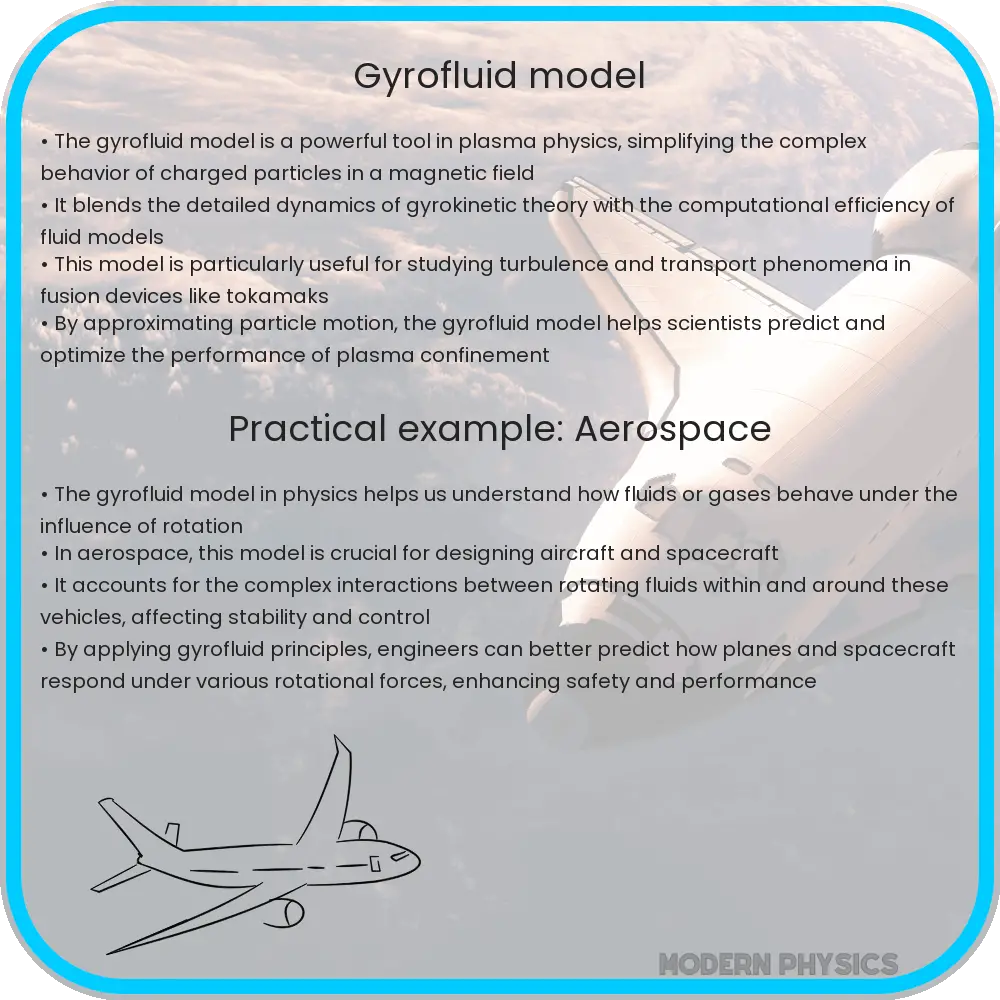
The gyrofluid model represents a significant advancement in plasma physics, offering a unique approach to studying the complex dynamics of magnetized plasmas. By blending the conceptual frameworks of fluid dynamics and gyrokinetic theory, this model provides insights into plasma behavior that are both detailed and computationally accessible. This article delves into the advances, applications, and insights brought about by the gyrofluid model in the realm of plasma physics.
Advances in Gyrofluid Modeling
At the core of gyrofluid modeling is the effort to simplify the gyrokinetic equations, which describe the motion of charged particles in a magnetic field, without sacrificing the accuracy necessary for understanding turbulent plasma phenomena. Recent advances have focused on enhancing the model’s precision in capturing the effects of turbulence, wave-particle interactions, and magnetic reconnection processes. These improvements have been instrumental in bridging the gap between theoretical predictions and experimental observations.
Applications Across Various Fields
The gyrofluid model has found applications in a wide range of fields, from astrophysical plasmas, such as those found in accretion disks and the solar wind, to controlled fusion research, where understanding plasma confinement is crucial. In fusion devices like tokamaks and stellarators, gyrofluid simulations help optimize magnetic confinement and predict plasma behavior, contributing to the development of more efficient and sustainable fusion energy sources.
Insights into Plasma Turbulence and Magnetic Reconnection
One of the most valuable contributions of the gyrofluid model is its ability to offer insights into plasma turbulence and magnetic reconnection, two phenomena critical to understanding plasma dynamics in both natural and laboratory settings. By accurately simulating the nonlinear interactions that drive turbulence, the model helps elucidate the mechanisms underlying energy and particle transport in plasmas. Additionally, it provides a clearer picture of magnetic reconnection, a process fundamental to solar flares, geomagnetic storms, and the stability of fusion plasmas.
Enhancing Computational Efficiency
The computational efficiency of the gyrofluid model is another area where significant progress has been made. Traditional gyrokinetic simulations require substantial computational resources due to the need to resolve the phase space of particles in a magnetic field. The gyrofluid model, by abstracting these particles into fluid-like elements while retaining the essential physics of gyrokinetic motion, significantly reduces the computational load. This efficiency enables researchers to perform large-scale simulations of plasma dynamics that were previously out of reach, facilitating a deeper understanding of complex plasma phenomena over longer time scales and larger spatial domains.
Future Directions in Gyrofluid Research
Looking forward, the gyrofluid model continues to evolve, with research efforts aimed at further enhancing its accuracy and applicability. One promising direction is the integration of machine learning techniques to refine the model parameters and improve the fidelity of simulations. Additionally, efforts to extend the model to encompass more complex physical effects, such as electromagnetic fluctuations and non-Maxwellian distribution functions, are underway. These advancements promise to open new vistas in plasma research, offering insights into phenomena that remain poorly understood.
Conclusion
The gyrofluid model represents a pivotal development in plasma physics, offering a balanced approach that combines the depth of gyrokinetic theory with the computational accessibility of fluid models. Its contributions to advancing our understanding of plasma dynamics, enhancing computational efficiency, and broadening the applications in both astrophysical and laboratory settings cannot be overstated. As the model continues to evolve, it holds the potential to unlock further mysteries of plasma behavior, paving the way for advancements in fusion energy, space exploration, and beyond. The ongoing integration of new computational techniques and the expansion into uncharted areas of plasma physics will ensure that the gyrofluid model remains at the forefront of scientific research, driving innovation and discovery in the years to come.