
Explore the fascinating world of gravitational waves, their origins, detection techniques, and the profound cosmic insights they offer into the universe’s mysteries.
Understanding Gravitational Wave Background
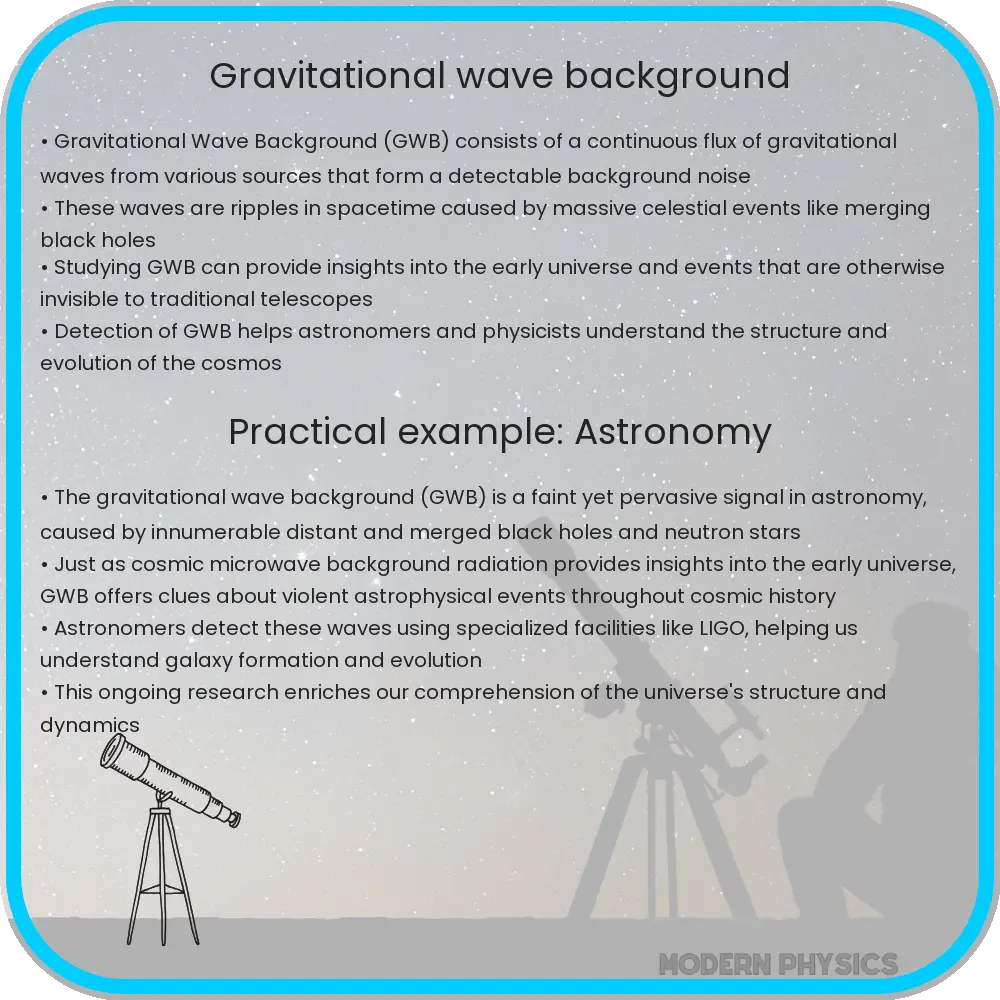
The concept of gravitational waves, ripples in the fabric of spacetime, has fascinated scientists and astronomers for decades. These waves are not just theoretical constructs but are physical manifestations of the universe’s most violent and energetic processes. The gravitational wave background (GWB) represents a cosmic symphony of these ripples, a persistent hum of waves from various sources spread across the cosmos.
Origins of Gravitational Waves
Gravitational waves are born from cataclysmic events in the vastness of space. These include the collisions and mergers of massive objects like black holes and neutron stars, supernovae, and even the remnants of the Big Bang itself. Each event contributes uniquely to the GWB, encoding information about the nature of gravity, the behavior of matter under extreme conditions, and the evolution of the universe.
Detection Techniques
Detecting the elusive gravitational wave background requires extraordinary sensitivity and precision. Facilities like LIGO (Laser Interferometer Gravitational-Wave Observatory) and Virgo have paved the way in this groundbreaking field. These observatories utilize laser interferometry, where the passage of a gravitational wave slightly alters the lengths of two long perpendicular arms, leading to a measurable change in light interference patterns.
However, detecting the GWB is more challenging than spotting single events. The GWB is a mixture of countless overlapping signals, not just a single distinct wave. Researchers use sophisticated data analysis methods to isolate this background noise from the cosmic symphony. By comparing observations with theoretical models, scientists aim to extract the GWB’s faint but invaluable signal.
Insights from Gravitational Waves
The study of gravitational waves opens new windows into understanding the universe. By analyzing the GWB, scientists can gain insights into the rates of cosmic events, the distribution of mass in the universe, and the nature of fundamental forces. Moreover, the GWB carries information about the earliest moments of the universe, potentially shedding light on mysteries like inflation and the distribution of dark matter.
Challenges and Future Prospects
The detection and analysis of the gravitational wave background pose significant scientific and technological challenges. The signals are extraordinarily weak and are drowned out by a sea of noise from various sources, both terrestrial and cosmic. Advanced algorithms and detection techniques are continually being developed and refined to separate the background signals from this noise. Additionally, future space-based observatories like LISA (Laser Interferometer Space Antenna) are expected to significantly enhance our ability to detect these faint ripples from space, free from the constraints of Earth-based noise.
Moreover, the interdisciplinary nature of gravitational wave research involves the collaboration of physicists, astronomers, mathematicians, and engineers. This collective effort not only advances our understanding of the universe but also pushes the boundaries of technology, leading to innovations that have wide-ranging applications beyond astrophysics.
Implications for Cosmology and Astrophysics
The successful detection and interpretation of the GWB will have profound implications for cosmology and astrophysics. It will provide a new lens through which we can observe the universe, complementing the insights gained from electromagnetic radiation, neutrinos, and cosmic rays. Understanding the GWB will help unravel the mysteries of black hole populations, neutron star dynamics, and the very fabric of spacetime itself. It represents a key piece of the puzzle in our quest to understand the history and structure of the universe.
Conclusion
In conclusion, the study of the gravitational wave background stands at the forefront of modern cosmology and astrophysics, offering a unique perspective on the universe’s most enigmatic phenomena. Despite the challenges, the relentless pursuit of these invisible ripples in spacetime continues to unlock new realms of knowledge, pushing the boundaries of what we understand about the cosmos. As detection methods improve and new observatories come online, we stand on the brink of a new era in gravitational wave astronomy, one that promises to illuminate the darkest corners of the universe and answer fundamental questions about our cosmic origins.