
Introduction to gravitational wave polarization, delving into how these waves distort spacetime and what their characteristics reveal about cosmic events.
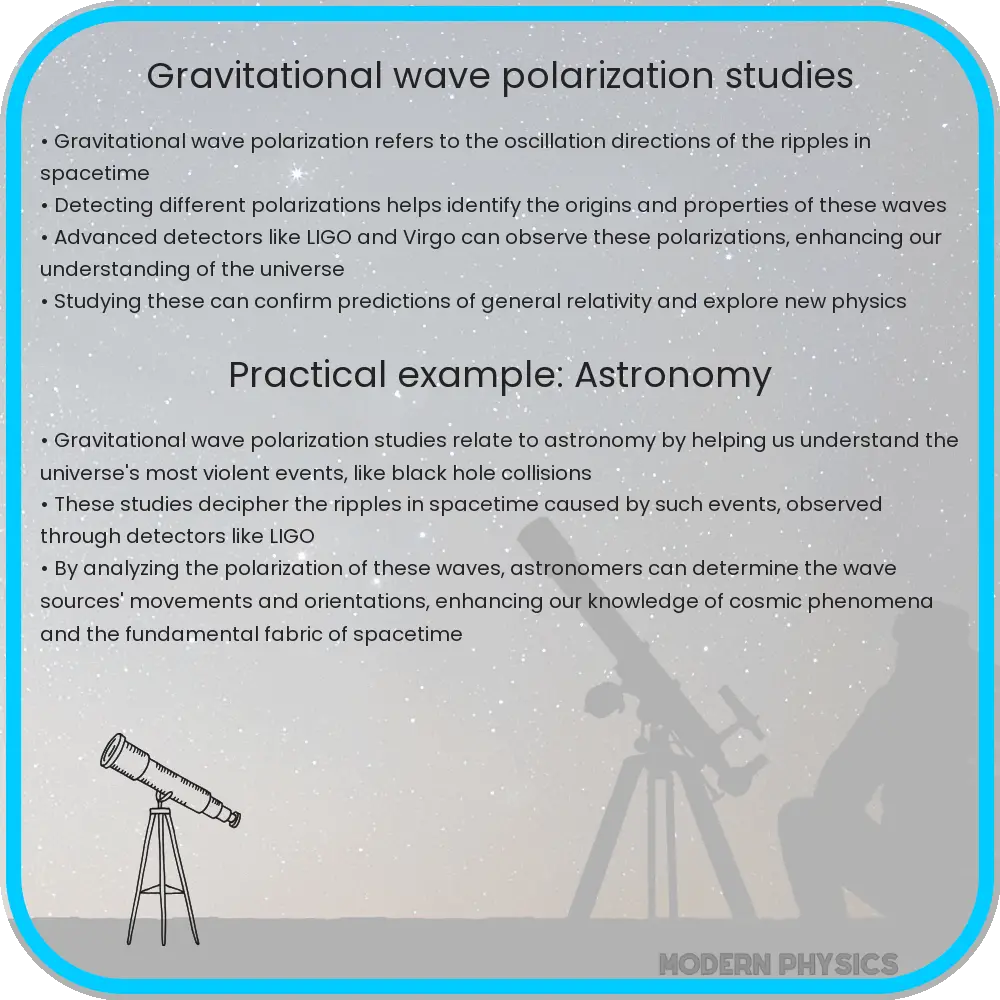
Introduction to Gravitational Wave Polarization
Gravitational waves, ripples in the fabric of spacetime, were first predicted by Albert Einstein’s theory of General Relativity in 1916. These waves are produced by some of the most violent and energetic processes in the Universe, such as the merging of black holes or neutron stars. An important characteristic of these waves is their polarization, which provides critical clues about their origins and the nature of gravity itself.
Understanding Polarization of Gravitational Waves
Polarization refers to the direction in which the gravitational waves distort space as they pass through it. Just as light waves can be polarized, gravitational waves exhibit two fundamental modes of polarization, typically referred to as “plus” (+) polarization and “cross” (x) polarization. These names derive from the patterns that the distortions create:
- Plus (+) Polarization: Causes space to stretch and compress along axes that are directly aligned with the direction of wave propagation.
- Cross (x) Polarization: Similar to plus polarization, but the stretch and compression occur at 45 degrees to the axis in the case of plus polarization.
These modes can be visualized as two perpendicular rubber bands stretching and contracting alternately as the wave moves through space. The orientation and amplitude of these movements can tell us a great deal about the events that generated the waves.
Detection of Gravitational Waves and Their Polarizations
The detection of gravitational waves is a monumental task, requiring incredibly precise measurements of minute distortions in spacetime. Facilities like LIGO (Laser Interferometer Gravitational-Wave Observatory) and Virgo are at the forefront of this research. They operate by using laser interferometry to measure changes in distance caused by a passing gravitational wave, with an accuracy smaller than a fraction of a proton’s diameter.
Each of these observatories has multiple arms arranged in an L-shape, which allows them to detect distortions in spacetime along two perpendicular orientations simultaneously. By analyzing the signal patterns and how they vary between these arms, scientists can determine the polarization of the gravitational waves.
Analysis Techniques for Gravitational Wave Polarizations
The analysis of gravitational wave signals involves complex data processing techniques. Key among these are:
- Matched Filtering: By comparing received signals with pre-calculated templates, researchers can identify specific wave patterns and their polarizations.
- Parameter Estimation: Once a signal matches a template, scientists use computational models to estimate the physical properties of the source, such as mass and spin, and details about the wave’s polarization.
- Waveform Reconstruction: Advanced algorithms reconstruct the waveforms of detected signals to isolate and analyze their polarization characteristics. This reconstruction helps in understanding more nuanced aspects of gravitational physics.
Through these techniques, researchers not only confirm the presence of gravitational waves but also dissect the intricate details locked in their polarizations. This analysis provides deeper insights into the cosmic cataclysms that produce these waves and tests the predictions of General Relativity in extreme conditions.
Impact of Understanding Gravitational Wave Polarization
Gravitational wave astronomy is revolutionizing our understanding of the Universe. By studying the polarization of these waves, scientists can gain unprecedented insights into the dynamics of cosmic events and test the limits of Einstein’s theory. The polarization data can reveal the orientations of the wave sources, their distance, and much more, opening new avenues for multimessenger astronomy.
This field also paves the way for using gravitational waves as another method to observe the Universe, complementing traditional electromagnetic observations. As the sensitivity of detection methods improves, we’re poised to uncover more secrets from the darkest and most distant corners of the cosmos.
Challenges and Future Prospects in Gravitational Wave Research
The current state of gravitational wave research, while impressive, faces significant challenges that must be overcome to improve detection capabilities and the detailed analysis of wave properties. One major challenge is the creation of more sensitive detectors that can catch weaker and more frequent gravitational wave signals from a broader range of cosmic events.
- Technological Advancements: Researchers are exploring technological innovations such as cryogenic detectors and space-based observatories (like the proposed LISA mission) to enhance the sensitivity and range of detection.
- Data Analysis Improvements: Enhancing the techniques for processing and analyzing the huge volumes of data produced by detectors will also be crucial. This includes developing more sophisticated algorithms for noise reduction and signal extraction.
- International Collaboration: Increased collaboration between international scientific communities can share knowledge and resources, accelerating the advancements in this field.
As technology and methods improve, upcoming generations of observatories will enable us to explore deeper into the fabric of spacetime, potentially leading to discoveries that could redefine our understanding of the universe.
Conclusion
The exploration of gravitational waves and their polarizations opens a new window into observing and understanding the universe. This field not only confirms the predictions made by Einstein’s theory of General Relativity but also offers potential to uncover new physics through the details hidden within these spacetime ripples. As our detection methods become more sophisticated and our international collaborations strengthen, we are on the brink of deeper discoveries that could illuminate our cosmic origins and further enrich our understanding of fundamental physics. Gravitational wave astronomy holds the promise of unlocking mysteries of the cosmos that have been beyond reach, offering endless possibilities for future scientific exploration.