
Explore the revolutionary field of gravitational wave astronomy, uncovering cosmic secrets and advancing our understanding of the universe.
Unveiling the Mysteries of the Universe through Gravitational Wave Astronomy
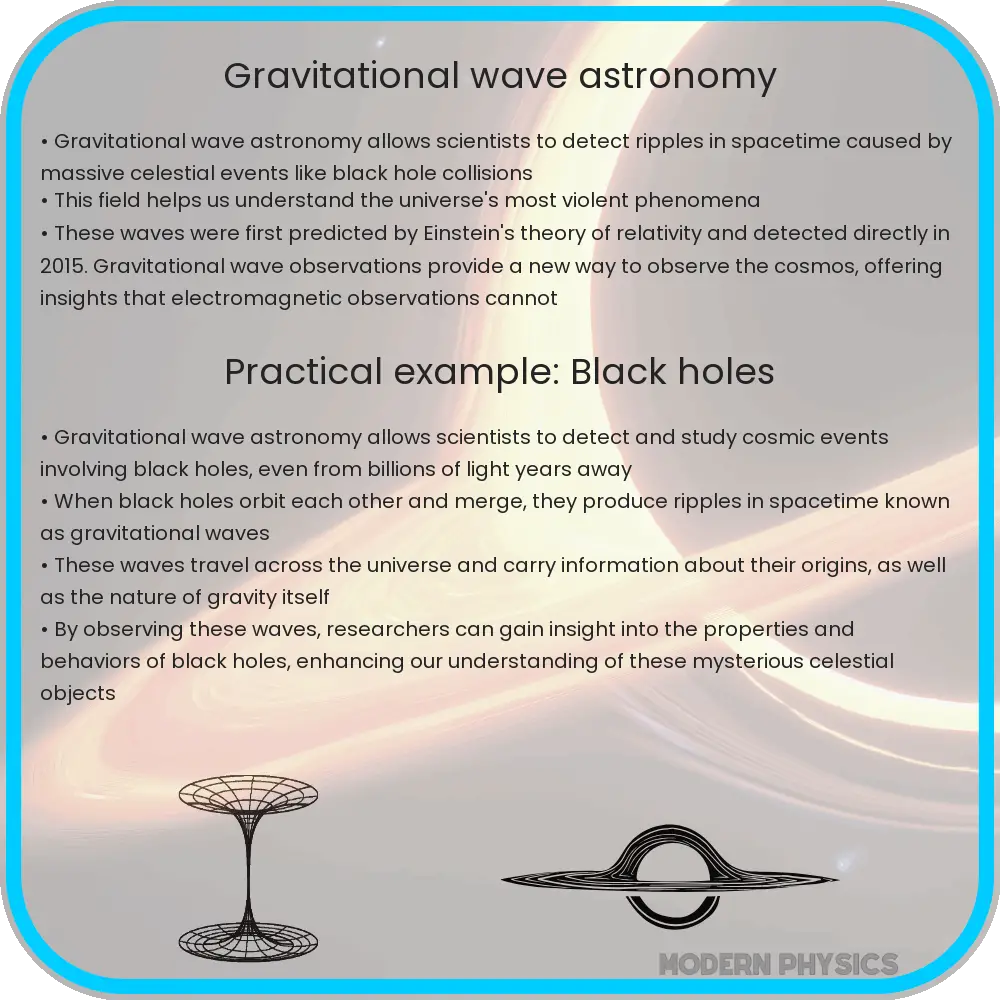
The realm of astrophysics has been revolutionized by the advent of gravitational wave astronomy, a field that probes the very fabric of the cosmos. Gravitational waves, ripples in spacetime, were first predicted by Albert Einstein’s General Theory of Relativity over a century ago. These waves are generated by some of the most cataclysmic events in the universe, such as the merging of black holes or neutron stars. The detection of these elusive waves opens a new window to understanding the universe, complementing the traditional electromagnetic spectrum observations.
The Breakthrough in Gravitational Wave Detection
The historic first direct detection of gravitational waves in 2015 by the Laser Interferometer Gravitational-Wave Observatory (LIGO) marked a milestone in astrophysics. This groundbreaking discovery, which observed waves from a binary black hole merger, validated Einstein’s theory and earned the Nobel Prize in Physics in 2017. The LIGO detectors, along with Virgo and KAGRA observatories, employ highly sensitive laser interferometry to measure the minuscule distortions in spacetime caused by passing gravitational waves.
Gravitational Waves: A New Lens to View the Cosmos
Gravitational wave astronomy offers a unique perspective, distinct from electromagnetic observations. While light can be absorbed, scattered, or blocked by interstellar matter, gravitational waves travel through the universe virtually unimpeded, carrying pristine information about their origins. This allows astronomers to peer into regions of the cosmos that were previously inaccessible, such as the cores of supernova explosions or the immediate surroundings of black holes.
Implications for Cosmology and Fundamental Physics
The study of gravitational waves not only enhances our understanding of astronomical phenomena but also provides insights into fundamental physics. By analyzing these waves, scientists can test the limits of General Relativity, probe the nature of extreme matter under incredible densities, and explore the very early universe moments after the Big Bang. This new era of astronomy is paving the way for discoveries that could reshape our understanding of the universe’s structure and history.
Gravitational wave astronomy also holds potential for novel discoveries in cosmology. The observation of gravitational waves from the early universe could offer clues about the nature of dark matter and dark energy, the mysterious components that constitute a significant portion of the universe’s mass-energy budget. These observations might also shed light on inflation, the rapid expansion of the universe in its infancy, offering a glimpse into the cosmos’s birth and evolution.
The Future of Gravitational Wave Astronomy
The future of gravitational wave astronomy is incredibly promising. Advanced projects, such as the Laser Interferometer Space Antenna (LISA), a space-based observatory, are in development. LISA aims to detect lower-frequency gravitational waves than those observed by ground-based detectors, potentially unveiling events like the merger of supermassive black holes at the centers of galaxies. Such projects will further expand our understanding of gravitational dynamics in the cosmos.
Interdisciplinary Impact and Technological Advancements
The impact of gravitational wave astronomy extends beyond astrophysics, driving advancements in technology and interdisciplinary science. The precise measurements required for detecting gravitational waves have spurred innovations in laser technology, vacuum systems, and vibration isolation techniques. These technologies have potential applications in various fields, from quantum computing to earthquake detection.
Enhancing Our Cosmic Perspective
Gravitational wave astronomy has also enriched our cosmic perspective, fostering a deeper connection with the universe. It emphasizes the dynamic nature of the cosmos and our evolving understanding of it. By observing phenomena that were once theoretical, such as black hole mergers, we are reminded of the universe’s vastness and complexity.
Conclusion
The advent of gravitational wave astronomy marks a transformative era in our exploration of the universe. It not only validates key aspects of Einstein’s General Relativity but also unveils phenomena that were once hidden from our view. This burgeoning field promises to answer some of the most profound questions about the universe’s nature, structure, and origin. As we continue to improve our detection capabilities and expand our observational horizons, the universe’s mysteries will gradually unfold, offering insights that could revolutionize our understanding of the cosmos. Gravitational wave astronomy is not just a scientific endeavor; it is a journey into the unknown, pushing the boundaries of human knowledge and imagination.