
Explore the Cosmic Microwave Background (CMB) and its relation to relativity, revealing insights into the universe’s origins and evolution.
Unraveling the Mysteries of the Universe: The Cosmic Microwave Background
The Cosmic Microwave Background (CMB) is a fascinating phenomenon that offers a window into the early universe. Discovered accidentally in 1965 by Arno Penzias and Robert Wilson, the CMB is a relic of the Big Bang, the colossal explosion that gave birth to the universe. This faint glow, permeating the entire cosmos, is the oldest light we can observe, dating back to approximately 380,000 years after the Big Bang.
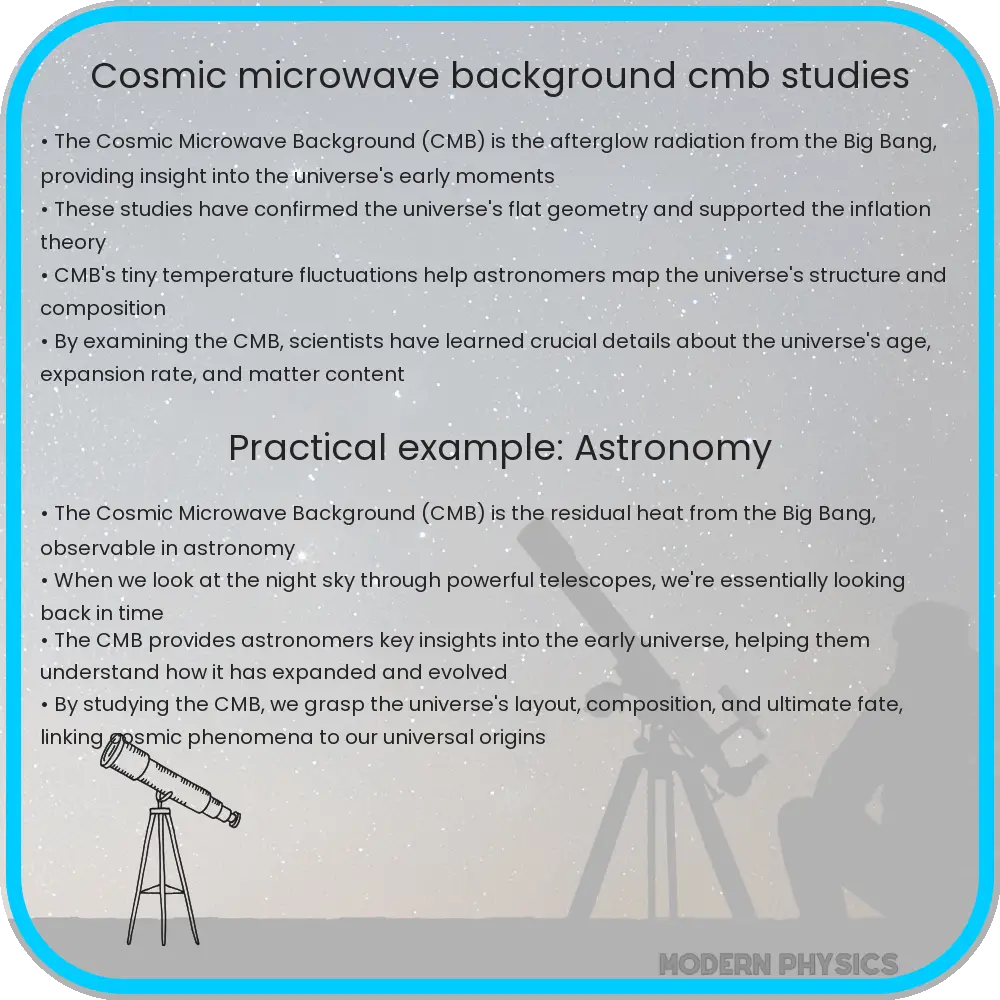
Understanding the CMB is crucial for cosmologists. It is not just a remnant of the universe’s infancy but also a rich source of information about its composition, age, and evolution. The CMB’s uniformity, with a temperature of about 2.7 Kelvin, astonishingly consistent across the sky, with only minor fluctuations, tells a story of an early universe that was remarkably homogeneous.
Relativity’s Role in the CMB’s Insights
Albert Einstein’s theory of general relativity, a cornerstone of modern physics, provides crucial insights into understanding the CMB. According to this theory, gravity results from the curvature of spacetime caused by mass and energy. As such, general relativity has significant implications for the study of the early universe, particularly in understanding how structures such as galaxies formed from the initial uniformity represented by the CMB.
General relativity also helps explain the redshift of the CMB. As the universe expands, the wavelengths of the CMB photons stretch, shifting them towards the red end of the spectrum. This redshift is pivotal in calculating the universe’s expansion rate and age. By studying the CMB’s redshift, cosmologists can trace back the expansion history of the universe, offering insights into its dynamic evolution.
Furthermore, the CMB also serves as a testbed for the theory of inflation, a rapid expansion phase that the universe is believed to have undergone fractions of a second after the Big Bang. This theory, rooted in the principles of quantum field theory and general relativity, suggests that the universe expanded exponentially, smoothing out any irregularities and leading to the uniformity observed in the CMB.
The CMB’s minute fluctuations, or anisotropies, are equally significant. These variations in density and temperature are believed to be the seeds of all current cosmic structures. By mapping these anisotropies, scientists can reconstruct the early universe’s conditions and understand the formation and distribution of galaxies and galaxy clusters.
As we delve deeper into the study of the CMB, we unravel more about the universe’s origins, composition, and fate. The insights gained from the CMB, coupled with the framework of general relativity, continue to challenge and refine our understanding of the cosmos.
Advanced Technologies in CMB Research
The study of the CMB has been revolutionized by advancements in technology. Instruments like the Cosmic Background Explorer (COBE), the Wilkinson Microwave Anisotropy Probe (WMAP), and the Planck space telescope have provided increasingly detailed maps of the CMB. These missions have measured the CMB’s temperature variations with unprecedented precision, revealing subtle features that inform our understanding of the universe’s composition and structure.
One of the most significant findings from these missions is the confirmation of the flatness of the universe. The distribution of temperature fluctuations in the CMB allows scientists to infer the geometry of the universe. A flat universe, as supported by CMB observations, implies that the total energy density of the universe is close to the critical density, balancing the rate of expansion and gravitational pull.
Implications of CMB Research
The CMB has profound implications for our understanding of fundamental physics. For instance, it provides evidence for the existence of dark matter and dark energy. The subtle fluctuations in the CMB are influenced by the gravitational pull of dark matter, helping scientists map its distribution. Similarly, the accelerated expansion of the universe, inferred from CMB studies, suggests the presence of dark energy, a mysterious force driving this expansion.
Moreover, the CMB research has led to refinements in the Standard Model of Cosmology, known as the ΛCDM model. This model, which incorporates the cosmological constant (Λ) and Cold Dark Matter (CDM), aligns closely with CMB observations, offering a comprehensive picture of the universe’s evolution from the Big Bang to the present day.
Conclusion: The Legacy of the CMB
The Cosmic Microwave Background remains one of the most significant discoveries in modern astrophysics. It has not only validated the Big Bang theory but has also provided a foundation for understanding the universe’s fundamental aspects. The CMB is a cosmic tapestry, encoding information about the universe’s earliest moments and its continued evolution over billions of years.
As technology advances, future missions aiming to study the CMB will likely unveil even more details about the early universe. These insights will continue to challenge and refine our understanding, potentially leading to new physics beyond our current models. The CMB, a faint echo from the dawn of time, thus stands as a testament to human curiosity and our relentless pursuit of understanding the cosmos.