
Explore Glauber Dynamics in chemical kinetics and stochastic processes, from basic principles to advanced applications and future trends.
Understanding Glauber Dynamics in Chemical Kinetics and Stochastic Processes
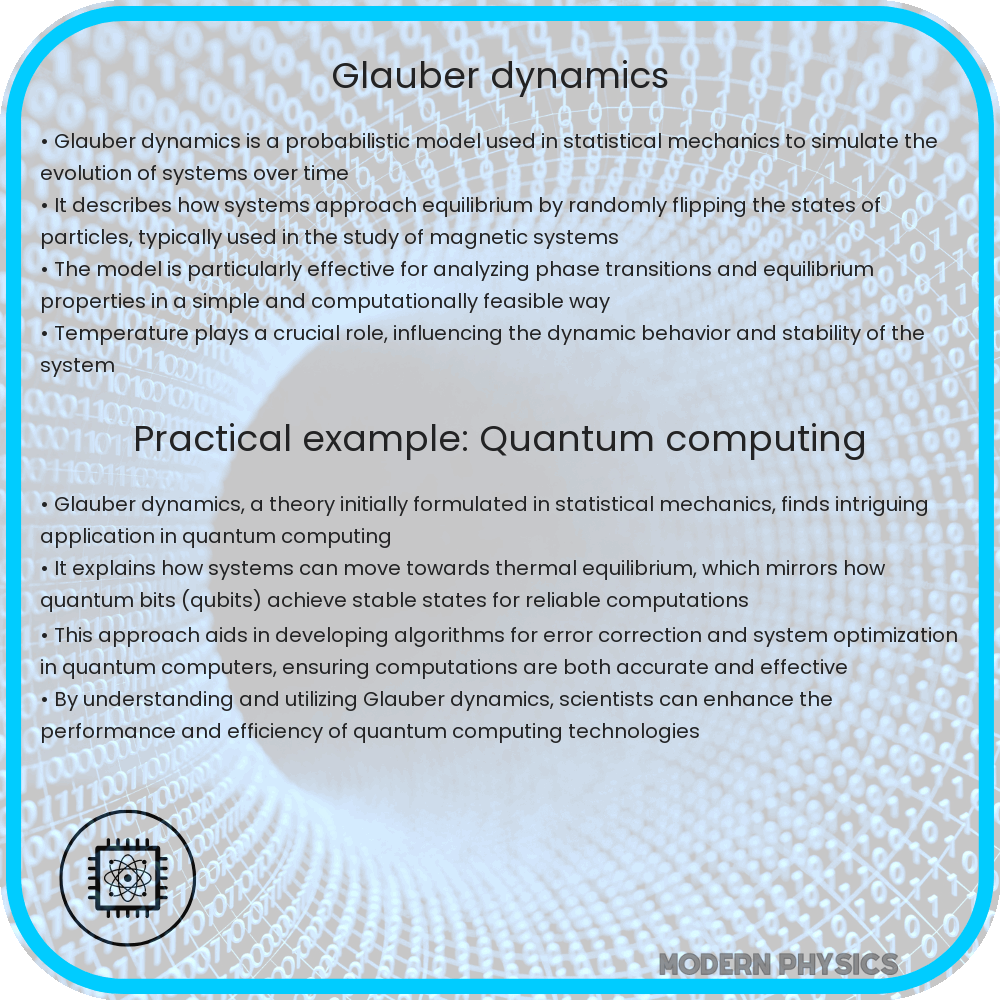
Glauber Dynamics, a concept named after physicist Roy J. Glauber, plays a significant role in the realms of chemical kinetics and stochastic processes. This model is particularly important in understanding systems near thermal equilibrium and the way they evolve over time. By using probabilistic rules, it helps in modeling the kinetics of various systems, especially in the field of statistical mechanics.
Key Principles of Glauber Dynamics
At its core, Glauber Dynamics is based on a set of rules used to simulate the time evolution of a system. It’s commonly applied to spin systems, where the spins on a lattice can flip according to certain probabilities. These probabilities are dependent on factors like the temperature of the system and the interactions between neighboring spins.
Application in Kinetics
In chemical kinetics, Glauber Dynamics is useful for understanding reaction rates and mechanisms at the microscopic level. It provides insights into how molecular interactions and thermal fluctuations influence reaction pathways, a crucial aspect in fields like catalysis and materials science.
Stochastic Processes and Glauber Dynamics
Stochastic processes involve systems that undergo changes in a random manner. Glauber Dynamics offers a framework to study these random transitions, especially in systems approaching equilibrium. It helps in analyzing the time it takes for a system to reach equilibrium, known as the relaxation time, which is vital in many physical and chemical processes.
Modeling and Simulations
One of the significant advantages of Glauber Dynamics is its applicability in computer simulations. Researchers use it to model complex systems, enabling the study of phenomena that are difficult to observe experimentally. These simulations provide valuable data for testing theoretical models and enhancing our understanding of dynamic systems.
The versatility of Glauber Dynamics in modeling various physical and chemical processes makes it a powerful tool in both theoretical and applied sciences. Its ability to encapsulate the stochastic nature of microscopic interactions offers profound insights into the behavior of complex systems.
Advanced Applications of Glauber Dynamics
Glauber Dynamics extends beyond basic chemical and physical processes, playing a pivotal role in areas like neuroscience and material science. In neuroscience, for instance, it aids in modeling neural networks’ dynamics, providing insights into how brain activity patterns evolve over time. Similarly, in material science, it’s instrumental in understanding phase transitions and the properties of novel materials at the atomic level.
Challenges and Limitations
Despite its wide applicability, Glauber Dynamics is not without its challenges. The accuracy of the models depends heavily on the assumptions made about the system, such as interaction types and boundary conditions. Furthermore, in systems with large numbers of particles or spins, computational limitations can restrict the model’s practicality. Thus, ongoing research aims to refine these models for more complex systems.
Recent Advances and Future Directions
Recent advancements in computational power and algorithms have enabled more detailed and accurate simulations using Glauber Dynamics. Researchers are now able to tackle larger and more complex systems, opening new avenues in various scientific fields. Future directions may include integrating Glauber Dynamics with other modeling approaches, like quantum mechanics, to explore phenomena at the nano-scale.
Conclusion
Glauber Dynamics stands as a cornerstone in the study of chemical kinetics and stochastic processes. Its ability to model the temporal evolution of systems under probabilistic rules has provided deep insights into various scientific fields. From helping understand the intricate workings of neural networks to aiding in the design of new materials, its impact is far-reaching. While challenges remain in terms of computational demands and model assumptions, ongoing advancements promise to extend its utility even further. As we continue to push the boundaries of science and technology, Glauber Dynamics will undoubtedly play a vital role in uncovering the mysteries of complex systems.