
Explore the Bullet Cluster’s impact on dark matter and cosmology, revealing how this cosmic event validates theories and deepens our understanding of the universe.
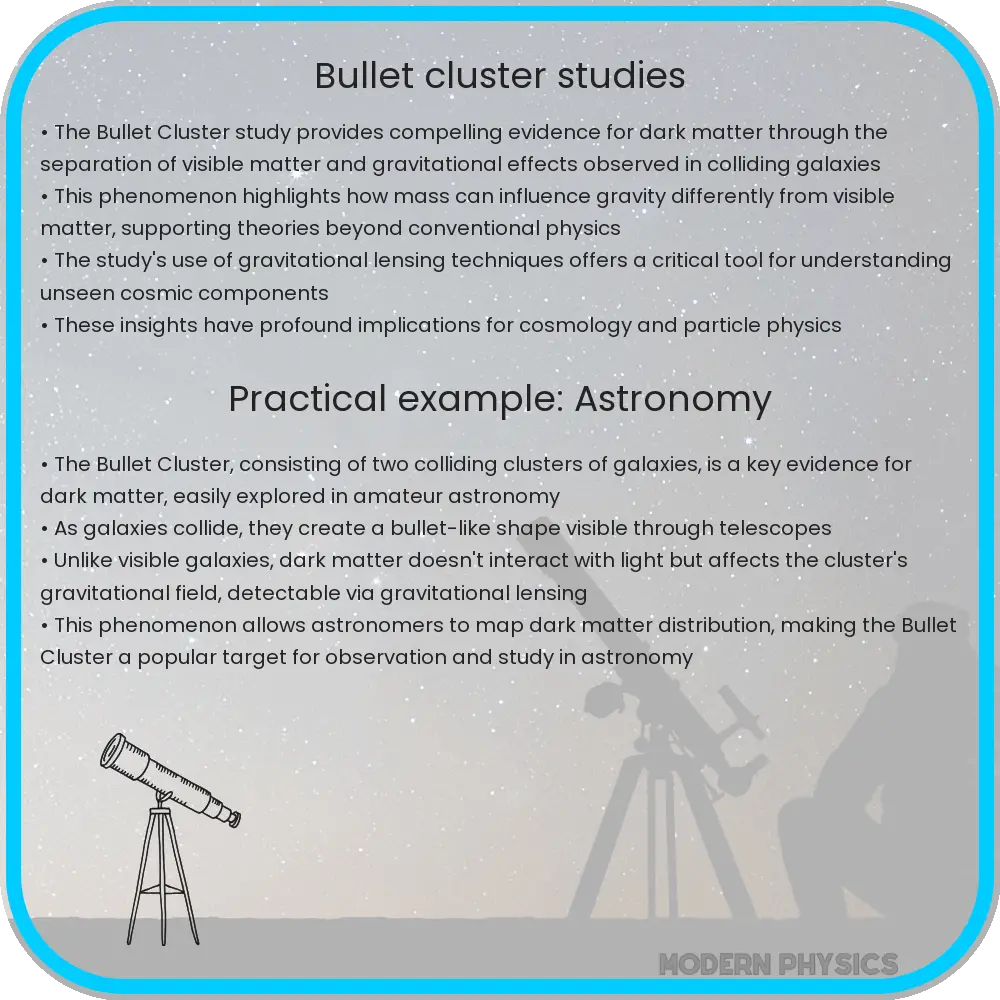
Exploring the Mysteries of the Bullet Cluster: A Cosmic Laboratory for Dark Matter
The Bullet Cluster, consisting of two colliding clusters of galaxies known as 1E 0657-56, provides a fascinating window into the universe’s unseen elements. This celestial phenomenon, located about 3.7 billion light-years away, has been instrumental in shaping our understanding of dark matter and the structure of the cosmos. Discovered through its X-ray emissions by the Chandra X-ray Observatory, the Bullet Cluster serves as a natural laboratory for studying cosmic collisions and the elusive nature of dark matter.
Insights into Dark Matter
One of the most compelling pieces of evidence for the existence of dark matter comes from the study of the Bullet Cluster. During the collision of the two galaxy clusters, the hot gas (made of ordinary matter) was observed slowing down, while the gravitational lensing effects showed that the majority of the mass in the clusters continued moving forward. This discrepancy can be explained by the presence of dark matter, which interacts only through gravity and not electromagnetically, meaning it does not emit, absorb, or reflect light, making it completely invisible to our current instruments.
Cosmological Implications
The observations of the Bullet Cluster have profound implications for cosmology and the standard model of particle physics. They provide strong evidence against alternative theories of gravity that do not require dark matter, such as Modified Newtonian Dynamics (MOND). The cluster’s behavior illustrates how dark matter shapes the large-scale structure of the universe and plays a crucial role in the formation and evolution of cosmic structures.
- Direct observation of dark matter’s effects through gravitational lensing.
- Challenges to alternative theories without dark matter.
- Insights into the dynamics and interaction of large-scale cosmic structures.
The Bullet Cluster’s study underscores the necessity of dark matter in explaining astronomical phenomena and continues to inspire astronomers and physicists to further explore the fundamental components of the universe.
Insights into the Bullet Cluster
The Bullet Cluster, officially known as 1E 0657-56, provides one of the most compelling pieces of evidence for the existence of dark matter. Consisting of two colliding clusters of galaxies, it was first brought to public attention in 2006 through a study that analyzed data from the Chandra X-ray Observatory. This celestial event, located approximately 3.8 billion light-years away, showcases a spectacular cosmic collision where the visible matter and the proposed dark matter have been separated due to gravitational effects.
During the collision, the hot gas from each cluster interacted and slowed down, while the galaxies themselves, being largely empty space, passed through each other without significant disruption. However, gravitational lensing studies revealed that the bulk of the mass of the clusters (which does not emit light) continued to move ahead of the visible gas clouds. This discrepancy suggests the presence of a substantial amount of unseen mass, which exerted enough gravitational force to warp the space around it, influencing the path of light from objects behind the cluster.
Dark Matter and Cosmology
The Bullet Cluster’s observations have had profound implications for cosmology and our understanding of the universe. The separation between the normal matter, visible as X-rays, and the mass inferred from gravitational lensing, supports the existence of dark matter. This invisible component does not interact with electromagnetic forces, meaning it does not emit, absorb, or reflect light, making it extremely hard to detect except through its gravitational effects.
Dark matter is estimated to constitute about 27% of the universe’s total mass and energy content, outweighing visible matter by approximately six to one. The findings from the Bullet Cluster have provided a direct empirical validation of simulations and theoretical models that predict the behavior of dark matter during galaxy cluster collisions.
Conclusion
The Bullet Cluster phenomenon has significantly influenced the field of cosmology by reinforcing the dark matter concept, challenging alternative theories of gravity, and providing a clearer picture of the universe’s structure. This extraordinary cosmic event underscores the importance of dark matter in the formation and evolution of cosmic structures and continues to inspire both observational and theoretical studies in astrophysics. As we develop more advanced telescopes and detection methods, our understanding of dark matter and its role in the cosmos is expected to deepen, potentially unlocking new mysteries of the universe.