
Explore the enigmatic world of Fuzzy Dark Matter, a theory challenging traditional dark matter models and offering solutions to cosmic mysteries like the core-cusp problem.
Fuzzy Dark Matter: Unraveling the Cosmic Enigma
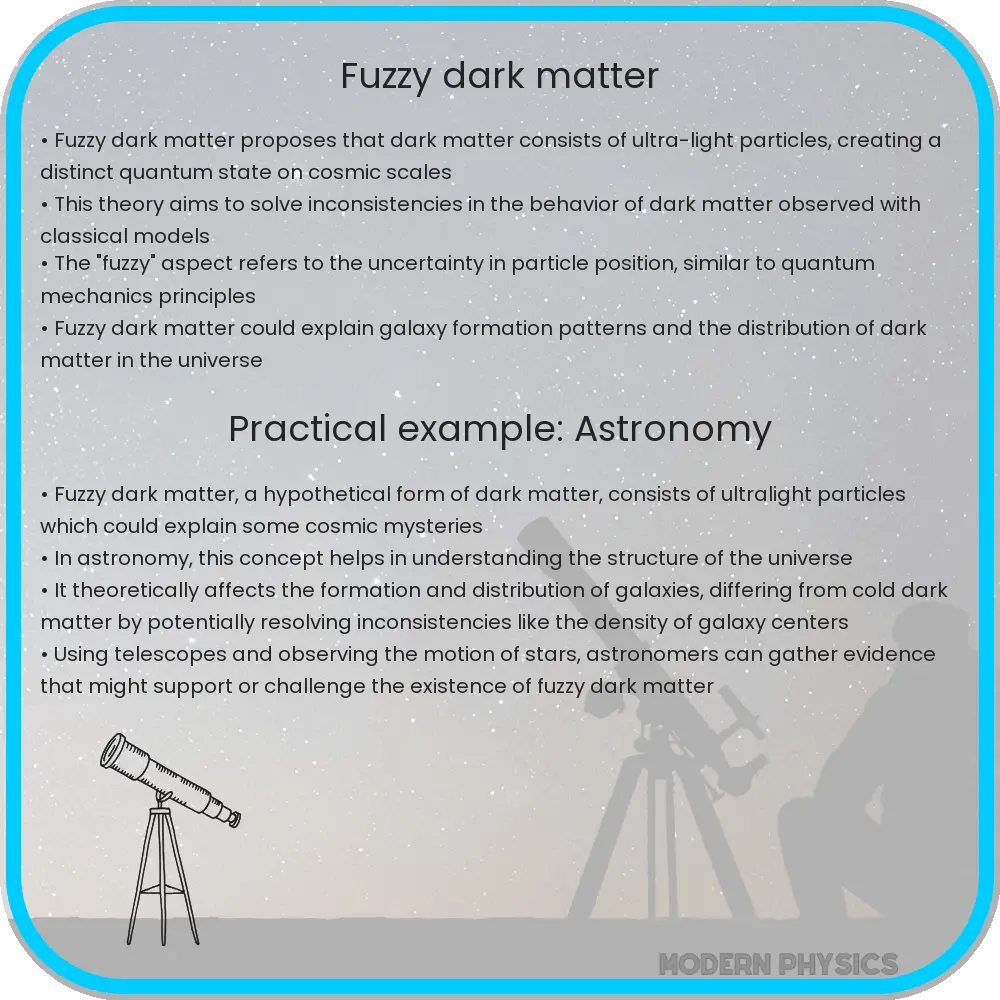
The concept of dark matter has long perplexed astronomers and physicists alike. Among the various hypotheses proposed to explain this mysterious component of the universe, the idea of Fuzzy Dark Matter (FDM) has gained traction, challenging conventional notions and suggesting a cosmos filled with unseen waves and particles. This theory represents a radical departure from cold dark matter models, suggesting instead that dark matter consists of ultralight particles, akin to a quantum wave spreading across galaxies.
The Mysteries of Dark Matter
Dark matter is a form of matter that does not emit, absorb, or reflect light, making it invisible and detectable only through its gravitational effects. Despite making up approximately 85% of the universe’s total matter, its nature remains one of the most profound mysteries in astrophysics. The introduction of Fuzzy Dark Matter proposes a solution to this enigma, positing particles with incredibly small masses — around 10-22 eV, which is far less than that of neutrinos, the lightest known particles with mass.
Theoretical Foundations and Implications
The FDM model is rooted in quantum mechanics, suggesting that dark matter could behave like a Bose-Einstein condensate — a state of matter where particles move in unison, manifesting macroscopic quantum phenomena. In this context, dark matter waves could extend over vast distances, larger than entire galaxies, making them “fuzzy” in terms of their spatial resolution. This fuzziness could explain why dark matter does not clump together in the same way as predicted by traditional cold dark matter models, offering new insights into the formation and structure of galaxies.
Current Research and Observations
Researchers are exploring the implications of Fuzzy Dark Matter through simulations and astronomical observations. One of the key predictions of FDM is the formation of solitonic cores at the centers of galaxies, where dark matter density would be significantly higher. Observations of galaxy rotations and distributions are crucial in testing these predictions, as they provide indirect evidence of dark matter’s presence and behavior. While direct detection remains elusive, advancements in technology and methodology continue to bring us closer to understanding the true nature of dark matter.
Fuzzy Dark Matter: An Enigmatic Component of the Universe
The concept of Fuzzy Dark Matter (FDM) has emerged as a fascinating subject in the field of astrophysics, challenging traditional views and proposing new theories about the composition of the universe. Unlike the cold dark matter (CDM) model, which suggests that dark matter consists of slow-moving, heavy particles, FDM proposes that dark matter is made up of ultra-light particles, with masses around 10-22 eV. This introduces a wave-like behavior on astronomical scales, a stark contrast to the particle-like nature of CDM.
One of the intriguing aspects of FDM is its potential to solve several longstanding astrophysical puzzles. For instance, it offers a plausible explanation for the ‘core-cusp’ problem, where observations of galaxy centers show a more uniform distribution of dark matter (core) rather than the sharp, dense accumulation predicted by CDM (cusp). Furthermore, FDM could account for the scarcity of small satellite galaxies around the Milky Way, a discrepancy known as the ‘missing satellites’ problem.
Research into Fuzzy Dark Matter is in its nascent stages, with scientists using both theoretical frameworks and observational data to test its viability. Theories suggest that the wave nature of FDM could interfere and form distinct patterns, unlike anything expected from conventional dark matter models. These patterns could potentially be observed and measured, offering a direct way to test the presence of FDM in the universe.
Current Challenges and Future Directions
Despite its promising aspects, FDM is not without its challenges. One of the main hurdles is the difficulty in detecting ultra-light particles, as current detection methods are primarily designed for heavier dark matter candidates. Additionally, there is still a lack of direct observational evidence specifically supporting FDM over other dark matter models.
However, the pursuit of understanding Fuzzy Dark Matter is driving technological advancements and fostering interdisciplinary collaborations. Forthcoming astronomical surveys and experiments are expected to provide more detailed data, potentially offering insights into the nature of dark matter. As technology progresses, the ability to detect or rule out FDM will become increasingly feasible.
In conclusion, Fuzzy Dark Matter represents a paradigm shift in our understanding of the universe’s unseen components. While it challenges conventional models and brings its own set of questions, it also opens new avenues for research and discovery. The mysteries of dark matter continue to perplex scientists, but the exploration of FDM adds an exciting chapter to the ongoing quest to decipher the cosmos’s hidden nature.