
Explore how Fresnel Zone Plates revolutionize optics with enhanced focus and resolution, offering a deeper understanding of advanced optical technologies.
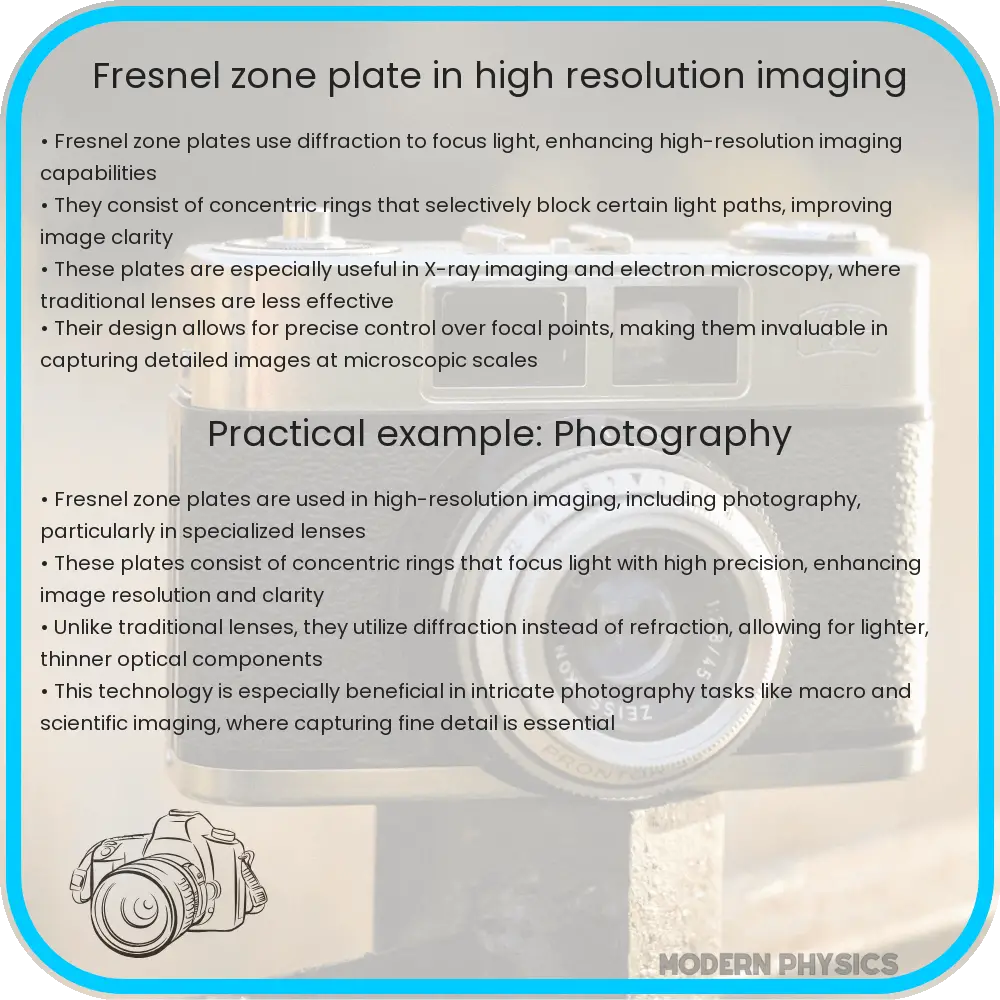
Understanding Fresnel Zone Plates in Optics
The realm of optical engineering and physics has long been fascinated by the quest for enhancing focus and resolution. Among the various methods developed, the Fresnel zone plate stands out as a significant tool. This innovative optical element leverages the principles of diffraction rather than refraction or reflection, which are commonly employed in traditional lenses and mirrors.
Principles Behind Fresnel Zone Plates
Fresnel zone plates are constructed based on the concept of constructive and destructive interference. They consist of a series of concentric rings, known as zones, which alternate between opaque and transparent. These zones are precisely designed so that light passing through them is diffracted in a manner that the waves reinforce each other at a specific focal point, enhancing the focus and resolution of the image.
Construction and Design
The design of a Fresnel zone plate is governed by a mathematical formula that determines the radius of each successive zone. The radius rn of the nth zone can be calculated using the equation rn = sqrt(nλf + (nλ)2/4), where λ is the wavelength of the light used and f is the focal length of the zone plate. This formula ensures that each zone contributes to the constructive interference at the focal point.
Applications and Advantages
Fresnel zone plates find applications in various fields, including microscopy, spectroscopy, and even in the design of compact optical systems. One of their key advantages is the ability to focus light at multiple focal points simultaneously, which is beneficial in advanced imaging techniques. Moreover, their thin, lightweight design makes them particularly attractive for applications where space and weight are critical factors.
Another significant advantage is the enhanced resolution they offer, particularly in the context of X-ray imaging and electron microscopy. Here, the ability of Fresnel zone plates to focus shorter wavelengths (such as X-rays) with high precision allows for imaging at resolutions beyond the capabilities of traditional optical elements.
Understanding Fresnel Zone Plates
Fresnel Zone Plates (FZP) stand as a cornerstone in the field of optics, offering enhanced focus and resolution capabilities beyond traditional lens systems. By exploiting the principles of diffraction, these devices harness concentric rings to focus light with remarkable precision. This innovative approach not only improves imaging quality but also paves the way for compact optical devices.
The Principle Behind Fresnel Zone Plates
The operation of Fresnel Zone Plates is grounded in the wave nature of light. Unlike conventional lenses that bend (refract) light, FZPs use diffraction to direct light towards a focal point. The plate consists of multiple concentric rings, known as zones, which alternately block and transmit light. This configuration creates constructive and destructive interference patterns, focusing light more efficiently and with higher resolution.
Applications and Advantages
- High-Resolution Imaging: FZPs are instrumental in applications requiring fine detail capture, such as microscopy and telescopic imaging.
- Compact Optical Systems: Their slim profile makes FZPs ideal for miniaturized devices, including portable cameras and optical sensors.
- Flexibility in Design: The ability to tailor FZP parameters allows for customization to specific wavelength and focusing requirements.
Enhancing Optical Performance
Advancements in fabrication techniques have significantly improved the performance of Fresnel Zone Plates. Modern methods, such as electron beam lithography, allow for the creation of zones with nanometer precision, drastically enhancing focus and resolution. Additionally, the incorporation of materials with higher refractive indices has further refined the efficiency and effectiveness of FZPs in directing light.
Conclusion
The Fresnel Zone Plate embodies a transformative approach to focusing light, combining compactness with high resolution in optical systems. Its principle, based on the diffraction of light rather than refraction, opens new avenues for optical design and application. From enhancing the capabilities of microscopes to enabling the development of thinner, more efficient lenses, FZPs offer a versatile and powerful tool in optics. As technology progresses, the potential applications of Fresnel Zone Plates continue to expand, promising even greater advancements in imaging, sensing, and beyond. The exploration of FZPs underscores the ongoing evolution in optical sciences, showcasing how innovative principles can lead to significant improvements in both performance and functionality.