
Explore the dynamics, stability, and advanced modeling of flux ropes in space weather, crucial for predicting solar flares and coronal mass ejections.
Understanding Flux Ropes: Core Dynamics, Stability, and Modeling
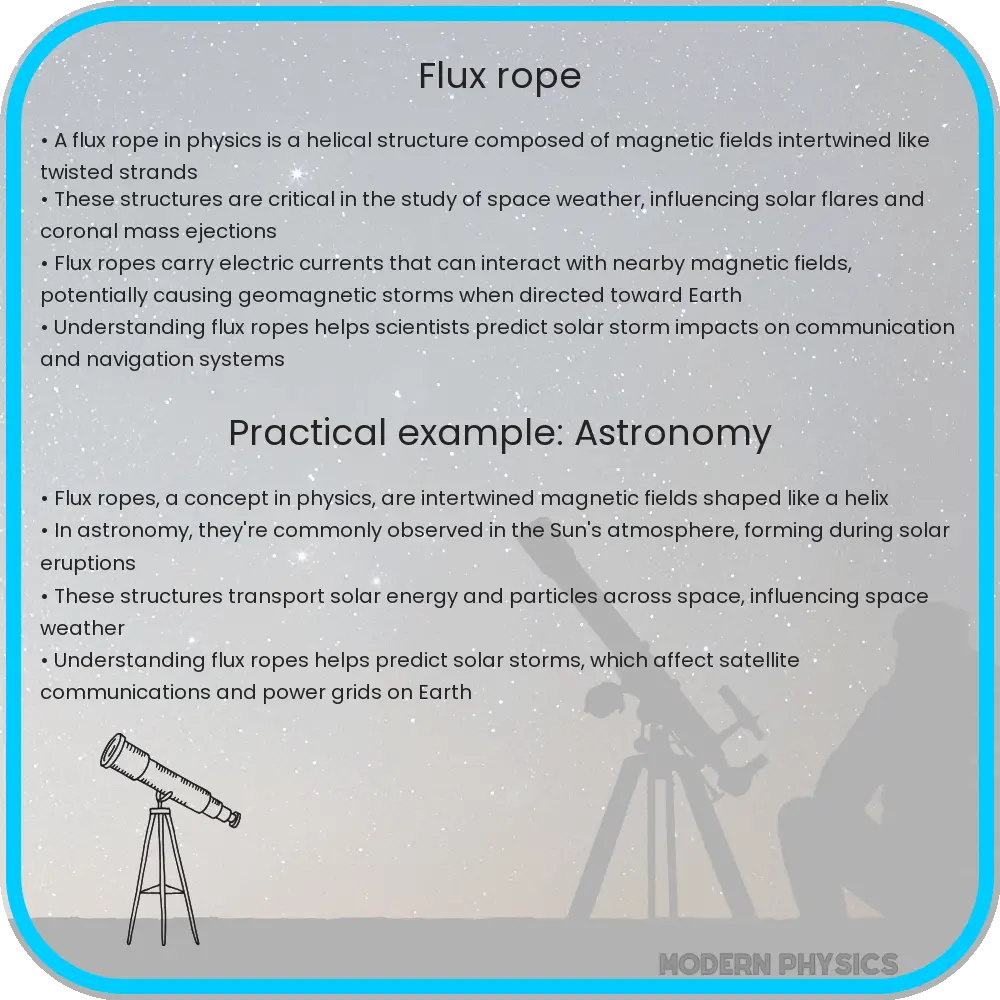
Flux ropes, significant structures in both astrophysical and laboratory plasmas, encapsulate complex magnetic phenomena that are crucial for understanding space weather events, such as solar flares and coronal mass ejections (CMEs). These twisted bundles of magnetic fields, resembling helical structures, play a pivotal role in the dynamics of the Sun’s atmosphere and the Earth’s magnetosphere. This article delves into the core dynamics, stability considerations, and modeling approaches associated with flux ropes, shedding light on their significance in plasma physics and space weather forecasting.
Core Dynamics of Flux Ropes
The core dynamics of flux ropes are governed by magnetohydrodynamics (MHD), the study of the magnetic properties and behavior of electrically conducting fluids. Flux ropes are characterized by their helical magnetic field lines, which can store a substantial amount of energy. This energy can be released abruptly, leading to explosive events like solar flares. The formation of flux ropes often involves processes such as magnetic reconnection, where opposing magnetic field lines converge, break, and reconnect, forming new configurations. This process is critical in transferring energy from the magnetic field to the plasma, contributing to the heating and acceleration of solar and stellar atmospheres.
Stability Considerations
Understanding the stability of flux ropes is essential for predicting space weather events. The stability of these structures is influenced by various factors, including their magnetic twist, the surrounding magnetic field environment, and plasma pressure. A key concept in assessing flux rope stability is the Kruskal-Shafranov limit, which predicts the critical twist necessary for maintaining stability. Exceeding this limit can lead to kink instability, causing the rope to become unstable and potentially erupt. Additionally, toroidal and poloidal magnetic field components contribute to the overall stability, with their ratio being a critical parameter in determining the onset of instability.
Modeling Flux Ropes
Accurate modeling of flux ropes is imperative for advancing our understanding of space weather phenomena. Numerical simulations using MHD equations offer insights into the formation, evolution, and dynamics of these structures. These models can simulate the complex processes involved in flux rope interactions, including magnetic reconnection and the subsequent energy release mechanisms. Advanced computational techniques, such as adaptive mesh refinement (AMR), enhance the resolution of simulations, allowing for detailed analysis of flux rope behavior under various astrophysical conditions. Through these models, researchers can predict the occurrence of solar flares and CMEs, aiding in the development of effective space weather forecasting systems.
Advanced Techniques in Flux Rope Modeling
Recent advancements in computational power and algorithms have significantly enhanced the modeling of flux ropes. Machine learning and artificial intelligence (AI) are now being integrated into traditional MHD simulations, offering new pathways for predicting and understanding flux rope dynamics. These technologies enable the analysis of vast datasets from solar observations, improving the accuracy of flux rope models. Moreover, 3D simulations have become increasingly prevalent, providing a more comprehensive view of flux rope formation and evolution. Such detailed models are crucial for studying the interaction between flux ropes and their environment, including the impact of solar wind and interplanetary magnetic fields.
Implications for Space Weather Prediction
The study of flux ropes and their stability has direct implications for space weather prediction. By understanding the conditions under which flux ropes become unstable, scientists can better forecast solar flares and CMEs. These events can have profound effects on Earth’s magnetosphere, potentially disrupting satellite operations, communication systems, and power grids. Therefore, accurate modeling and prediction of flux rope behavior are essential for mitigating the risks associated with space weather. Ongoing research and development in this field are aimed at improving the reliability of space weather forecasts, contributing to the safety and efficiency of space-based and terrestrial technologies.
Conclusion
Flux ropes are at the heart of many dynamic and explosive phenomena in the cosmos, particularly those affecting our solar system and Earth’s space weather. The core dynamics, stability, and advanced modeling of flux ropes are critical areas of research in plasma physics and astrophysics, offering insights into the mechanisms driving solar flares, CMEs, and other space weather events. Through the integration of MHD simulations, advanced computational techniques, and AI, scientists are enhancing our understanding of these complex magnetic structures. The ongoing advancements in flux rope research not only contribute to our knowledge of the universe but also play a crucial role in safeguarding our technology-dependent society from the impacts of space weather. As we continue to explore and model the intricacies of flux ropes, we pave the way for more accurate predictions and effective mitigation strategies against the challenges posed by space weather.