
Learn about flexural waves, critical in acoustics and vibration engineering, influencing the design of buildings, bridges, and musical instruments.
Understanding Flexural Waves in Acoustic Theory
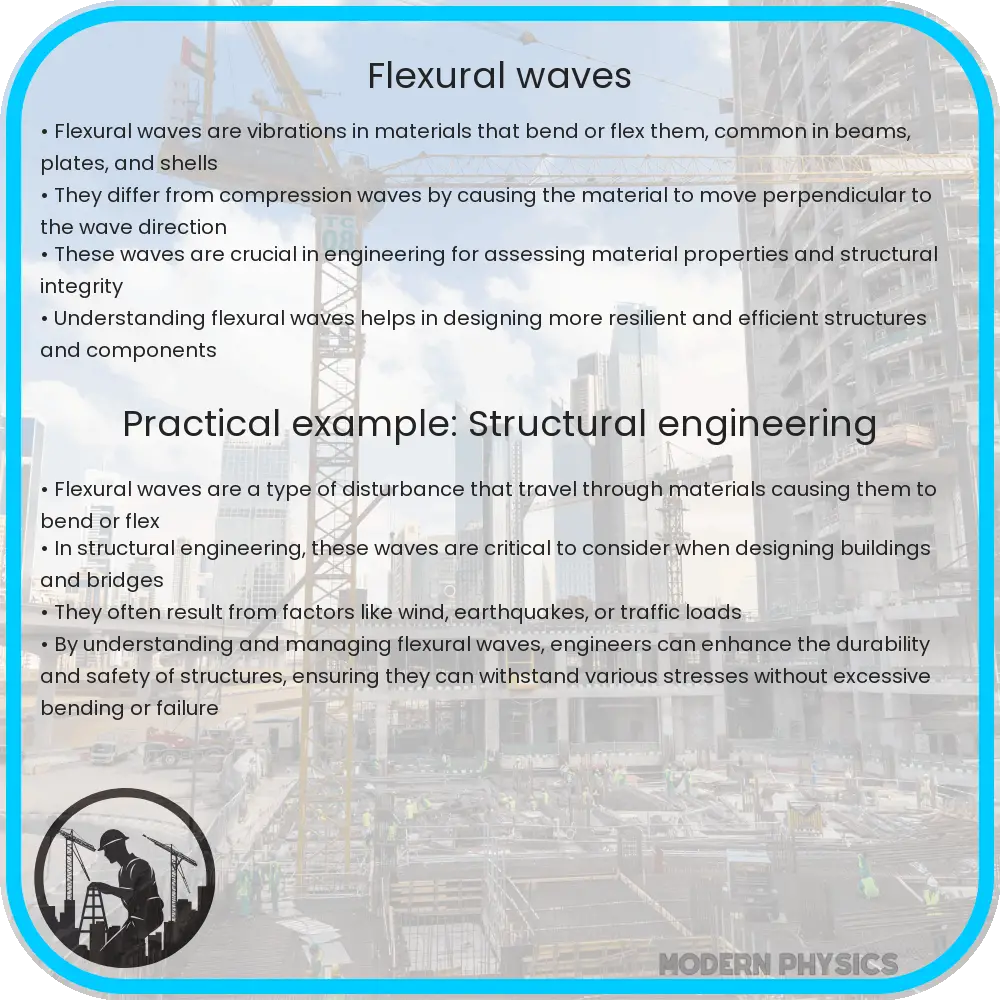
Flexural waves, often referred to as bending waves, play a critical role in the fields of acoustics and vibration engineering. These waves are types of mechanical waves that propagate through materials which have a tendency to bend when subjected to dynamic forces, rather than compressing or expanding uniformly. Understanding how flexural waves work provides insight into a wide range of engineering applications, from the construction of buildings and bridges to the design of musical instruments.
Formation of Flexural Waves
Flexural waves are generated in materials when they undergo bending due to dynamic loads. This kind of wave can be commonly observed in beams, plates, or shells. The propagation of flexural waves is governed mainly by the beam’s or object’s geometry, material properties, and the boundary conditions. The stiffness of the material and its geometric configuration significantly influence the speed and behavior of these waves.
Mathematical Description of Flexural Waves
The behavior of flexural waves can be mathematically analyzed using the Euler-Bernoulli beam theory, which is a simplification of the linear theory of elasticity. The basic wave equation for a flexural wave in a beam is defined as:
w”” – (ρA / D) * w_tt = 0
where:
- w is the lateral displacement
- ρ (rho) is the density of the material
- A is the cross-sectional area
- D is the flexural rigidity, a combination of the material’s elasticity modulus (E) and the moment of inertia (I) of the cross-section, expressed as E*I
- w”” (w with four primes) represents the fourth derivative of w with respect to the spatial coordinate (x), indicating bending
- w_tt (w with two t’s subscript) represents the second derivative of w with respect to time (t), indicating acceleration
This equation shows us that the wave’s behavior is influenced by both the material properties (like density and elasticity) and geometric properties (such as shape and size).
Propagation and Characteristics of Flexural Waves
As flexural waves propagate through a structure, they carry energy across its length and breadth, which can cause significant vibrations. One of the unique characteristics of flexural waves is their dispersion – the phenomenon where waves with different frequencies travel at different speeds. This dispersion is particularly prevalent in flexural waves due to the dependency of wave speed on frequency, a reflection of the material’s geometric and elastic properties.
Lower frequency waves tend to travel faster and with less attenuation, while higher frequencies travel slower and decay more quickly. This behavior impacts the design of various structures and devices, particularly where vibration control and sound insulation are concerned.
Applications and Importance in Engineering
The study and control of flexural waves are vital in many engineering disciplines. For example, in civil engineering, understanding the flexural wave behavior in beams and plates helps in the design of structures that withstand earthquakes. In automotive engineering, controlling flexural vibrations can reduce noise and improve the durability of vehicle components.
In the realm of musical instruments, particularly those involving strings or membranes like guitars and drums, flexural waves are essential for producing sound. The shape and material of the instrument determine how these waves propagate, thus influencing the quality and timbre of the sound produced.
On the other hand, manufacturers of noise-cancelling devices use knowledge of flexural wave properties to develop products that can effectively reduce unwanted vibrations and noise in environments ranging from industrial workplaces to residential areas.
Challenges in Managing Flexural Waves
Despite the benefits of understanding and utilizing flexural waves, there are significant challenges in managing these waves effectively. One major challenge is the precise prediction of how these waves will behave in complex materials and under varying conditions. Materials with heterogeneous properties, such as composite materials, add complexity to the propagation of flexural waves, making mathematical predictions less accurate.
Another challenge lies in the integration of vibration control technologies in existing structures, where modifications are limited by design or historical value. Engineers must often find innovative, non-intrusive ways to enhance the structural integrity and acoustic performance without compromising the original design.
Innovations and Future Directions
The field of flexural wave research is continuously evolving, with new technologies and materials being developed to better control and utilize these waves. Metamaterials, for example, offer extraordinary possibilities for controlling the propagation of mechanical waves, including flexural waves, by enabling custom wave manipulation capabilities that were not possible with traditional materials.
In addition, advancements in simulation and computational models are improving our ability to predict and analyze the behavior of flexural waves in various applications, leading to more efficient and innovative engineering solutions.
Conclusion
Flexural waves are a fundamental aspect of acoustic and vibration engineering that influence many areas of our daily lives, from the safety of the structures we inhabit to the quality of the music we enjoy. Understanding these waves allows engineers to design better materials and structures that optimize performance and control undesirable vibrations. Despite existing challenges, ongoing research and technological advancements continue to enhance our understanding and manipulation of flexural waves, promising even greater innovations in engineering applications and materials science in the future.