
Explore firehose instability in plasma dynamics, its risks, and mitigation strategies in fusion reactors and astrophysical plasmas, with future research directions.
Understanding Firehose Instability in Plasma Dynamics
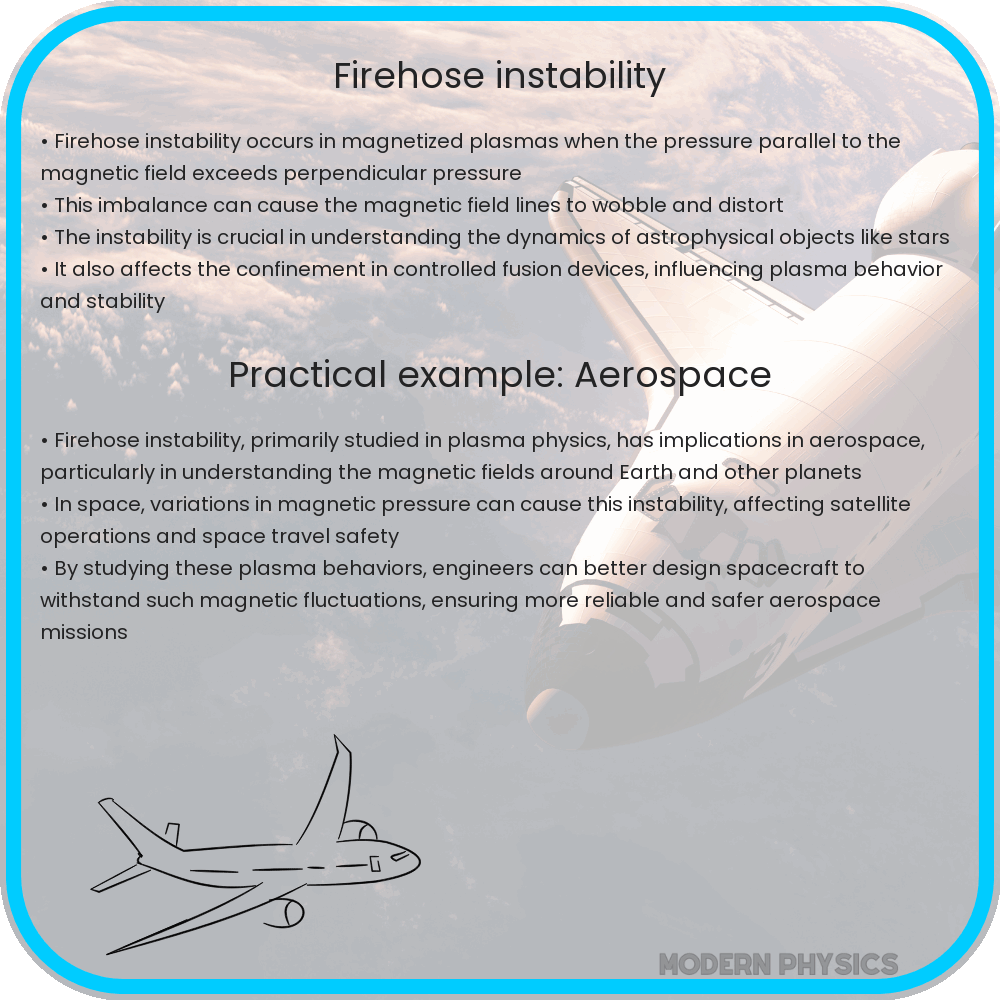
Firehose instability represents a complex phenomenon in the field of plasma physics, crucial for both astrophysical and laboratory plasmas. It arises under certain conditions, predominantly when the pressure along the magnetic field lines exceeds the perpendicular pressure by a significant margin. This imbalance triggers an instability that can lead to the deformation or disruption of the magnetic field lines, affecting plasma confinement and stability.
Risks Associated with Firehose Instability
The primary risk associated with firehose instability lies in its potential to destabilize plasma containment systems, such as those used in fusion reactors or in the confinement of astrophysical plasmas. In fusion reactors, for instance, maintaining stable plasma is critical for sustained nuclear fusion reactions. The onset of firehose instability can disrupt this stability, leading to energy losses and potentially damaging the reactor infrastructure. In space, firehose instability can influence solar wind dynamics and magnetospheric processes, affecting space weather and posing risks to satellites and other spaceborne technologies.
Mitigation Strategies
- Pressure Balancing: One approach to mitigate firehose instability involves adjusting the plasma conditions to ensure that the pressure anisotropy remains below the threshold at which instability occurs. This can be achieved through the careful control of plasma temperature and density.
- Magnetic Field Stabilization: Enhancing the strength and configuration of magnetic fields used to confine plasma can help counteract the effects of firehose instability. Techniques include the application of external magnetic fields or the modification of magnetic field geometry to improve stability.
- Advanced Diagnostics and Control Systems: Implementing real-time diagnostics and feedback control systems can provide early detection of conditions favorable to firehose instability. These systems can automatically adjust plasma parameters or magnetic field configurations to preemptively counteract the instability.
Understanding and mitigating firehose instability requires a comprehensive approach that combines theoretical physics, experimental research, and advanced engineering. By addressing this challenge, scientists and engineers can enhance the safety and efficiency of plasma-based technologies, paving the way for advancements in energy production, space exploration, and beyond.
Advanced Research and Future Directions
The ongoing research into firehose instability spans across several domains, aiming to deepen our understanding and improve our control over this phenomenon. Advanced simulation tools and computational models play a pivotal role, offering insights into the complex dynamics of plasma under various conditions. These tools help in predicting the onset of instability and in designing more effective mitigation strategies. Additionally, experimental plasma physics has made significant strides, with cutting-edge facilities able to replicate the conditions under which firehose instability occurs, allowing for real-world testing of theories and mitigation approaches.
Future directions in addressing firehose instability involve the integration of machine learning and artificial intelligence (AI) into plasma control systems. These technologies offer the potential for predictive control strategies that can dynamically adjust to the plasma conditions in real-time, potentially outpacing the onset of instabilities. Moreover, the exploration of novel materials and magnetic field configurations could lead to breakthroughs in plasma containment, further reducing the risks associated with firehose instability.
Conclusion
Firehose instability in plasma dynamics presents a significant challenge, yet also a compelling area of study within both astrophysical and laboratory settings. The risks it poses to plasma containment and stability are non-trivial but can be mitigated through a combination of pressure balancing, magnetic field stabilization, and the adoption of advanced diagnostics and control systems. The future of managing firehose instability looks promising, with ongoing research and technological advancements aimed at overcoming this challenge. By harnessing the power of computational modeling, experimental physics, and potentially AI, the field is moving towards more reliable and efficient plasma control methods. As our understanding and technology evolve, so too will our ability to harness the vast potential of plasma for a variety of applications, from energy production to space exploration, marking a significant step forward in our scientific and technological capabilities.