
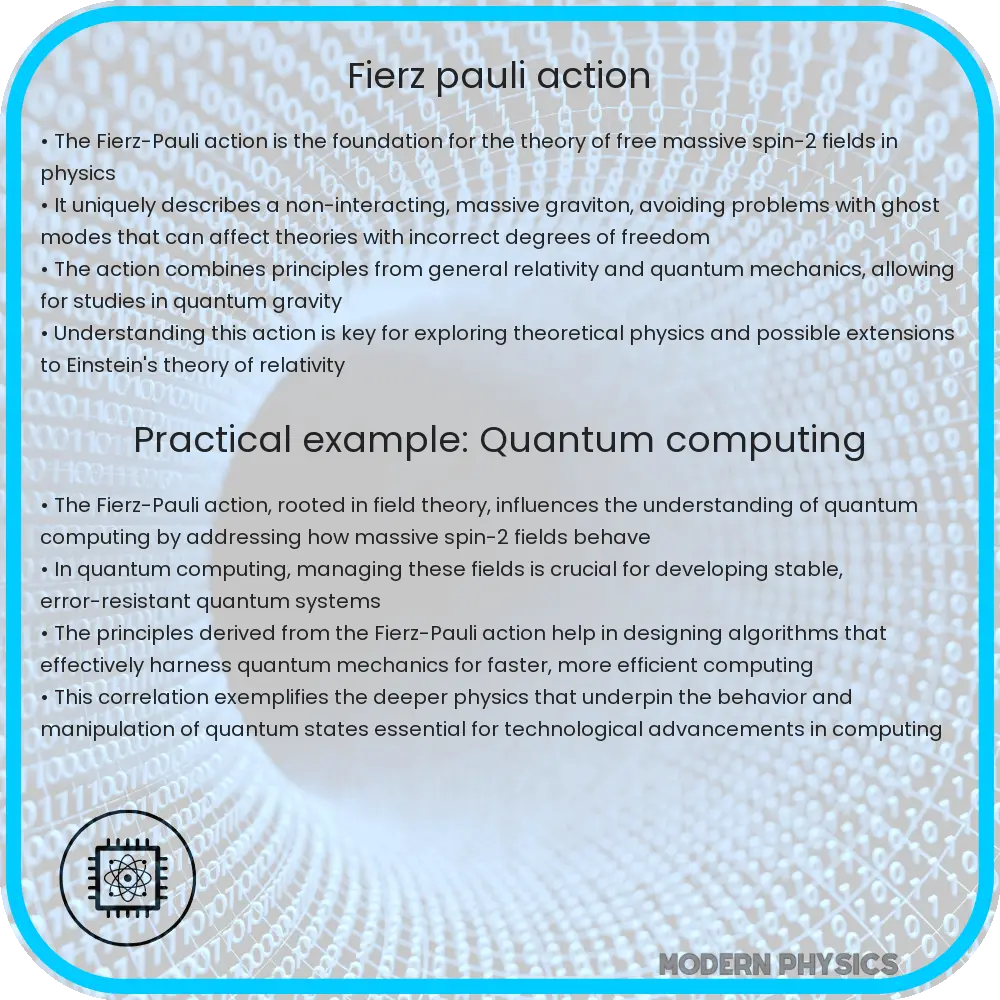
The Fierz-Pauli action describes a massive spin-2 field in flat spacetime, providing a framework for quantum gravity and enhancing understanding of Lorentz invariance.
Understanding the Fierz-Pauli Action
The Fierz-Pauli action represents a fundamental cornerstone in the study of theoretical physics, specifically in the fields of quantum theory and gravitation. It provides a pivotal framework for understanding massive spin-2 fields, which are crucial in the quantum description of gravity. This article aims to explain the Fierz-Pauli action in an accessible manner, emphasizing its implications for Lorentz invariance and how it fits into the broader context of modern physics.
Background: Quantum Theory and Gravitation
Quantum theory and Einstein’s theory of general relativity are the two pillars upon which modern physics stands. Quantum theory deals with the fundamental particles and their interactions at extremely small scales, while general relativity predominantly governs the dynamics of spacetime and gravitation at the macroscopic level. A unification of these two theories, or a formulation of quantum gravity, has been a major goal in physics. The Fierz-Pauli action is one critical step towards understanding how gravity could be described in the quantum framework.
What is the Fierz-Pauli Action?
The Fierz-Pauli action is named after Swiss physicists Markus Fierz and Wolfgang Pauli, who first proposed the formula in 1939. It describes a free, massive spin-2 field in a flat spacetime environment. The action is expressed as:
$$S = \int d^4x \left[ -\frac{1}{2} (\partial^\mu h^\nu_\nu) ( \partial_\mu h^\sigma_\sigma) + (\partial^\mu h_{\mu\nu}) (\partial^\rho h^\nu_\rho) – (\partial^\mu h_{\mu\nu}) (\partial^\nu h^\sigma_\sigma) + \frac{1}{2} (\partial_\mu h_{\nu\rho}) (\partial^\mu h^{\nu\rho}) – \frac{m^2}{2} (h_{\mu\nu} h^{\mu\nu} – h^\mu_\mu h^\nu_\nu) \right],$$
where \( h_{\mu\nu} \) is the spin-2 field, \( \partial^\mu \) denotes partial derivatives, and \( m \) is the mass of the spin-2 particle. The elegant combination of these terms ensures that the theory respects the principles of special relativity—chiefly, Lorentz invariance—while introducing mass to the gravitational field.
Lorentz Invariance and Its Importance
Lorentz invariance is a key principle in the theory of relativity, asserting that the laws of physics are the same for all observers, irrespective of their relative motion. In the context of the Fierz-Pauli action, maintaining Lorentz invariance ensures that the theory does not prefer any particular state of motion or direction in spacetime, an essential feature for any theory aiming to describe universal gravitation.
The inclusion of mass in the Fierz-Pauli theory introduces interesting complexities compared to the massless theories. For instance, the mass terms break gauge invariance, which is a symmetry property of the field equations in general relativity. This breaking of gauge invariance in the massive case leads to what is known as the van Dam-Veltman-Zakharov (vDVZ) discontinuity, a surprising theoretical result indicating different physical predictions of massless and massive theories in the limit as mass approaches zero.
Challenges and Implications of the Fierz-Pauli Action
While the Fierz-Pauli action marks a significant breakthrough in theoretical physics, it is not without challenges. One major issue is the aforementioned vDVZ discontinuity, which suggests potential inconsistencies in the physical predictions as mass becomes infinitesimally small. These inconsistencies are particularly pronounced when comparing the results with classical tests of general relativity, such as the bending of light or the precession of planet orbits.
To address these challenges, further modifications and extensions of the Fierz-Pauli action have been proposed. One prominent development is the introduction of nonlinear terms to the action, leading to what are known as “massive gravity theories. These theories attempt to rectify the shortcomings of the Fierz-Pauli action by naturally incorporating nonlinear interactions, thus aiming to recover consistency with general relativity at long distances.
The Role of the Fierz-Pauli Action in Modern Physics
Despite its limitations, the Fierz-Pauli action remains a crucial element in the ongoing quest to merge quantum mechanics and general relativity into a single cohesive framework. It serves as a foundational prototype for exploring more complex theories of quantum gravity and provides essential insights into the behavior of massive gravitational fields. The exploration of these fields significantly contributes to our understanding of the universe, particularly in the study of dark matter and energy, which continue to elude complete scientific explanation.
The development of the Fierz-Pauli action and its subsequent modifications highlight the iterative nature of scientific progress. Each theoretical advancement brings new questions and challenges, propelling further research and deeper understanding.
Conclusion
The Fierz-Pauli action, introduced by Markus Fierz and Wolfgang Pauli, represents a seminal step in the theoretical description of massive spin-2 fields in a quantum framework. By integrating mass into the field equations while maintaining Lorentz invariance, this action paves the way for more comprehensive theories that attempt to unify the macroscopic laws of general relativity with the microscopic rules of quantum mechanics.
Though faced with challenges like the vDVZ discontinuity, the tenets of the Fierz-Pauli action ignite continual theoretical development, leading towards the resolution of these discrepancies and enhancing our understanding of the universe’s deep-rooted principles. As physics strides forward, the lessons learned from studying the Fierz-Pauli action will undoubtedly be vital in unraveling the complexities of gravity, quantum mechanics, and ultimately, our cosmos.