
Learn about Fiber Reinforced Polymer (FRP), its composition, types, properties, and diverse applications in various industries.
Understanding Fiber Reinforced Polymer: Strong, Lightweight & Durable
Fiber Reinforced Polymer (FRP) is a composite material made from a polymer matrix reinforced with fibers. This sophisticated material is becoming increasingly popular due to its high strength-to-weight ratio and excellent durability, making it a favored choice in industries ranging from aerospace to civil engineering. In this article, we’ll delve into the basics of FRP, exploring its composition, types, properties, and applications.
Composition of Fiber Reinforced Polymer
Fiber Reinforced Polymers consist of two main components: the polymer matrix and the reinforcing fibers. The polymer matrix, often made from thermosetting resins like epoxy, polyester, or vinyl ester, acts as a binder that holds the reinforcing fibers together and distributes the load among them. The fibers, which commonly include materials like glass, carbon, or aramid, provide the strength and stiffness to the composite. The unique arrangement of these fibers within the polymer matrix can be tailored to meet specific engineering requirements, enhancing the material’s overall mechanical properties.
Types of Fiber Reinforced Polymer
- Glass Fiber Reinforced Polymer (GFRP): Known for its robustness and cost-effectiveness, GFRP is widely used in building and automotive fields. Glass fibers offer a good balance of strength and flexibility.
- Carbon Fiber Reinforced Polymer (CFRP): Noted for its exceptionally high stiffness and strength, CFRP is typically employed in demanding engineering applications, such as aerospace and high-performance automotive components.
- Aramid Fiber Reinforced Polymer (AFRP): Famous for its outstanding impact resistance and tensile strength, AFRP is often utilized in military and aerospace sectors for ballistic protection.
Properties of Fiber Reinforced Polymers
FRP composites exhibit a range of valuable properties that make them suitable for various applications. Some of these key properties include:
- High Strength-to-Weight Ratio: FRP composites are stronger per weight than many metals, making them ideal for lightweight constructions.
- Corrosion Resistance: Unlike metals, FRP does not corrode, making it suitable for harsh environmental conditions including exposure to chemicals and moisture.
- Flexibility in Design: The properties of FRP can be customized according to specific needs by changing the type, orientation, and arrangement of the fibers.
Applications of Fiber Reinforced Polymers
Due to their advantageous properties, FRPs are used in numerous fields. Here are a few applications:
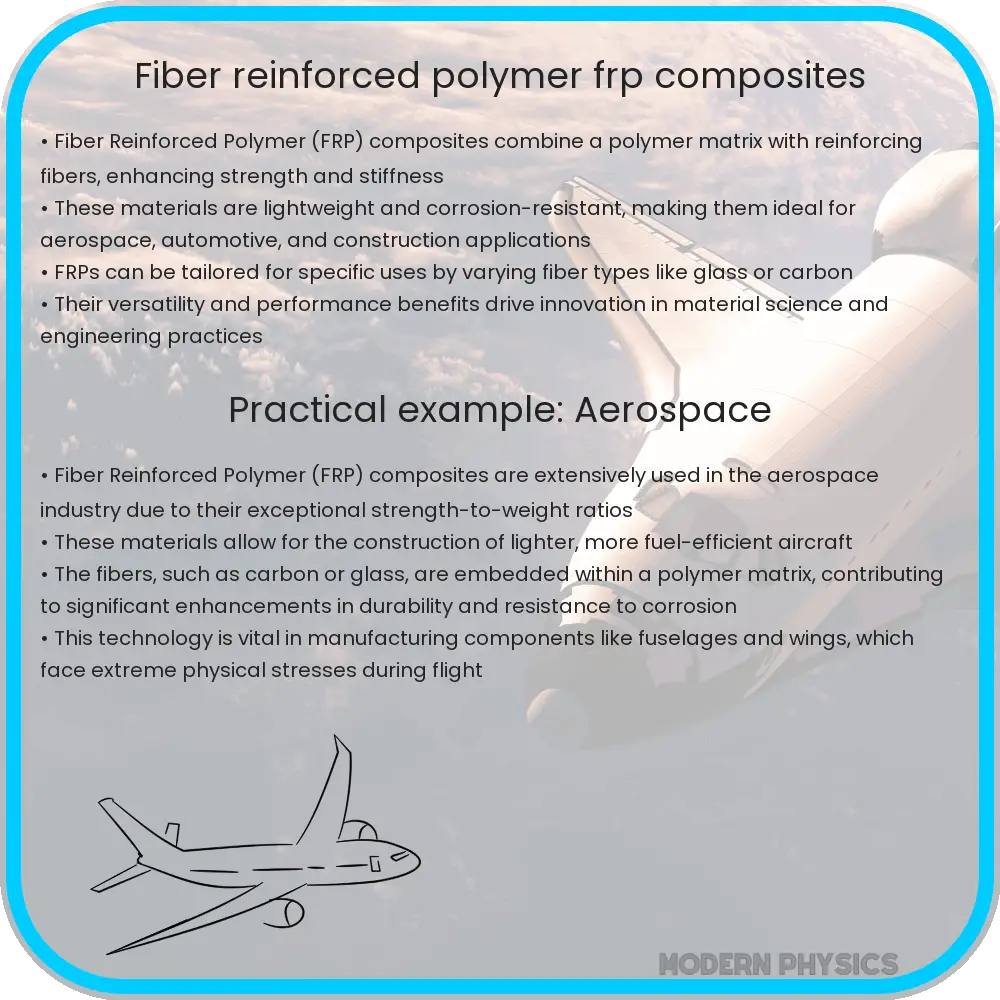
- Aerospace: FRP composites are used in the manufacture of structural components for aircraft and spacecraft because they combine lightness with the ability to withstand the stresses of flight and space conditions.
- Automotive: In the automotive industry, FRPs help in reducing the weight of vehicles, which can lead to improved fuel efficiency and performance.
- Civil Engineering: In civil engineering, FRP is applied in the construction of bridges, buildings, and roads due to its strength and resistance to environmental decay.
Advancements and Future Prospects in FRP Technology
As research and technology advance, the potential for improving and expanding the applications of FRPs continues to grow. Innovative manufacturing techniques such as 3D printing are being explored to create more complex and efficient structures. Furthermore, the development of new polymer matrices and reinforcement fibers could lead to even lighter, stronger, and more resilient FRP composites. This progress promises to open up new avenues in fields as diverse as renewable energy, where FRPs could be used to create more efficient wind turbine blades, and in medicine for developing lightweight prosthetics that offer better functionality and comfort.
Environmental Impact and Sustainability Concerns
Despite the benefits, the environmental impact of FRPs, particularly the non-biodegradability of many resins and fibers, poses sustainability challenges. However, ongoing research focuses on developing recyclable FRPs and bio-based resins that can help mitigate these environmental concerns. These sustainable alternatives aim to maintain the beneficial_properties_of FRPs while reducing the ecological footprint.
Conclusion
Fiber Reinforced Polymer composites represent a significant advancement in material science, offering a combination of strength, lightweight, and versatility that is unmatched by many traditional materials. From aerospace to civil engineering, the benefits of FRPs capitalize on their high strength-to-weight ratios and corrosion resistance. With ongoing developments in technology and a conscientious approach towards environmental sustainability, FRPs hold a promising future in not only continuing to meet the demands of current industries but also in paving the way for new applications that benefit society in diverse and substantial ways. As we continue to innovate and improve upon these materials, their potential to revolutionize industries and improve daily life remains vast and inspiring.