
Equatorial Kelvin Waves are oceanic and atmospheric waves vital for understanding climate patterns like El Niño, influencing global weather through their dynamics along the equator.
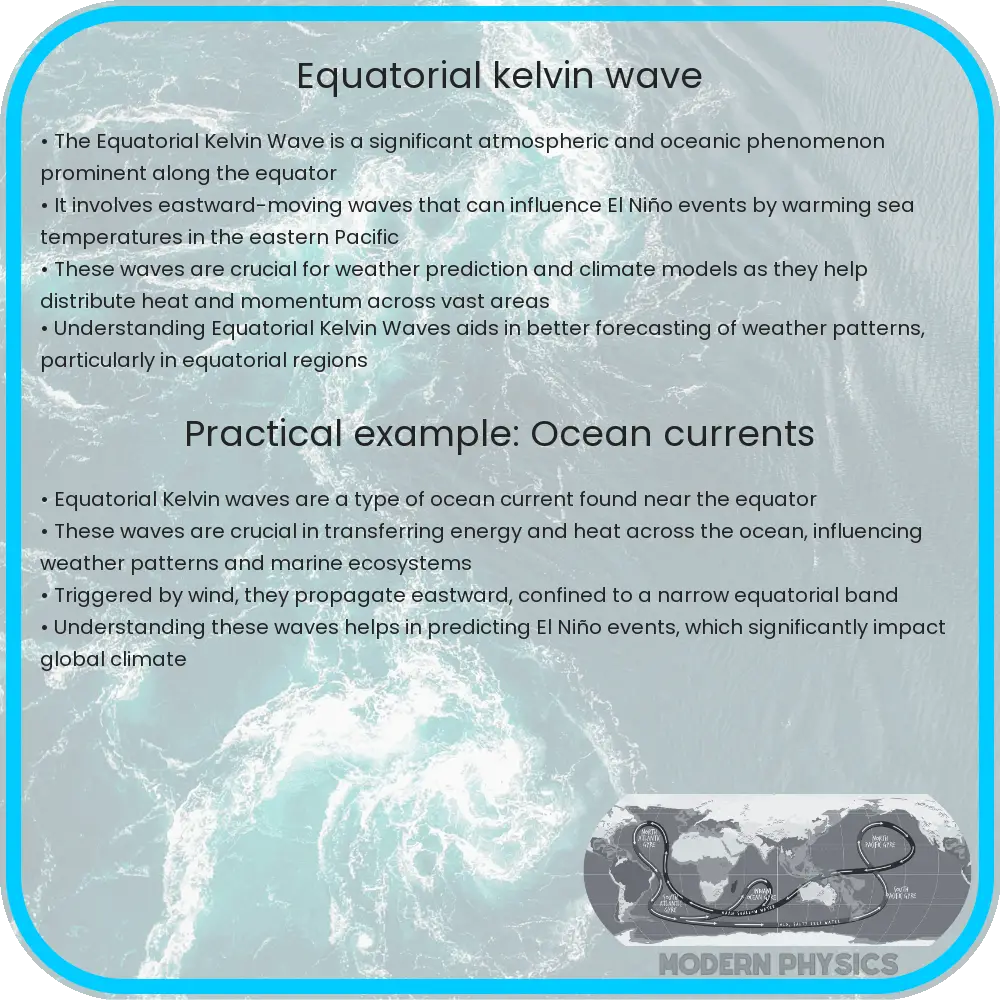
Understanding Equatorial Kelvin Waves
Equatorial Kelvin Waves are an intriguing phenomenon in the dynamics of the Earth’s atmosphere and oceans, playing a significant role in climate systems, particularly in the tropical regions. Primarily observed in the Pacific and Atlantic Oceans, these waves are vital in understanding and predicting climate patterns such as the El Niño-Southern Oscillation (ENSO).
What are Equatorial Kelvin Waves?
Equatorial Kelvin Waves are a type of oceanic and atmospheric wave confined to the equatorial region. They are characterized by their propagation along the equator, moving from west to east. In the ocean, these waves manifest as a coherent structure in the upper layer, influencing sea surface temperature and currents. Atmospheric Kelvin Waves are similar but occur in the tropical atmosphere, affecting wind and pressure patterns.
The Dynamics of Equatorial Kelvin Waves
The fundamental mechanism behind Equatorial Kelvin Waves lies in the balance of pressure gradients and the Coriolis effect, a force arising from the Earth’s rotation which affects the movement of masses such as air and water. On the equator, the Coriolis force is zero; however, its effects are felt slightly off the equator, guiding the waves along it.
These waves are categorized as gravity waves, meaning they attempt to restore equilibrium if displaced from their position. This restoration is facilitated by gravity and pressure gradients, guiding the wave’s energy along the equatorial belt. The general equation describing these waves is:
vt + c*hx = 0
where v is the perturbation velocity, h is the thickness of the upper ocean layer affected by the wave, c* is the phase speed of the wave, and the subscripts t and x refer to time and spatial derivatives along the equator, respectively.
Climate Impact of Equatorial Kelvin Waves
Equatorial Kelvin Waves can have profound impacts on global weather and climate patterns. In the ocean, these waves contribute to the regulation of sea surface temperatures, which is crucial for marine life ecosystems and the operation of global ocean currents. Notably, their role in phenomena like El Niño involves major shifts in weather patterns across the globe, including altered precipitation rates, droughts, or floods in different regions.
Atmospheric Equatorial Kelvin Waves contribute to the Madden-Julian Oscillation (MJO), which significantly influences weather variability. The MJO is a major element in sub-seasonal weather forecasting, which can affect planning in agriculture, disaster management, and water resources.
Prediction of Equatorial Kelvin Waves
Predicting Equatorial Kelvin Waves is key in forecasting climate events, particularly ENSO cycles. Advanced models and observational data are utilized to understand and anticipate these waves. Typically, satellite imagery, buoy data, and oceanic sensors provide critical data that feed into dynamic models. These models, which integrate atmospheric and oceanic conditions, allow scientists to predict the development and effects of these waves weeks to months in advance.
Recent advancements in computational power and data analysis techniques have greatly enhanced the accuracy of these predictions, facilitating better preparedness for the associated weather and climate impacts.
Real-World Examples
A prime example of the significant impact of Equatorial Kelvin Waves is the 1997-1998 El Niño event, one of the strongest on record. These waves were instrumental in the rapid warming of central and eastern Pacific Ocean waters, which triggered extreme weather conditions worldwide, ranging from severe droughts in Indonesia to devastating floods in South America.
Understanding and monitoring Equatorial Kelvin Waves not only aids in predicting such events but also helps in mitigating the adverse effects on ecosystems, economies, and communities globally.
Technological Tools for Monitoring Kelvin Waves
Technological advancements have revolutionized the monitoring of Equatorial Kelvin Waves. The deployment of Argo floats, which are autonomous ocean sensors, provides real-time data critical for understanding ocean dynamics. These floats measure temperature and salinity at different depths, giving insights into the wave propagation mechanisms beneath the sea surface.
Remote sensing technologies, such as radar altimetry satellites, are also employed to track the waves’ surface signatures. These satellites can detect slight variations in sea surface height which correspond with the depth changes induced by Kelvin Waves, offering another layer of valuable data for climate scientists.
Educational and Research Implications
The study of Equatorial Kelvin Waves is not only important for scientific and predictive purposes but also plays a crucial role in educational contexts. Universities and research institutes around the world offer courses and seminars focusing on these waves, highlighting their importance in oceanography and climate science. This educational focus helps cultivate a new generation of scientists equipped with the knowledge to tackle climate-related challenges.
Furthermore, ongoing research into Kelvin Waves fosters international collaboration among scientists. This collaborative effort is crucial for advancing our understanding and developing better predictive models that can effectively anticipate climate anomalies tied to these waves.
Conclusion
Equatorial Kelvin Waves are a pivotal component of the Earth’s climatic system, influencing weather patterns across the globe. Understanding these waves helps not only in predicting natural events such as El Niño but also in mitigating their effects on ecosystems and human societies. The continuous advancement in technology and science plays a crucial role in monitoring these waves, improving predictions, and educating future generations of climate scientists.
With better predictive abilities, nations can prepare more effectively for the adverse impacts of climate anomalies, ensuring that the global community is better equipped to handle natural variability. The study and monitoring of Equatorial Kelvin Waves are, therefore, vital pursuits that hold the key to unlocking further secrets of our planet’s climate system and enhancing our ability to live sustainably within it.