
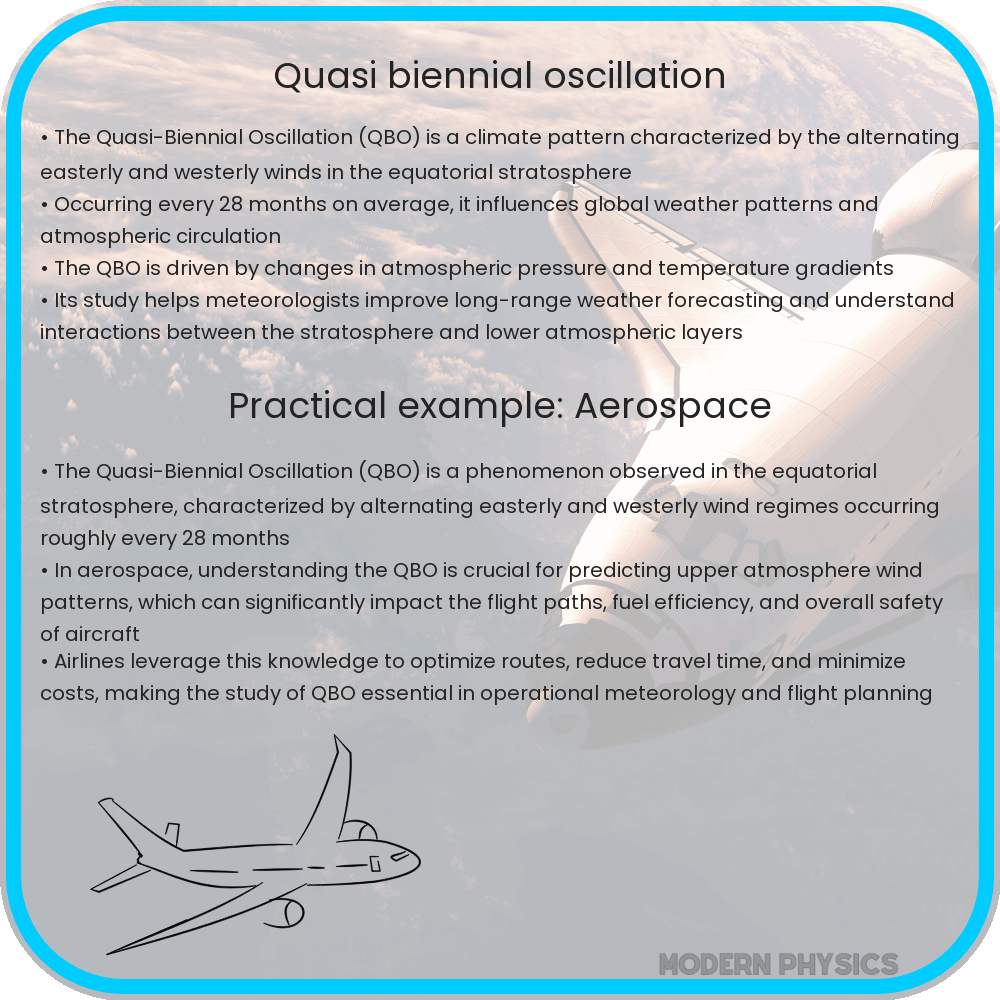
The Quasi-Biennial Oscillation (QBO) is a regular variation in equatorial stratosphere wind direction, influencing climate and weather patterns.
Understanding the Quasi-Biennial Oscillation: An Essential Climate Phenomenon
The Quasi-Biennial Oscillation (QBO) is a captivating pattern in Earth’s climate system, manifesting as a regular variation in the wind direction within the equatorial stratosphere. Typically, these wind patterns alternate between easterlies and westerlies approximately every 28 to 29 months. Understanding the QBO is crucial due to its significant impact on atmospheric conditions, including its potential influence on the ozone layer, weather patterns, and prediction models.
Climate Impact of the Quasi-Biennial Oscillation
The primary climate impact of the QBO is its interaction with the stratospheric temperature and circulation patterns. It strongly influences the transport of ozone, which plays a vital role in protecting Earth from harmful ultraviolet (UV) radiation. During the westerly phase of the QBO, there is generally an increased downward mixing of ozone-rich air. Conversely, the easterly phase often leads to diminished ozone in the equatorial stratosphere. This nuanced interaction underscores the importance of the QBO in climate studies and atmospheric chemistry.
Furthermore, the QBO can modulate the behavior of other climate phenomena such as the El Niño-Southern Oscillation (ENSO) and the monsoon systems. It has been observed that certain phases of the QBO can either enhance or suppress the effects of these significant climatic events, thus impacting global weather patterns in profound ways.
Predicting the Quasi-Biennial Oscillation
Predicting the timing and intensity of the QBO is a challenging aspect of atmospheric science. The oscillation is driven by waves generated by tropical thunderstorms that propagate upwards and interact with the background wind in the stratosphere. These interactions can vary significantly, influenced by factors such as the global temperature distribution and other evolving weather patterns. Advanced climate models and observational data are continually refined to improve the accuracy of QBO predictions.
- Modeling Techniques: Current approaches involve using sophisticated computer models that simulate the atmospheric conditions leading to the generation of the QBO.
- Satellite Data: Observations from satellites provide critical data on wind patterns and atmospheric temperature, essential for monitoring the current state of the QBO and validating models.
- Historical Data Analysis: Long-term climate records are analyzed to understand past behaviors of the QBO and refine the models based on observed patterns and anomalies.
These predictive efforts are vital for anticipating changes in weather extremes, such as tropical cyclones, droughts, and heavy rainfall events, especially in vulnerable tropical regions.
Patterns of the Quasi-Biennial Oscillation
Examining the patterns of the QBO reveals a complex interaction of atmospheric dynamics. The oscillation exhibits a typical cycle ranging from 24 to 30 months, though significant variability exists in both the duration and intensity of each phase. The amplitude and phase of the QBO can be influenced by broader climatic changes, including global warming and volcanic eruptions.
Recent studies suggest that climate change could be impacting the regularity and characteristics of the QBO, potentially leading to altered interactions with other weather and climate systems. Such shifts could have wide-ranging effects on global climate patterns, emphasizing the need for ongoing research and monitoring.
The detailed study and understanding of the Quasi-Biennial Oscillation is not just an academic pursuit but a necessity for better weather prediction and climate adaptability strategies worldwide. As researchers continue to decode the complexities of this phenomenon, it remains a key focus in the field of atmospheric sciences.
The Role of Technology in Understanding QBO
Technological advancements have significantly enhanced our ability to study and understand the Quasi-Biennial Oscillation. Innovations in remote sensing, satellite communications, and data analysis tools allow scientists to track atmospheric changes with unprecedented precision. For instance:
- Supercomputing: High-performance computers enable the processing of vast amounts of climate data, facilitating detailed simulations of the QBO and its interactions with other atmospheric elements.
- Remote Sensing: Advanced sensors on satellites provide real-time data on wind, temperature, and humidity, which are essential for tracking the QBO’s development and movement.
- Machine Learning: Artificial intelligence and machine learning techniques are increasingly employed to analyze complex data sets and predict future patterns of the QBO more accurately.
These technological tools are crucial for enhancing our predictive capabilities and for formulating effective strategies to mitigate the impacts of climate variability.
Educational and Policy Implications
Understanding the Quasi-Biennial Oscillation has important implications not only for scientists and researchers but also for educators and policymakers. Education initiatives that include climate science can benefit from simplified explanations of the QBO, making the concept more accessible to students and the public. This knowledge can lead to greater awareness and more informed decisions regarding climate-related policies.
Policymakers can use insights gained from QBO studies to draft more effective climate adaptation and mitigation strategies, particularly in regions heavily affected by its impacts. Ensuring that these strategies are based on sound science will be crucial in addressing the challenges posed by climate change and atmospheric phenomena.
Conclusion
The Quasi-Biennial Oscillation is more than just an interesting quirk of our planet’s atmosphere; it is a pivotal component of the Earth’s climate system with substantial impacts on global weather patterns and climate variability. Through continued research, improved predictive models, and effective use of technology, our understanding of the QBO can significantly enhance global weather forecasts and climate change mitigation efforts. By integrating this knowledge into educational frameworks and policy making, we can better prepare for and adapt to the ever-changing nature of our environment, ensuring a resilient response to the challenges of global climate dynamics.