
Explore how physics principles play a crucial role in environmental monitoring, from air and water quality assessments to remote sensing and seismology.
Understanding the Role of Physics in Environmental Monitoring
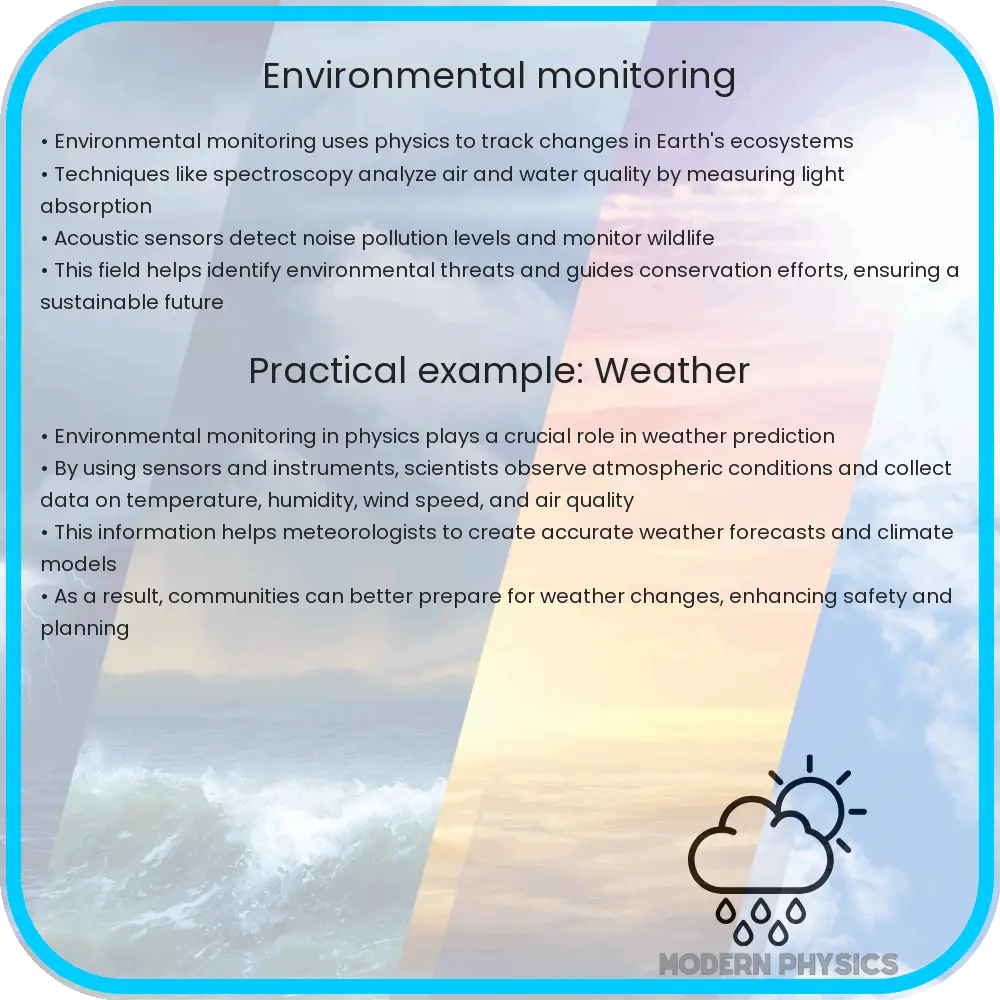
Environmental monitoring is a critical scientific process used to understand and protect our natural surroundings. It involves the collection of data about air, water, and soil to analyze changes over time, helping to detect patterns, predict future conditions, and guide policy decisions. At the heart of environmental monitoring lies a range of physics principles that enable precise measurement and analysis of environmental parameters.
Tools and Techniques in Environmental Monitoring
Various tools and techniques in environmental monitoring utilize physics to accurately assess environmental conditions. For example, spectroscopy, a technique based on the interaction of light with matter, is essential for analyzing the composition of atmospheric gases and pollutants. This method can reveal the concentration of gases like carbon dioxide and methane, crucial for understanding and mitigating climate change.
- Remote Sensing: This technique uses satellites and drones equipped with sensors to collect data from large and inaccessible areas. The physics of electromagnetic waves is fundamental in remote sensing, allowing for the detailed observation of Earth’s surface changes over time.
- Seismology: Used primarily to study earthquakes, seismology relies on the principles of wave propagation through different media to detect and analyze the movement of Earth’s crust. Instruments like seismographs record the waves generated by earthquakes, providing data crucial for disaster preparedness and mitigation.
The Physics Behind Air Quality Monitoring
Air quality monitoring is a perfect example of applied physics in environmental science. Instruments used in monitoring, such as particulate matter sensors, work on principles like light scattering and absorption. When airborne particles pass through a laser beam inside the sensor, they scatter light in patterns that can be analyzed to determine the concentration of particulates in the air.
Another method involves the use of chemiluminescence, a process where certain chemical reactions produce light, the intensity of which can be measured to quantify the presence of specific pollutants like nitrogen oxides. This understanding helps in crafting strategies to reduce air pollution, demonstrating how physics tools directly aid environmental health and safety.
Application of Physics in Water Quality Assessment
Water quality assessment uses several physics-based technologies to ensure the safety and cleanliness of water bodies. Turbidimeters, for example, measure the turbidity of water by detecting the amount of light that is scattered by suspended particles in the water. This is crucial in evaluating the water’s suitability for various uses such as drinking, cooking, and irrigation.
Moreover, acoustic Doppler current profilers (ADCPs) use the Doppler effect to measure water flow and sediment transport. By emitting sound waves and analyzing how they bounce back from particulates within the water, ADCPs provide insights into the velocity and direction of water currents, informing water management strategies and flood prediction models.
Challenges and Innovations in Physics for Environmental Monitoring
While the application of physics in environmental monitoring has significantly advanced our capabilities, it also presents unique challenges. One major challenge is the development of sensors and devices that can withstand harsh environmental conditions while maintaining accuracy and reliability. Innovations such as nanotechnology and advanced materials are playing critical roles in overcoming these obstacles. For instance, sensors made with nanomaterials can detect pollutants at incredibly low concentrations and are more resistant to corrosive environments.
Another hurdle is the data management and analysis from the countless sensors deployed in various locations. Advances in data science and computer modeling have begun to address these challenges, allowing for more precise predictions and effective environmental policies based on complex physical data.
- Integration of AI and Physics: Artificial intelligence (AI) is being increasingly integrated with physical monitoring tools to enhance data processing and interpretation. AI algorithms can analyze vast amounts of data quickly, identifying trends and anomalies that might be missed by human analysts.
- Long-term Sustainability: Developing sustainable monitoring systems that require minimal maintenance and are energy efficient is crucial. Solar-powered sensors and passive monitoring systems are examples of how physics is helping create environmentally friendly technologies that are sustainable in the long term.
Conclusion
The role of physics in environmental monitoring is indispensable and ever-evolving. As we face global challenges such as climate change and environmental degradation, the principles of physics provide the tools needed to not only understand but also mitigate these issues. From the microscale of nanoparticles to the macroscale of satellite imaging, physics enables precise and critical insights into the state of our environment.
The integration of newer technologies like AI and nanotechnology with traditional physics-based methods is opening up new frontiers in environmental science. These advancements not only increase the accuracy and efficiency of data collection and analysis but also ensure the sustainability of monitoring practices. As these technologies continue to evolve, their integration into environmental monitoring promises a future where we can better predict, understand, and manage the natural world around us, ensuring a healthier planet for future generations.