
Environmental health physics focuses on protecting health and environment from radiation effects, integrating physics, biology, and engineering principles.
Understanding Environmental Health Physics
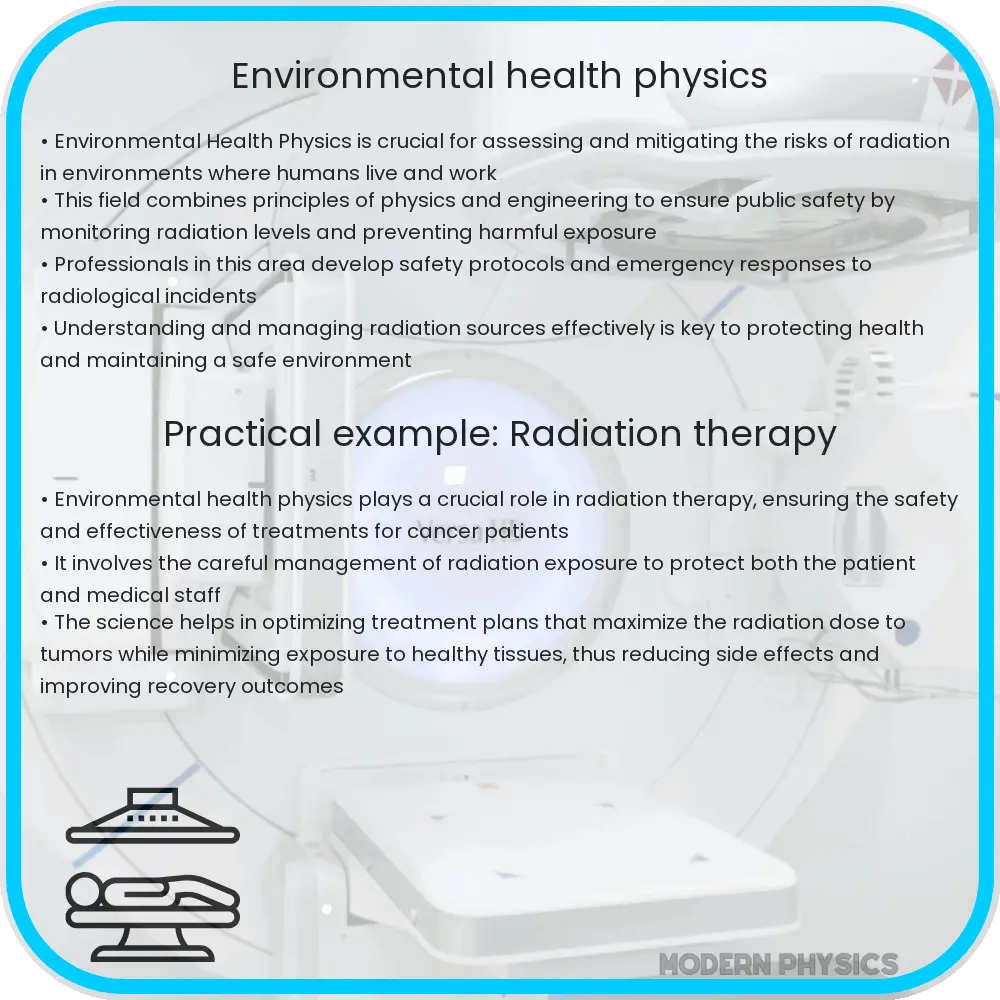
Environmental health physics, also known as radiation protection, is a vital field that combines elements of physics, biology, engineering, and environmental science to safeguard human health and the environment from the potentially harmful effects of radiation. The goal of this discipline is to manage and control exposures to radiation in a way that minimizes risks while maximizing technological and medical benefits.
Safety Measures and Regulations
Professionals in the field of environmental health physics implement a variety of safety measures to protect both individuals and ecosystems from radiation exposure. These measures are guided by three fundamental principles:
- Justification: Any decision that could increase exposure to radiation must have a clear benefit that outweighs the potential harm.
- Optimization: Radiation exposures must be kept as low as reasonably achievable (ALARA principle), considering economic and societal factors.
- Dose Limitation: Exposures to radiation must not exceed prescribed limits set by regulatory bodies, such as the International Commission on Radiological Protection (ICRP) or the U.S. Nuclear Regulatory Commission (NRC).
This framework helps ensure that applications of radioactive materials and ionizing radiation in medical settings, industrial processes, and even research are conducted safely and responsibly.
The Role of Radiation in Environment Management
Radiation plays a crucial role in several environmental management strategies. For example, it is employed in:
- Sterilization of pollutants: Radiation can be used to break down hazardous contaminants in air, water, and soil, making areas safer for human activity.
- Control of invasive species: Sterilization via radiation can prevent the reproduction of invasive species, protecting native ecosystems.
- Radiotracer studies: Radiotracer techniques involve the introduction of radioactive isotopes to track movement and distribution of substances within the environment. This can be crucial for understanding patterns such as water flow in rivers or nutrient uptake by plants.
Each application requires careful planning and execution to maximize benefits while minimizing negative impacts on the environment and human health.
Radiation Monitoring and Environmental Sustainability
Continuous monitoring of environmental radiation ensures that changes in levels are promptly addressed to prevent adverse effects. This involves the use of sophisticated detection and measurement equipment that can analyze radiation types and intensities in different environments. Such monitoring is integral to ensuring the sustainability of ecosystems that might be affected by natural or anthropogenic sources of radiation.
Environmental health physics professionals play a key role in the development of sustainable practices by advising on and implementing strategies that align with long-term ecological health and regulatory compliance. Their expertise ensures that the beneficial uses of radiation in society do not compromise the environment or human health.
Educational and Career Opportunities in Environmental Health Physics
For those interested in pursuing a career in environmental health physics, there are numerous educational pathways ranging from undergraduate degrees to PhDs in related fields. Courses typically cover topics like radiation physics, toxicology, environmental legislation, and risk assessment methodologies. Many professionals also receive on-the-job training to handle specific challenges such as radiation emergency response or nuclear facility management.
Certification through professional bodies, such as the American Board of Health Physics, can enhance credibility and career prospects, offering specialized credentials recognized within the industry.
Technological Advancements in Radiation Protection
The field of environmental health physics continually benefits from technological advancements. Innovations such as better radiation shielding materials, more sensitive and accurate detectors, and advanced computational models for predicting radiation dispersion are improving safety protocols. These technologies not only enhance the capability to protect human health and the environment but also allow for the safer handling and disposal of radioactive materials.
Artificial intelligence and machine learning are beginning to play a role in monitoring systems, where they help predict radiation patterns and automate safety responses with greater precision and speed.
Conclusion
Environmental health physics is a critical field that combines the principles of physics with environmental science to protect our health and the ecosystems around us from the adverse effects of radiation. By adhering to core principles like justification, optimization, and dose limitation, professionals ensure that radiation exposure is managed responsibly. The role of radiation in environmental management, such as in sterilizing pollutants and controlling invasive species, highlights its importance in maintaining ecological balance.
With ongoing advancements in technology and a strong framework for monitoring and regulation, environmental health physics not only contributes to safer work and living environments but also to sustainable development. As the field continues to evolve, it will provide new opportunities for innovation and enhanced protective measures, affirming the vital role of science in safeguarding our planet and its inhabitants.