
Explore electrostatic adhesion technology: its principles, applications across industries, environmental benefits, and future market impact.
Electrostatic Adhesion: Revolutionizing Attachment Technology
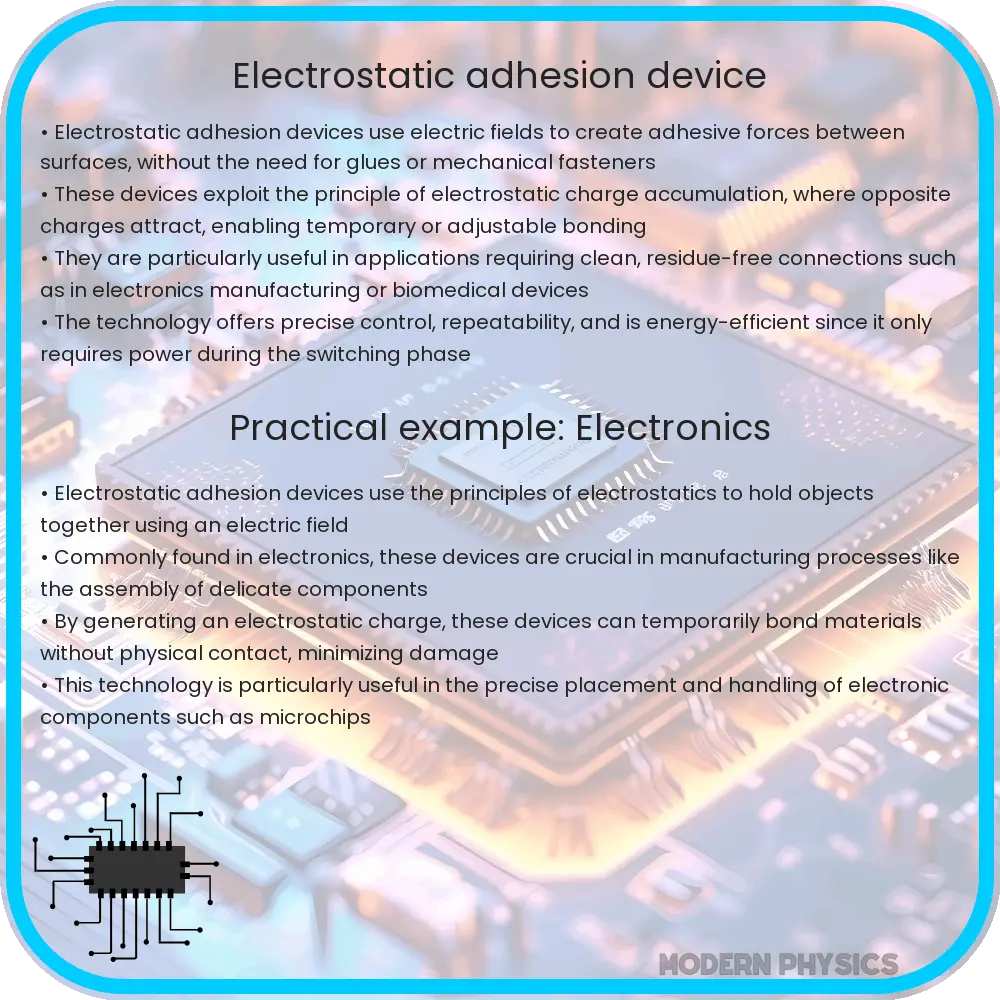
Electrostatic adhesion technology is an innovative approach that has transformed various industries. This method, utilizing electrostatic forces, offers a unique and efficient way to adhere materials without traditional adhesives or mechanical fasteners. This article delves into the underlying principles of electrostatic adhesion, its applications, and its advantages.
Principles of Electrostatic Adhesion
Electrostatic adhesion is based on the concept of electrostatic force, which is the attraction or repulsion between particles charged with electricity. When an object is electrically charged, it induces an opposite charge in nearby objects, leading to an attractive force. This phenomenon can be expressed using Coulomb’s Law, which states that the electrostatic force (F) between two charges (q1 and q2) is directly proportional to the product of the charges and inversely proportional to the square of the distance (r) between them, represented as F = k * (q1 * q2) / r2, where k is Coulomb’s constant.
Applications in Various Industries
Electrostatic adhesion devices have found applications in multiple industries, ranging from manufacturing to biomedical fields. In the automotive industry, they are used for holding parts in place during assembly or painting. The technology is also employed in the semiconductor industry for handling delicate silicon wafers without physical contact. In the medical field, electrostatic adhesion is used for non-invasive surgical tools and for positioning medical devices during procedures.
Advantages of Electrostatic Adhesion
The primary advantages of electrostatic adhesion technology include its non-invasive nature, efficiency, and safety. Unlike traditional adhesives, electrostatic forces do not leave residues, making it an ideal solution for clean environments like semiconductor fabrication. The technology is also energy-efficient, as it requires minimal power to maintain adhesion. Furthermore, it enhances safety by reducing the need for physical fasteners, which can be a source of failure or injury in certain applications.
In conclusion, electrostatic adhesion technology stands as a significant innovation in the field of material handling and attachment. Its application across diverse industries highlights its versatility and potential to further revolutionize these sectors. The following section will explore the challenges, future prospects, and potential impacts of this technology on the global market.
Challenges and Future Prospects
Despite its advantages, electrostatic adhesion faces challenges that must be addressed. One major concern is the control and precision of the adhesive force, especially in environments with fluctuating humidity and temperature. Another issue is scalability – adapting the technology for larger or more complex surfaces without compromising efficiency. Researchers are actively working on these challenges, focusing on developing more adaptable and robust systems.
Impact on Global Market
The impact of electrostatic adhesion technology on the global market is significant. Its adoption can lead to more efficient manufacturing processes, reduced material waste, and enhanced product quality. Moreover, as industries strive for more sustainable and environmentally friendly practices, the demand for non-residue and energy-efficient adhesion methods like this is expected to grow. This growth presents opportunities for innovation and investment in the field, potentially leading to new job creation and economic development.
Environmental Considerations
Environmental sustainability is another aspect where electrostatic adhesion excels. Traditional adhesives often contain volatile organic compounds (VOCs) and other harmful substances. In contrast, electrostatic adhesion, being a physical process, eliminates the need for such chemicals, thus reducing environmental pollution and health risks associated with VOCs. This aspect aligns well with the global push towards greener technologies.
Conclusion: The Future of Adhesion Technology
Electrostatic adhesion represents a paradigm shift in attachment and handling technology. Its advantages in terms of efficiency, safety, and environmental friendliness position it as a preferred choice in various industries. The ongoing research and development aimed at overcoming its current limitations promise even broader applications in the future. As industries continue to evolve and seek more innovative and sustainable solutions, electrostatic adhesion technology is poised to play a pivotal role. This technology not only offers immediate benefits but also paves the way for a more efficient and environmentally responsible future in manufacturing and beyond.