
Learn how biomimetic adhesives, inspired by natural adhesion methods, offer sustainable and effective alternatives in various industries.
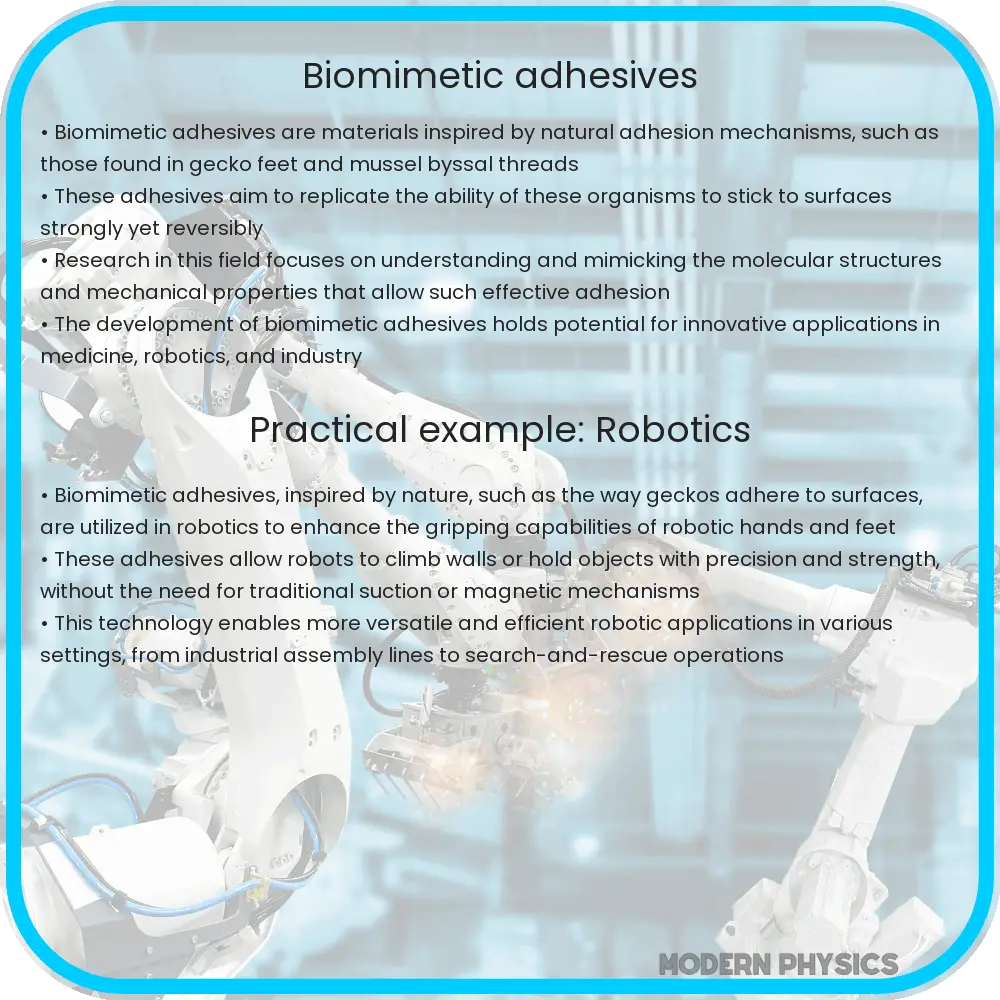
Exploring Biomimetic Adhesives: Inspired by Nature
The quest for more effective, durable, and environmentally friendly adhesives has led scientists to turn to one of the most innovative engineers known: nature itself. Biomimetic adhesives are materials designed to mimic the natural adhesion strategies found in various organisms. This approach not only promises enhanced durability and versatility but also champions eco-friendly solutions.
Understanding Biomimesis in Adhesion
Biomimicry, or biomimesis, involves studying the structure and function of biological systems as models for designing materials and machines. In the world of adhesion, researchers have been particularly fascinated by creatures like geckos, mussels, and burrs. For example, geckos can climb smooth surfaces such as glass without slipping thanks to their foot pads composed of tiny hairs called setae that can make intimate contact with surfaces at the molecular level.
- Gecko-Inspired Adhesives: Mimicking the setae, synthetic adhesives have been developed with microscale and nanoscale fibrillar structures that achieve a reversible and robust grip on various surfaces without leaving a residue.
- Mussel-Inspired Adhesives: Mussels adhere to rocks in wet environments using a protein-based glue. This has inspired adhesives that can cure and maintain bonding strength underwater, proving invaluable in medical and underwater construction applications.
- Burrs: The mechanism by which burrs hook onto passing animals using tiny hooks has led to the development of Velcro. This technology utilizes a hook-and-loop fastening system and is widely used in clothing, footwear, and more.
The Role of Sustainability
Biomimetic adhesives also stand out for their potential environmental benefits. Traditional synthetic adhesives often involve toxic ingredients and can create harmful byproducts. By contrast, adhesives inspired by natural mechanisms tend to utilize or mimic biodegradable proteins and other natural compounds which are more likely to be non-toxic and less damaging to ecosystems.
Several biomimetic adhesives are now being developed using renewable raw materials, which reduces dependency on petrochemicals and minimizes the environmental footprint of the production process. This shift not only helps in conserving natural resources but also supports a move towards a more sustainable and circular economy.
Applications Across Industries
The versatility of biomimetic adhesives extends across various industries. In medical fields, they are used for drug delivery systems and wound closure techniques that require gentle yet firm adhesion to human tissue. In electronics, they facilitate the assembly of sensitive components. In construction, bio-inspired adhesives can be utilized for creating more robust and durable building materials.
These applications demonstrate not only the practical utility of mimicking nature but also the potential for innovation in traditional industries. By integrating principles of natural adhesion, new products can be designed to be both more effective and more harmonious with the environment.
Challenges in Development
Despite their potential, the path to integrating biomimetic adhesives into widespread use is not without challenges. Replicating the complex structures and chemical properties of natural adhesives requires advanced materials science and precision engineering. Moreover, scaling up production to industrial levels often involves overcoming significant technical and economic hurdles.
Additionally, there are longevity and durability concerns under varying environmental conditions such as temperature, humidity, and UV exposure. These factors must be carefully considered to ensure that biomimetic adhesives can perform comparably to, or better than, their traditional counterparts in real-world applications.
Future Prospects
Looking forward, ongoing research and development in the field of biomimetic adhesives hold promise for groundbreaking solutions to longstanding adhesion challenges. Enhanced investment in biotechnology and nanotechnology could pave the way for the next generation of adhesives that are not only effective under extreme conditions but also produced in environmentally responsible ways. Researchers are exploring ways to improve the recyclability of these materials and reduce the overall lifecycle environmental impact. The journey towards fully sustainable adhesives, though challenging, appears to be within reach.
Education and Collaboration Opportunities
As research in biomimetic adhesives evolves, there is also a growing need for educational programs that can prepare the next generation of scientists and engineers with a deep understanding of biomimicry principles. Additionally, fostering collaborations between academia, industry, and environmental organizations can further enhance the innovation and application of eco-friendly adhesives. These partnerships are crucial in ensuring that the solutions developed are not only scientifically viable but also economically and environmentally sustainable.
Conclusion
Biomimetic adhesives represent a transformative area within materials science, marrying the ingenuity of nature with the promise of advanced technology. By taking inspiration from geckos, mussels, burrs, and other organisms, this innovative field offers solutions that are not only robust and versatile but also environmentally conscious. The applications of these biomimetic materials span industries, touching everything from health care to construction, showcasing their broad utility. As research continues to surmount the challenges of production and durability, biomimetic adhesives are poised to play a pivotal role in a more sustainable future. With concerted efforts in research, education, and collaboration, the full potential of these nature-inspired solutions can be realized, paving the way for a new era in ecologically responsible manufacturing.