
Explore the world of Electrostatic Actuators: Unveiling their precision, speed, and efficiency in modern engineering and technological applications.
Understanding Electrostatic Actuators: A Blend of Precision, Speed, and Efficiency
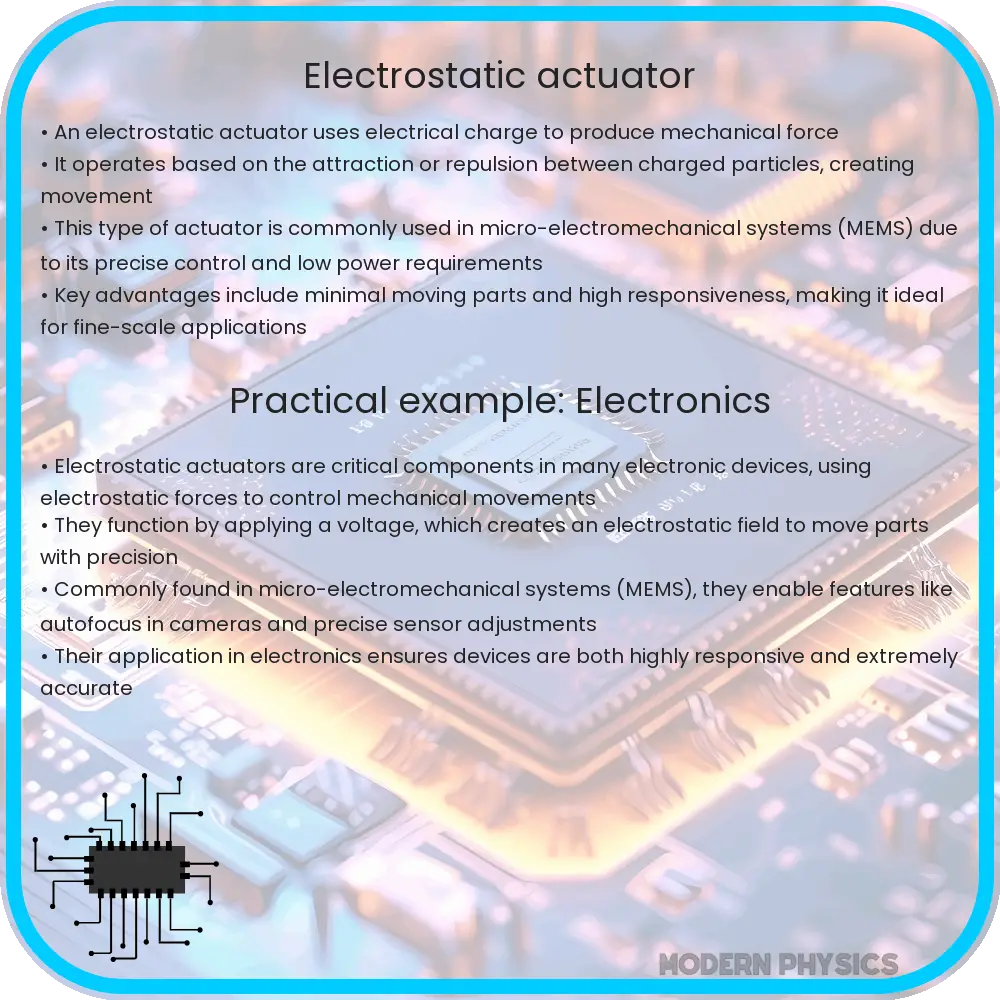
Electrostatic actuators, a critical component in the realm of precision engineering, have garnered significant attention due to their exceptional speed, efficiency, and accuracy. These actuators operate on the principle of electrostatic force, which is the force exerted by the electric field on charged particles. This technology is widely implemented in various micro and nanoelectromechanical systems (MEMS and NEMS), offering precise control at small scales.
Principles of Operation
The fundamental working principle of an electrostatic actuator is based on Coulomb’s law, which states that the force between two charges is directly proportional to the product of the charges and inversely proportional to the square of the distance between them. In simpler terms, when a voltage is applied across the electrodes, an electrostatic field is generated, resulting in an attractive force that moves the actuator. This movement can be linear or rotational, depending on the design of the actuator.
Key Features of Electrostatic Actuators
- Precision: One of the most remarkable features of electrostatic actuators is their high precision. They are capable of producing movements with sub-nanometer accuracy, making them ideal for applications requiring extreme precision.
- Speed: These actuators respond extremely quickly to electrical signals, allowing for rapid movement. This high-speed operation is essential in applications like optical systems and microfluidics.
- Efficiency: Electrostatic actuators are highly energy-efficient. They consume power only when there is a change in the position, unlike electromagnetic actuators that require continuous power to maintain a position.
Applications in Industry and Research
Electrostatic actuators find their usage in a wide range of applications. In the field of microelectronics, they are used for the precise positioning of wafers and microchips. In optical systems, these actuators play a crucial role in lens positioning and focusing mechanisms. Additionally, in the burgeoning field of microfluidics, they enable the precise control of fluid flow at microscale dimensions.
The advantages of electrostatic actuators are not limited to precision and efficiency. Their small size and ability to be integrated into various systems make them invaluable in the development of miniaturized devices and instruments. As technology progresses, the scope and capabilities of these actuators are expected to expand, paving the way for more innovative applications in various scientific and industrial fields.
Challenges and Future Prospects
Despite their numerous advantages, electrostatic actuators face challenges, particularly in generating large forces. This limitation is due to the inherent nature of electrostatic forces, which are effective over very small distances. However, ongoing research and development are focusing on overcoming these limitations by exploring new materials and designs that can enhance the force output without compromising on precision and efficiency.
Looking ahead, the future of electrostatic actuators appears promising. With continuous advancements in materials science and MEMS/NEMS technology, these actuators are set to revolutionize the way we approach precision engineering. Their integration into more complex systems will likely open new frontiers in automation, robotics, and even biomedical devices.
Advancements in Electrostatic Actuator Technology
Recent advancements in electrostatic actuator technology have focused on enhancing their capabilities and expanding their range of applications. Innovations in materials, such as the use of advanced polymers and composites, have contributed to the production of more robust and reliable actuators. Additionally, the integration of nanotechnology has facilitated the creation of actuators with even finer precision and responsiveness.
Another area of significant progress is in the control systems used with electrostatic actuators. Advanced algorithms and precise control mechanisms have been developed to better manage the actuation process, ensuring more accurate and stable performance. This is particularly crucial in fields where even the slightest error can lead to significant consequences, such as in aerospace or medical applications.
Electrostatic Actuators in Emerging Technologies
The versatility of electrostatic actuators is evident in their growing use in emerging technologies. In the field of biotechnology, for instance, these actuators are being employed in lab-on-a-chip devices, enabling the manipulation of cells and biomolecules with unprecedented precision. In the realm of robotics, electrostatic actuators are being utilized to develop more refined and dexterous robotic limbs, enhancing their functionality and interaction capabilities.
Furthermore, the automotive industry has seen a surge in the adoption of electrostatic actuators for various applications, ranging from sensor deployment to vibration control. This trend is a testament to the actuators’ reliability and efficiency in diverse operational environments.
Conclusion
In conclusion, electrostatic actuators represent a remarkable fusion of precision, speed, and efficiency. Their ability to operate with high accuracy and minimal energy consumption makes them an invaluable component in modern engineering and technology. As the demand for miniaturization and precision continues to grow across various sectors, electrostatic actuators will undoubtedly play a pivotal role in shaping the future of technological advancements.
The ongoing developments in material science, control systems, and application methods promise to further enhance the capabilities of these actuators. Whether it’s in the intricate world of MEMS/NEMS, the demanding requirements of aerospace and biotechnology, or the burgeoning field of robotics, electrostatic actuators are poised to be at the forefront of innovation. Their potential for transforming a wide array of industries is not only immense but also a testament to the remarkable progress in precision engineering and technology.