
Explore the role of Electromagnetic Field Meters in safety and efficiency, covering their uses, advanced features, and selection guide.
Understanding Electromagnetic Field Meters: Precision, Safety, and Efficiency
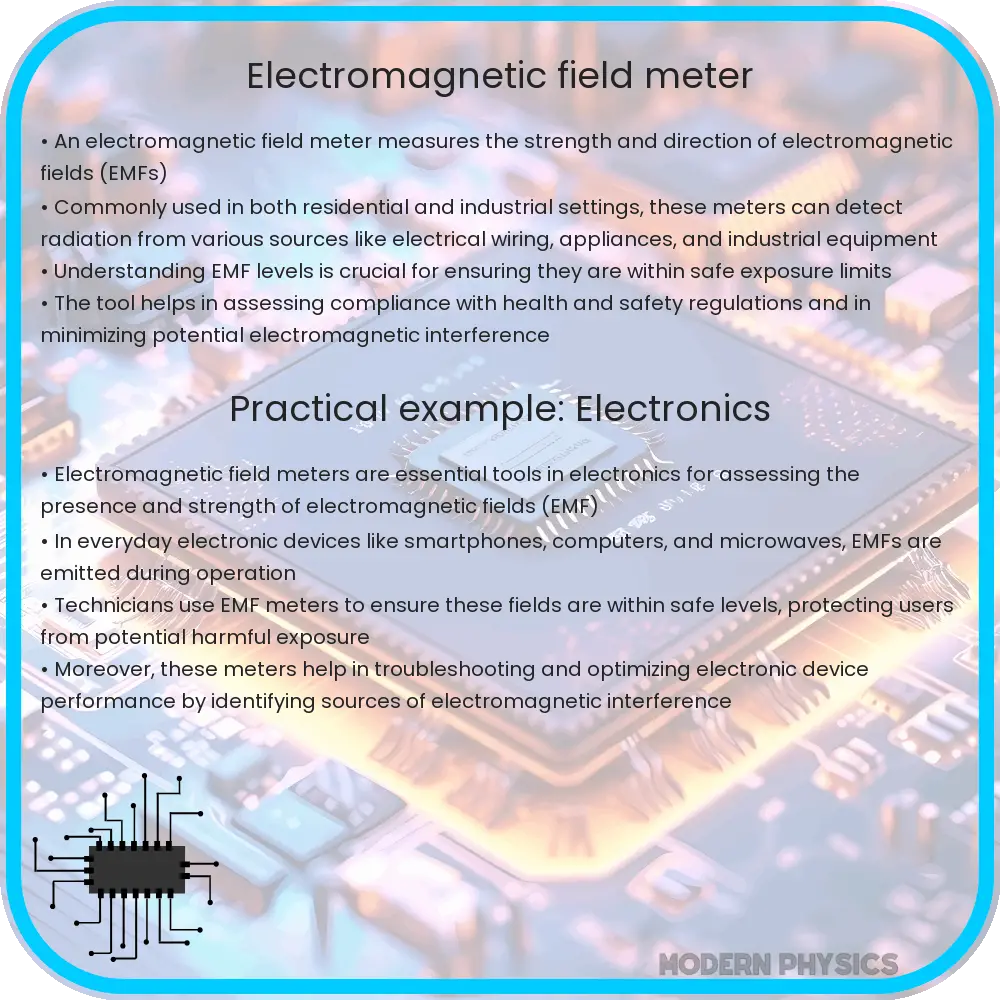
Electromagnetic Field (EMF) meters are essential tools used for measuring the strength of electromagnetic fields emitted by electrical devices and infrastructure. These meters are crucial in various industries, including electrical engineering, telecommunications, and environmental health, ensuring safety standards and efficient operations.
What is an Electromagnetic Field Meter?
An EMF meter is a device designed to detect and measure the intensity of electromagnetic fields. These fields are a combination of electric and magnetic fields, which are generated by electrically charged objects. The meter typically measures electromagnetic radiation frequencies within a certain range, often including radio waves, microwaves, and even visible light.
Key Applications of EMF Meters
- Electrical Safety: In industrial settings, EMF meters are used to assess the safety levels around power lines, transformers, and other high-voltage equipment. This assessment helps in maintaining safe distances and minimizing the risk of electromagnetic exposure.
- Healthcare: EMF meters play a crucial role in healthcare environments, especially in ensuring that the electromagnetic fields generated by medical equipment, like MRI machines, remain within safe limits.
- Environmental Studies: Researchers use EMF meters to evaluate the impact of electromagnetic pollution on the environment and living organisms, contributing to ecological conservation efforts.
Features of High-Quality EMF Meters
To achieve precision, safety, and efficiency in EMF measurements, a high-quality meter should possess several key features:
- Accuracy: The meter should provide precise readings, with minimal error margins. This is crucial in applications where safety or regulatory compliance is a concern.
- Frequency Range: A broad frequency range enables the meter to detect a wide spectrum of electromagnetic emissions, from low-frequency fields around power lines to high-frequency emissions from wireless devices.
- User-Friendly Interface: A simple and intuitive interface aids in quick and efficient measurements, making the tool accessible to both professionals and amateurs.
Understanding the basic principles behind EMF meters involves delving into the physics of electromagnetism. Electromagnetic fields are described by Maxwell’s equations, which mathematically explain how electric charges and currents create these fields. The fundamental equation for an electromagnetic wave in a vacuum is:
\[ E = h \times \nu \]
where \( E \) is the energy of the wave, \( h \) is Planck’s constant (\( 6.62607015 \times 10^{-34} \) Joule-second), and \( \nu \) is the frequency of the wave.
This equation highlights the direct correlation between the energy of an electromagnetic wave and its frequency, a principle that underpins the operation of EMF meters.
Advanced Technologies in EMF Meters
Modern EMF meters incorporate advanced technologies to enhance their functionality and accuracy. These include:
- Digital Signal Processing (DSP): DSP technology improves the precision of EMF measurements by filtering out noise and irrelevant signals, ensuring more accurate readings.
- Wireless Connectivity: Some advanced meters offer wireless connectivity, enabling remote monitoring and data logging. This feature is particularly useful in hazardous or hard-to-reach areas.
- Integrated Software: Software integration allows for advanced data analysis and visualization, making it easier to interpret complex EMF readings.
Choosing the Right EMF Meter
When selecting an EMF meter, consider the following factors:
- Application Need: The choice of meter depends on the specific application, whether it’s for industrial, environmental, or personal use.
- Sensitivity and Range: Ensure that the meter’s sensitivity and frequency range are suitable for the electromagnetic fields you intend to measure.
- Calibration: Regular calibration is essential for maintaining the accuracy of the meter. Choose a model with easily accessible calibration services.
Safety Guidelines and Standards
It’s crucial to adhere to safety guidelines and standards when using EMF meters. Organizations like the International Commission on Non-Ionizing Radiation Protection (ICNIRP) provide guidelines on exposure limits to electromagnetic fields. Compliance with these standards ensures the safety of both the operator and the general public.
Conclusion
Electromagnetic Field meters are indispensable in our technologically advanced world, where electromagnetic radiation is omnipresent. From ensuring safety in industrial settings to assessing environmental impacts, these devices play a vital role. The advancement in EMF meter technology, including digital signal processing and wireless connectivity, has further enhanced their efficiency and accuracy. When selecting an EMF meter, it’s important to consider the application, sensitivity, and calibration needs. Adhering to safety standards and guidelines is paramount for safe and effective usage. Ultimately, EMF meters serve as a critical tool in navigating the complexities of electromagnetic fields, balancing technological advancements with health and environmental considerations.