
Learn about the key electrical properties of conductivity, resistance, and reactivity, and how these factors influence the behavior of circuits and devices.
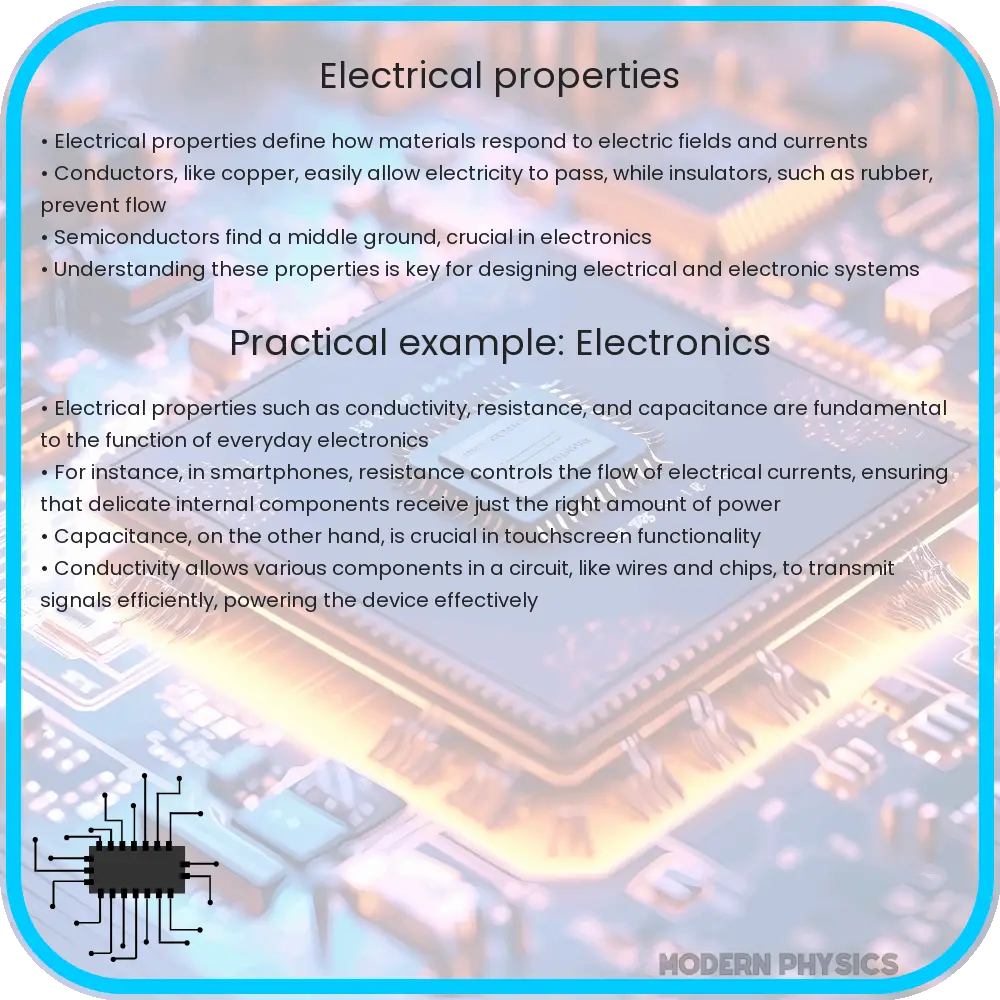
Understanding Electrical Properties: Conductivity, Resistance, and Reactivity
Electricity is a fundamental part of our day-to-day life, and understanding its basic principles is essential. Electrical properties such as conductivity, resistance, and reactivity play crucial roles in how we harness and use this vital energy. Let’s delve into these properties to understand how they influence the behavior of electrical circuits and devices.
Conductivity
Conductivity refers to a material’s ability to allow the flow of electric charge. It is primarily influenced by the material’s composition and structure. Materials with high conductivity, such as metals like copper and aluminum, are often used in electrical wiring and components due to their efficiency in conducting electric current.
The electrical conductivity of a material is typically measured in Siemens per meter (S/m), and it depends on the number of charge carriers (usually electrons) available to move through the material when an electric field is applied. The formula to calculate conductivity, σ, is expressed as:
Where:
- n is the number of charge carriers per unit volume,
- q is the charge of the carriers,
- \(\mu\) (mobility) is how quickly the carriers can move through the material.
Resistance
Resistance is the hindrance to the flow of electric current through a material. It is the flip side of conductivity, where materials with high resistance reduce the flow of current, transforming electric energy into heat or other forms of energy. Resistance is primarily utilized in heating devices and for controlling current levels in various electronic circuits.
The resistance \( R \) of a material can be calculated using Ohm’s Law, which states:
Where:
- V is the voltage across the material,
- I is the current flowing through the material.
Moreover, resistance is also influenced by the material’s dimensions and is given by:
Where:
- \(\rho\) (rho) is the resistivity of the material,
- L is the length of the material,
- A is the cross-sectional area through which the current flows.
Reactivity (In Electrical Context)
In the electrical context, reactivity refers to how a material responds to an alternating electric field or current, primarily concerning capacitive and inductive elements in circuits. Reactivity encompasses concepts such as impedance and reactance, which are crucial in designing circuits for alternating current (AC).
Capacitive and inductive reactances are given by:
Where:
- XC is the capacitive reactance,
- XL is the inductive reactance,
- \(\omega\) (omega) is the angular frequency of the AC supply,
- C is the capacitance,
- L is the inductance.
These elements play significant roles in tuning the frequency response of circuits and in managing phase differences between voltage and current, influencing how energy is stored and dissipated in an AC circuit.
Practical Applications
The principles of conductivity, resistance, and reactivity have widespread applications across various fields. In electronics, understanding and manipulating these properties allow for the design of more efficient circuits and devices. For instance:
- Consumer Electronics: The right balance of resistance and conductivity ensures that devices like smartphones and laptops function optimally without overheating.
- Power Systems: High conductivity materials are used in power lines to minimize energy losses during transmission. Additionally, components designed to have specific reactances are crucial in managing power flow and stability.
- Automotive: In electric vehicles, managing the resistance and reactance of components can significantly impact the efficiency and battery life.
Environmental and Economic Impact
The choice of materials with appropriate electrical properties is not only a technical decision but also an environmental one. Using materials with high conductivity can lead to significant reductions in power losses, which in turn can reduce the carbon footprint associated with electricity generation and usage. Economically, efficient electrical systems lead to lower operational costs and can contribute to the longevity of devices and systems, saving money in the long term.
Conclusion
Understanding the electrical properties of materials—conductivity, resistance, and reactivity—is crucial for harnessing and optimizing the use of electricity. These properties influence everything from the design of simple circuits to the development of complex power systems. By mastering the concepts of electrical conductivity, resistance, and reactivity, engineers can design devices and systems that are both efficient and sustainable, helping pave the way towards more technologically advanced and eco-friendly solutions. Whether for powering homes or designing the next generation of electronics, the principles discussed are foundational to numerous applications and innovations in the field of electrical engineering.