
This article explains the fundamental thermal properties crucial in various industries: thermal conductivity, capacity, and transfer, detailing how they affect heat management in materials and systems.
Understanding Thermal Properties: Conductivity, Capacity, and Transfer
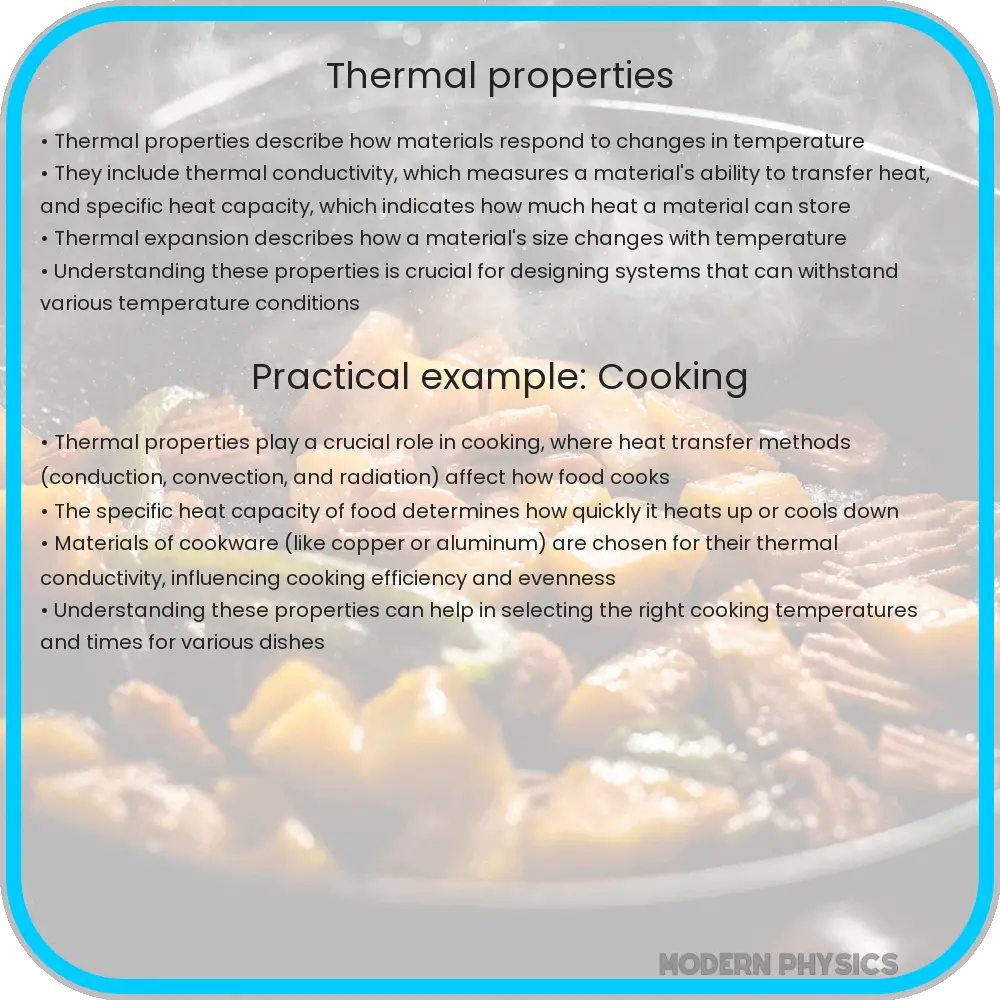
Thermal properties of materials play a critical role in a wide range of applications, from building insulation and electronic devices to automotive engineering and spacecraft design. The three key thermal properties to understand are thermal conductivity, thermal capacity, and thermal transfer. Each of these properties influences how energy in the form of heat is managed and manipulated in different environments.
1. Thermal Conductivity
Thermal conductivity is a measure of a material’s ability to conduct heat. It tells us how easily heat can pass through a material. High thermal conductivity materials, such as metals, are excellent heat conductors, while low thermal conductivity materials, like wood or foam, are good insulators. The thermal conductivity (k) of a material can be expressed mathematically by Fourier’s law of heat conduction:
q = -k * A * (dT/dx)
- q is the heat transfer rate (in watts, W)
- k is the thermal conductivity of the material (in watts per meter-kelvin, W/m*K)
- A is the cross-sectional area through which heat is flowing (in square meters, m2)
- dT/dx is the temperature gradient (in kelvin per meter, K/m)
This equation is particularly useful in determining how much insulation is required in a building, or how quickly a component might overheat in an electronic device.
2. Thermal Capacity
Thermal capacity, or more accurately specific heat capacity, is a measure of the heat energy required to raise the temperature of a given mass of a substance by one degree Celsius (or one Kelvin). This property is crucial for understanding how materials respond to changes in temperature, particularly in systems where temperature control is vital. The specific heat capacity (cp) is generally given by the equation:
Q = m * cp * ΔT
- Q is the amount of heat added (in joules, J)
- m is the mass of the substance (in kilograms, kg)
- cp is the specific heat capacity (in joules per kilogram-kelvin, J/kg*K)
- ΔT is the change in temperature (in kelvins, K or degrees Celsius, °C)
This relationship helps engineers and scientists predict how long it will take for a substance to reach a certain temperature when a known amount of heat is applied.
3. Thermal Transfer
Thermal transfer deals with the rate at which heat moves from one place to another and can occur through three primary mechanisms: conduction, convection, and radiation. Each of these mechanisms involves different processes:
- Conduction is the transfer of heat between substances that are in direct contact with each other. It relies on the movement of heat within a body or between two bodies in contact, normally through the vibration and movement of molecules and electrons.
- Convection involves the movement of heat by the physical movement of fluid (which could be a liquid or gas). Natural convection is caused by buoyant forces due to temperature variations in the fluid, whereas forced convection is caused by external sources like fans or pumps.
- Radiation refers to the transfer of heat in the form of electromagnetic waves, such as infrared radiation. Unlike conduction and convection, heat radiation can occur through a vacuum, as no medium is required.
Understanding these mechanisms is essential for optimizing the thermal management in systems, from cooling electronic devices to designing climate control systems in buildings.
Practical Applications of Thermal Properties
In the real world, the understanding and application of thermal properties like conductivity, capacity, and transfer are essential across several industries. For instance:
- In construction, choosing materials with the appropriate thermal conductivity can ensure energy efficiency and comfort in buildings. Insulation materials with low thermal conductivity are used to minimize heat loss.
- In the automotive industry, engines and other components are designed with materials that have specific thermal capacities to manage heat effectively, thus improving efficiency and safety.
- In electronics, thermal management through conduction, convection, and radiation is critical to prevent devices from overheating, thereby extending their operational lifespan and enhancing performance.
This practical application of thermal properties also extends to environmental engineering and sustainable technology, where they are used to develop systems that can maintain temperature without excessive energy use.
Conclusion
Understanding the thermal properties of materials is not just about comprehending scientific concepts but also about applying this knowledge to solve real-world problems. From keeping our homes warm and our food cold to ensuring the safety and efficiency of high-tech gadgets and vehicles, thermal properties impact a wide array of human activities. By mastering the basic concepts of thermal conductivity, capacity, and transfer, we equip ourselves with the tools to innovate and improve the myriad technologies that shape our modern life. With the combined efforts of scientists and engineers, the innovative application of these thermal principles will continue to play a crucial role in advancing technology and solving the challenges posed by energy management and climate control.