
Explore the role of Earth’s gravity in structural equilibrium and stability, from skyscraper design to space structures and climate challenges.
Understanding Earth’s Gravity: Forces, Equilibrium, and Structures
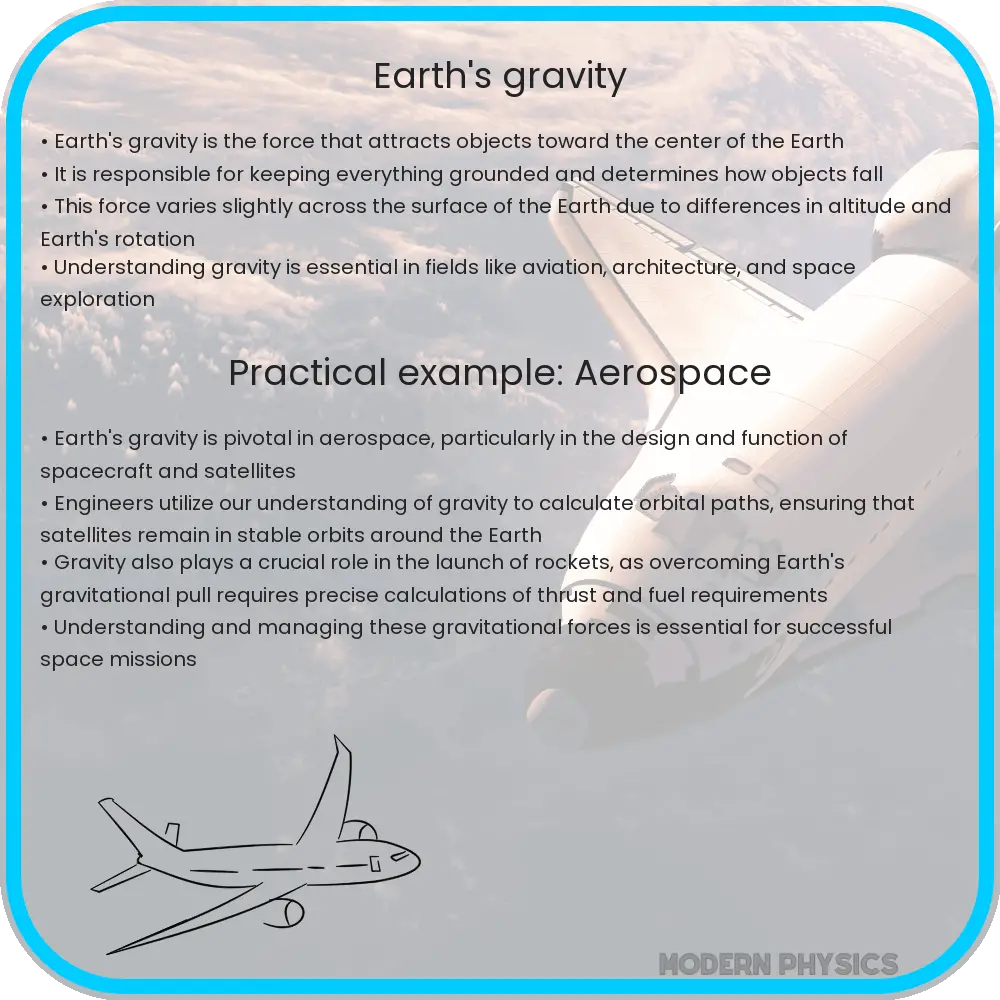
Earth’s gravity, a fundamental force of nature, influences everything from the movements of celestial bodies to the structures we build. It is the force that attracts a body towards the center of the Earth or towards any other physical body having mass. This invisible force has profound implications for the equilibrium and stability of structures, both natural and man-made.
Gravitational Force: The Basics
The gravitational force is described by Isaac Newton’s Universal Law of Gravitation, which states that every point mass attracts every other point mass in the universe with a force that is proportional to the product of their masses and inversely proportional to the square of the distance between their centers. This force is expressed as:
F = G * (m1 * m2) / r2
where F is the force of attraction, G is the gravitational constant, m1 and m2 are the masses of the two objects, and r is the distance between the centers of the two objects.
Impact on Structures
When it comes to structures, understanding gravity is crucial for ensuring stability and equilibrium. Architects and engineers must consider the gravitational pull in their designs to ensure that buildings and other structures can withstand the forces exerted on them. This involves calculations that take into account the mass of the structure, the distribution of that mass, and the strength of the materials used.
Equilibrium and Stability
Equilibrium in structures is achieved when the sum of all forces and moments acting on them is zero. In this state, a structure can efficiently resist external forces such as gravity, wind, or seismic activity. Stability, on the other hand, refers to the ability of a structure to maintain its equilibrium under external disturbances. A stable structure will return to its original state after being disturbed, whereas an unstable structure may collapse or undergo irreversible deformation.
Gravitational forces play a critical role in determining both equilibrium and stability. For example, in tall buildings, the center of gravity must be carefully calculated and aligned with the structure’s support system to prevent toppling. Similarly, in bridges, gravity affects the tension and compression forces within the structure, influencing its design and materials.
Understanding and counteracting Earth’s gravitational force is key in the construction of safe and enduring structures. Through precise calculations and innovative designs, engineers and architects harness this fundamental force, creating balance and stability in the structures that populate our world.
Engineering Challenges and Innovations
Addressing the challenges posed by Earth’s gravity requires innovative engineering solutions. In skyscrapers, for example, gravitational forces necessitate the use of specialized materials and construction techniques to ensure that the weight is evenly distributed across the foundation. Similarly, in bridge construction, engineers must design structures that can not only support their own weight but also handle the dynamic loads of traffic and environmental stressors.
Gravity and Structural Health Monitoring
Structural Health Monitoring (SHM) systems play a vital role in assessing the integrity of structures under the influence of gravity. These systems utilize sensors to monitor changes over time, detecting potential problems before they lead to structural failure. For instance, in dams, SHM systems can help detect deformations or shifts that might compromise the structure’s stability.
Gravity in Space Structures
The concept of gravity extends beyond Earth, impacting the design of space structures like satellites and space stations. Here, the challenge is the opposite: dealing with microgravity environments. Engineers must consider how the lack of significant gravitational force affects materials, fluid dynamics, and human physiology in space.
The Future: Adapting to Climate Change
As climate change leads to more extreme weather events, understanding and adapting to gravitational forces becomes even more critical. Rising sea levels, for instance, can change the gravitational load on coastal structures, necessitating new approaches in architectural design and materials science.
Conclusion
Earth’s gravity, a force that we often take for granted, plays a pivotal role in the equilibrium and stability of structures. From the towering skyscrapers that grace our city skylines to the vast bridges spanning our waterways, the influence of gravity is omnipresent. Engineers and architects must continually innovate to ensure that these structures can withstand not only the force of gravity but also the additional challenges posed by natural and human-made factors. As we venture further into the realm of space exploration and grapple with the realities of climate change, the importance of understanding and harnessing this fundamental force becomes ever more apparent. In this quest, the balance between embracing technological advancements and respecting the laws of nature will be key to building a resilient and sustainable future.