
Acoustic phased arrays enable precise sound wave manipulation, essential in medical imaging, underwater exploration, and noise cancellation.
Understanding Acoustic Phased Arrays
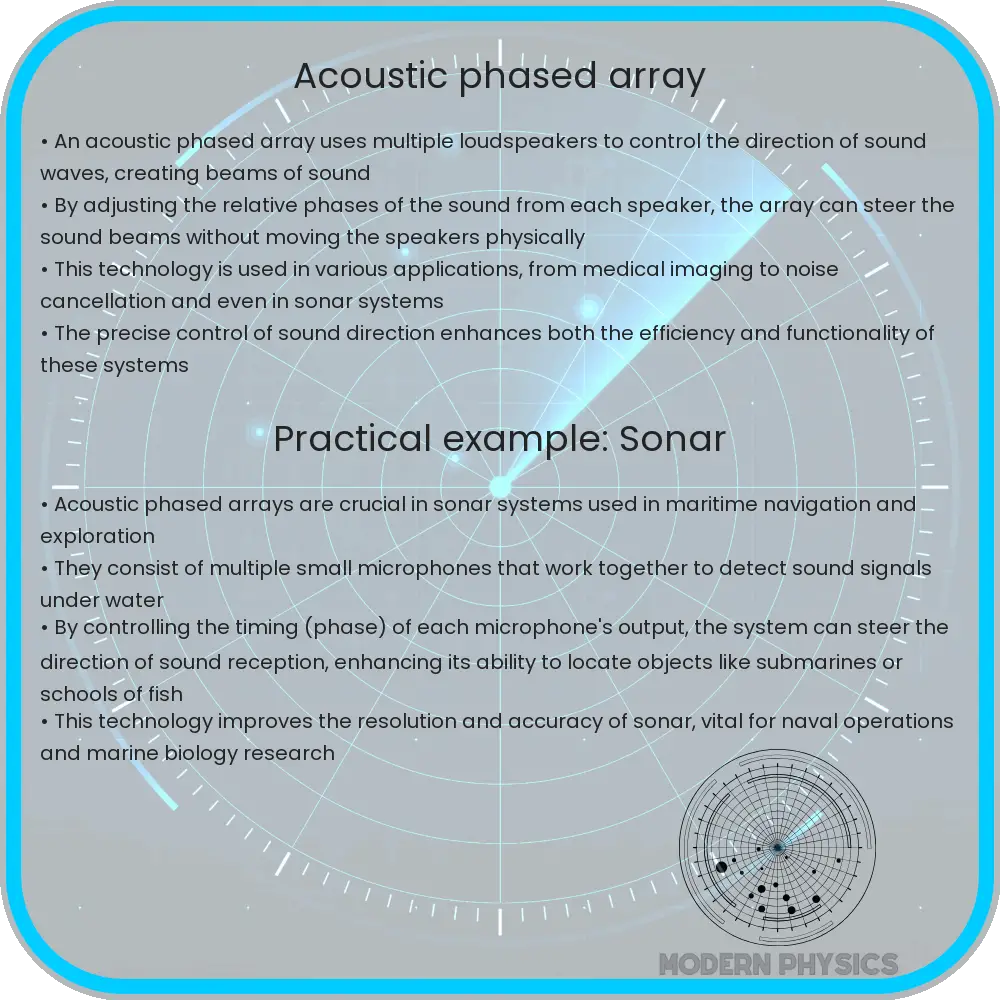
Acoustic phased arrays represent a sophisticated technology that harnesses the principles of physics to manage and manipulate sound waves. This technology enables unprecedented control over sound propagation, allowing the beams of sound waves to be directed precisely without moving the physical array. Such capabilities are pivotal for various applications, including medical imaging, underwater exploration, and even in noise cancellation systems.
Basics of Acoustic Phased Array Technology
The fundamental idea behind an acoustic phased array system is relatively straightforward: it consists of multiple sound sources, often called transducers, which generate waves that are systematically controlled to interact in such a way as to constructively and destructively interfere with each other. This results in the formation of directable, focused acoustic beams.
- Phase Control: The key to directability is the manipulation of the phase of the waves emitted by each transducer. By adjusting the timing (phase) of each sound wave, the array can create a pattern of interference that focuses the sound energy in a specific direction.
- Beam Steering: Steering the beam involves changing the relative phases of the emissions from the transducers in real-time, allowing the beam to be pointed in different directions without the need for mechanical movement.
The Physics Behind the Technique
At the heart of acoustic phased arrays lies the principle of wave interference. When two or more sound waves meet, they can interfere with each other in two primary ways:
- Constructive Interference: Occurs when waves combine to make a wave with a larger amplitude than either of the original waves. This is used to amplify the sound in a specific direction.
- Destructive Interference: Occurs when waves combine to make a wave with a smaller amplitude than one of the original waves, effectively reducing the sound in unwanted directions.
The careful orchestration of these interactions within a phased array allows for precise control over the sound field, resulting in the ability to “shape” the sound waves.
Mathematical Insight
The control over the direction and focus of the acoustic beam is typically expressed mathematically by the array factor, an equation that represents the pattern of interference produced by the phased array. The array factor is a function of the frequency, the spacing between the transducers, and the phases of the individual emissions:
AF(θ) = ∑n=1N exp(i(wt – kxnsinθ))
Here, AF(θ) denotes the array factor as a function of the angle θ, N is the number of transducers, w is the angular frequency of the sound waves, t represents time, k is the wave number (related to wavelength λ by k = 2π/λ), and xn is the position of the nth transducer. The term sinθ reflects the directional dependence of the beam.
This formula illustrates how adjusting the phases of emissions at different transducers can steer the acoustic beam in various directions, enabling precise targeting without moving the array itself.
Applications of Acoustic Phased Arrays
The precision and control offered by acoustic phased arrays have led to their adoption in numerous fields, each leveraging the core ability to manipulate sound with great accuracy:
- Medical Imaging: In applications such as ultrasound, phased arrays are used for creating detailed images inside the body without any invasive procedures.
- Underwater Exploration: Sonar systems use phased arrays to map the ocean floor, locate objects, and track marine life over vast distances.
- Noise Cancellation: Advanced noise-canceling headphones and systems utilize phased array principles to destructively interfere with ambient noise, improving audio clarity.
This introduction to acoustic phased arrays sheds light on the significant impact that controlled sound waves can have across different technologies and industries. With continued advancements, the applications of this technology seem bound only by the limits of innovation.
Future Prospects and Challenges
The advancements in acoustic phased array technology continue to open new doors in various scientific and industrial areas. The potential for further refinement and application is vast, yet, like all technologies, it faces certain challenges:
- Miniaturization: As devices become smaller, integrating phased array systems in compact formats without losing efficiency poses a significant engineering challenge.
- Cost Reduction: High production costs currently limit more widespread application. Developing cost-effective manufacturing methods is crucial for broader adoption.
- Sensitivity and Resolution: Improving the sensitivity and resolution of acoustic phased arrays can vastly enhance their effectiveness, especially in medical and underwater imaging.
Despite these obstacles, ongoing research and development promise to harness even greater capabilities from acoustic phased arrays, potentially revolutionizing how we interact with and manipulate sound in our environment.
Conclusion
Acoustic phased arrays represent a fascinating blend of physics and engineering, showcasing how a deep understanding of wave phenomena can lead to innovative applications that impact our daily lives. From improving medical diagnostics to exploring the ocean’s depths and enhancing our audio experiences, this technology illustrates the practical benefits of scientific principles. As research continues to push the boundaries of what’s possible, acoustic phased arrays will not only refine existing technologies but also inspire new ones, making the study of sound waves an ever-exciting field in science and engineering.