
Understanding the multidisciplinary field of Earth System Science, which integrates biology, physics, chemistry, and geography to analyze Earth’s complex systems and predict future environmental conditions.
Understanding Earth System Science: Climate Dynamics, Sustainability, and Modeling
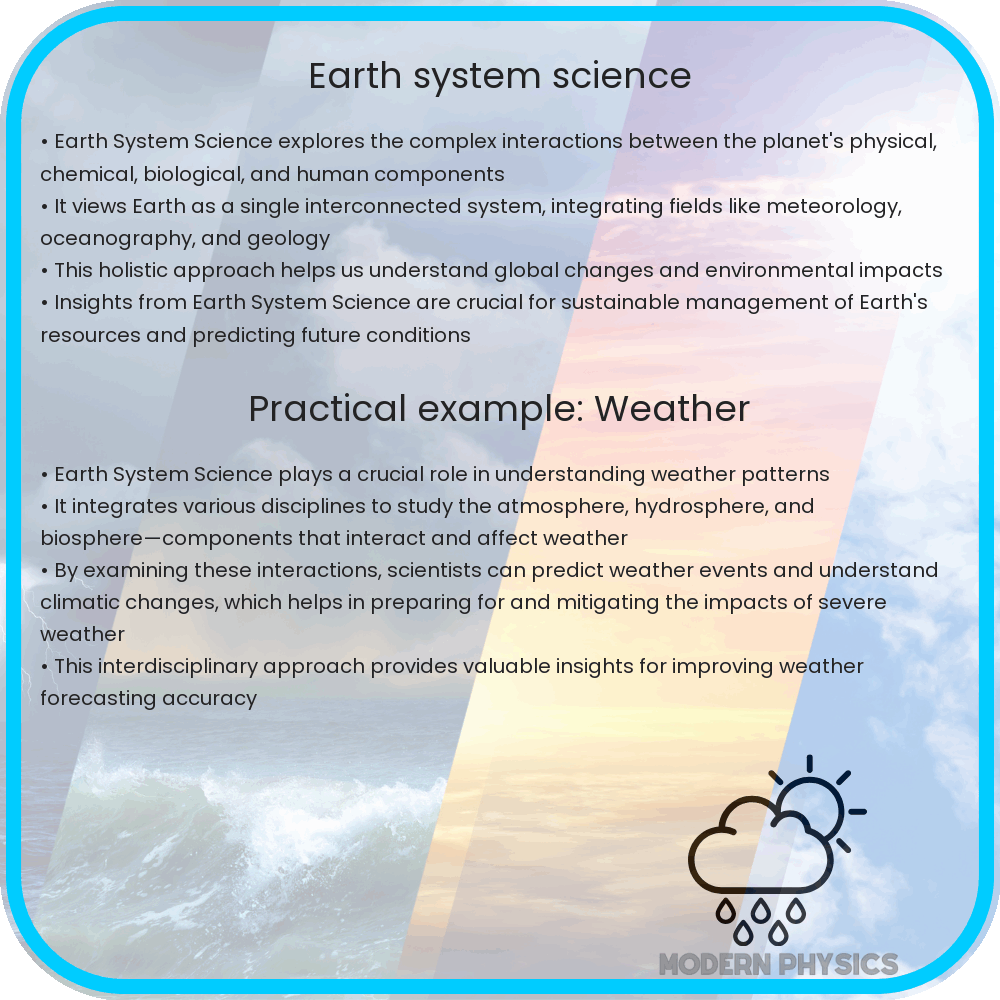
Earth System Science (ESS) is a multidisciplinary field that combines various branches of science, including biology, physics, chemistry, and geography, to understand the complex interactions within the Earth’s system. Central to ESS is the study of climate dynamics, sustainability, and the development of models to predict future environmental conditions. This article will explore these three critical areas and their importance in shaping our understanding of Earth’s system.
Climate Dynamics
Climate dynamics delves into the physical and chemical processes that influence the Earth’s climate. This includes studying phenomena like greenhouse gas concentrations, solar radiation, and ocean circulation patterns. The Earth’s climate is driven by the energy it receives from the sun and the way this energy is distributed and stored within the atmosphere, hydrosphere (water bodies), and lithosphere (Earth’s crust).
The main engine behind climate dynamics is the balance between incoming solar radiation and the heat that is radiated back into space. The composition of gases in the atmosphere, commonly known as greenhouse gases (like CO2 and CH4), plays a crucial role in this process. These gases trap heat within the atmosphere, leading to a natural warming of the Earth, known as the greenhouse effect.
Sustainability
Sustainability in the context of Earth System Science means understanding and managing human impacts on the ecosystem to ensure that future generations inherit a planet that is vibrant and capable of supporting life. This involves practices such as conserving water, reducing greenhouse gas emissions, and protecting biodiversity. Sustainability is fundamentally about maintaining the systems and processes that the planet relies on for balance and continuity.
Modeling in Earth System Science
Modeling is a vital tool in Earth System Science, providing scientists and researchers with a method to simulate and predict future environmental conditions. These models integrate physical, chemical, and biological processes to recreate the interactions occurring within the Earth’s system. They help in understanding potential future climate scenarios based on different variables like CO2 emissions or deforestation rates.
Models can range from relatively simple, focusing on a single aspect of the system, to incredibly complex, simulating the whole Earth system. The most known models are General Circulation Models (GCMs), which simulate the movement of energy and materials through the atmosphere and oceans. GCMs are crucial for climate prediction and understanding potential future climate changes.
- Physical models simulate climate processes like airflow, ocean currents, and heat exchange.
- Chemical models focus on chemical reactions in the atmosphere, such as the formation of ozone or the interaction of various pollutants.
- Biological models examine the interplay between living organisms and their environments, including the effects of human interventions like agriculture and urbanization.
The integration of these models helps predict how alterations in one part of the Earth system might affect others. For instance, a decrease in Arctic sea ice due to global warming can lead to changes in global weather patterns, affecting ecosystems and human societies around the globe.
Understanding and effectively managing the Earth’s intertwined systems are more critical than ever. As we continue to witness shifts in the climate and their subsequent impacts on global ecosystems, Earth System Science provides crucial insights necessary for developing sustainable strategies and mitigating future environmental changes.
Challenges and Opportunities in Earth System Science
Despite its significant advancements, Earth System Science faces several challenges. One major challenge is the uncertainty inherent in predicting complex system interactions. Due to the immense complexity and variability of the Earth’s systems, models may sometimes produce different outcomes based on slight changes in initial conditions or assumptions.
Moreover, there is an ongoing need for better data collection methods and technologies to enhance the accuracy of predictions. Advancements in satellite technology, remote sensing, and data analytics offer promising opportunities to improve these models, making it possible to gather and analyze vast amounts of environmental data like never before.
Impacts on Policy and Education
The insights gained from Earth System Science have profound implications for policy-making and educational curriculums. By providing a more comprehensive understanding of how various components of the Earth interact, policymakers can devise more effective environmental regulations and strategies for sustainable development. Additionally, incorporating Earth System Science into educational systems can help cultivate a generation of informed citizens who understand the complexities of environmental issues and are prepared to tackle them.
- Policy Development: Strategies derived from ESS research can help in creating policies that address critical issues such as climate change, water scarcity, and biodiversity loss.
- Educational Integration: Teaching ESS at different educational levels can encourage students to engage in scientific discussions and consider future careers in environmental sciences or related fields.
Conclusion
Earth System Science stands at the forefront of our quest to understand and manage the Earth’s complex ecological, chemical, and physical processes. Through studying climate dynamics, emphasizing sustainability, and improving environmental modeling, this field provides essential insights that help guide our interaction with the planet’s natural systems. The future of ESS promises even greater advancements as technologies evolve, offering new tools to tackle the challenges of environmental management and preservation.
The collaboration across disciplines, enhanced by technological progress, signifies hope for achieving a deeper understanding and better management of the Earth’s systems. Emphasis on integrating this science into policy and education can not only facilitate more informed decisions but also inspire a responsible stewardship of our planet, ensuring its health and vitality for future generations.