
Learn how environmental modeling uses precision, analysis, and physics to predict and understand ecological and atmospheric phenomena.
Understanding Environmental Modeling: Precision, Analysis, and Physics
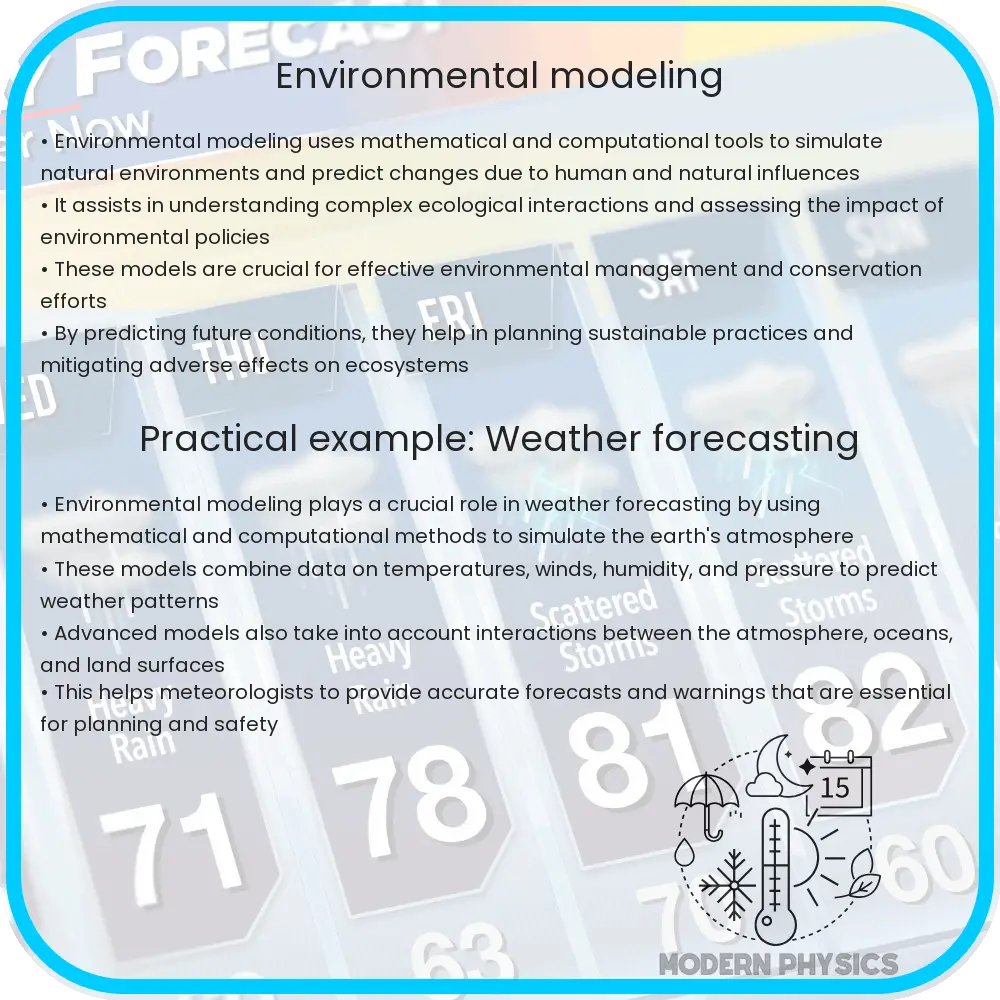
Environmental modeling is a crucial aspect of modern science, helping to predict and understand the complexities of various ecological and atmospheric phenomena. From climate change predictions to air quality assessments, environmental models rely heavily on the principles of physics to provide accurate and reliable data. This article explores the role of precision and analysis in environmental modeling and how physics underpins the entire process.
Precision in Environmental Modeling
Precision refers to the closeness of two or more measurements to each other. In environmental modeling, precision is vital because it impacts the reliability of the model predictions. High precision in environmental models is achieved through meticulous data collection, state-of-the-art technology, and rigorous validation techniques. Sensors used for collecting environmental data, such as temperature, humidity, and pollutant levels, must be finely calibrated to ensure the accuracy of the data input.
- Consistency in data collection methods.
- Advanced computational models that can process large datasets accurately.
- Sophisticated algorithms that minimize errors and variability in model outputs.
Analysis in Environmental Modeling
Analysis in environmental modeling involves processing and interpreting the data collected to formulate predictions or patterns. This process uses various mathematical and physical theories to convert raw data into understandable and usable information. One of the key physics concepts used in analysis is fluid dynamics, particularly when modeling atmospheric or oceanic currents. The equations governing fluid dynamics, such as the Navier-Stokes equations, are pivotal in predicting how pollutants move through water and air.
Another critical aspect of analysis is statistical physics, which helps model the randomness and uncertainty inherent in natural systems. By applying principles of statistical mechanics, scientists can make probabilistic predictions about environmental outcomes, ensuring that their models can account for the variability observed in nature.
The Role of Physics in Environmental Modeling
Physics is fundamentally integrated into every aspect of environmental modeling. It provides the theoretical framework and equations necessary for modeling complex systems. Conservation laws, such as the conservation of mass, energy, and momentum, are central to environmental physics. These laws ensure that the models adhere to physical realities, making the simulations realistic and grounded in scientific principles.
For example, in climate modeling, the law of conservation of energy is used to ensure that the energy received from the sun balances with the energy lost to space, which is crucial for predicting temperature changes. Similarly, the principles of thermodynamics guide the understanding of heat transfers within the Earth’s atmosphere, influencing weather and climate models.
The precision and analysis involved in environmental modeling are deeply intertwined with physics. By applying these scientific principles, environmental models become more than just computational tools; they transform into dynamic systems that can mirror real-world behavior, predict future conditions, and help in strategic planning and policy-making. This integration of physics not only enhances the accuracy of models but also enriches our understanding of the natural environment.
Challenges in Environmental Modeling
Despite advances in technology and methodology, environmental modeling faces several challenges. One of the main challenges is the scale of prediction. Environmental phenomena can span from very small scales, such as a local pollution incident, to global climate systems spread across the planet. Each scale requires different types and amounts of data, as well as varying computational approaches.
Another significant challenge is dealing with the inherent uncertainty in natural systems. Environmental systems are complex and often nonlinear, meaning small changes in input data can lead to large variations in the output. This sensitivity to initial conditions is a well-known aspect of chaotic systems, such as weather systems, and poses a substantial hurdle in achieving both precision and reliability in environmental predictions.
The variability in data quality and availability also poses challenges. Data collected from different sources may have varying levels of accuracy and may not always be available for all regions or times needed. This inconsistency can affect the robustness of the models and the credibility of the predictions.
The Importance of Continued Innovation and Collaboration
To overcome these challenges and enhance the accuracy of environmental models, ongoing innovation and collaboration among scientists, engineers, and technology developers are crucial. Implementing new technologies such as artificial intelligence and machine learning can play a significant role in refining data analysis and model precision. These technologies can automate the processing of vast datasets and identify patterns that might be missed by human analysts.
Moreover, international collaboration is essential for gathering and sharing diverse data, especially for global issues like climate change. By combining data from multiple sources worldwide, models can achieve greater coverage and provide more comprehensive and accurate predictions.
- Integration of satellite data for wider geographic coverage and real-time monitoring.
- Development of more robust models through shared research efforts.
- Enhanced predictive capabilities by leveraging diverse expertise and technologies.
Conclusion
Environmental modeling is a vital tool in our efforts to understand and mitigate the impacts of environmental changes. Precision and analysis, rooted in the fundamental principles of physics, are key to developing reliable models that can predict a range of ecological and atmospheric phenomena. The challenges inherent in modeling complex environmental systems underscore the necessity for advanced technologies and international cooperation. As we continue to refine these tools and methodologies, environmental models will not only provide clearer insights into our planet’s dynamics but also support critical decision-making processes that aim to preserve and protect our natural environment. In embracing these challenges and innovations, we are taking significant steps toward a sustainable future, guided by science and technology.