
Explore the Dual Superconductor Model in QCD: Understand quark confinement, flux tubes, and their implications in particle and astrophysics.
Understanding the Dual Superconductor Model in Quantum Chromodynamics
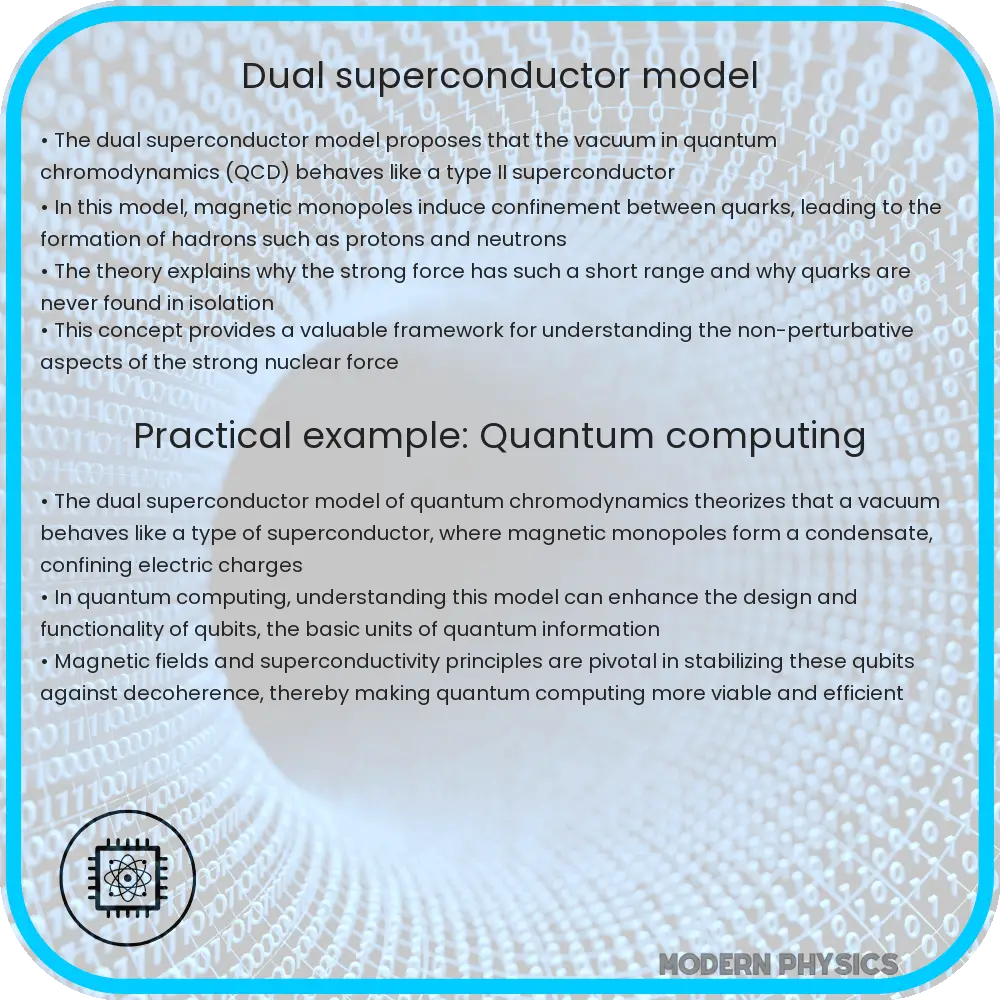
Quantum Chromodynamics (QCD), the theory describing the strong interactions of quarks and gluons, is enriched by the concept of the Dual Superconductor Model. This theoretical framework provides a compelling explanation for confinement, a phenomenon where quarks are perpetually bound within hadrons, such as protons and neutrons, and never exist in isolation. The analogy of a superconductor, a material exhibiting zero electrical resistance and expelling magnetic fields, plays a pivotal role in understanding this model.
Key Concepts of the Dual Superconductor Model
At the heart of the Dual Superconductor Model lies the idea of ‘dual’ phenomena. In a conventional superconductor, Cooper pairs of electrons move without resistance, and magnetic fields are expelled or quantized into vortices. Analogously, in the dual superconductor theory applied to QCD, the roles of electric and magnetic fields are reversed. Here, it’s the chromo-magnetic monopoles that condense, leading to the confinement of chromo-electric fields into narrow tubes or ‘flux tubes’ between quarks.
This flux tube formation is akin to the Meissner effect in superconductivity, where magnetic field lines are squeezed out of the superconducting material. In QCD, the chromo-electric field lines are squeezed between quark-antiquark pairs, forming a string-like structure. This string exerts a constant force over distance, explaining why quarks are never found alone. The energy of the string increases with length, leading to a phenomenon known as ‘string breaking’, where new quark-antiquark pairs are created.
Applications and Implications in QCD
The Dual Superconductor Model has profound implications in the study of QCD. It provides a framework for understanding the mass and structure of hadrons, as well as the dynamics of quark-gluon plasma, a state of matter believed to have existed shortly after the Big Bang. In this state, quarks and gluons are free from confinement, akin to the normal state of a superconductor where resistance reappears.
Furthermore, the model aids in the exploration of the phase diagram of QCD, particularly in the context of high temperature and density conditions. This is crucial for understanding the behavior of matter in extreme environments, such as inside neutron stars or during heavy ion collisions in particle accelerators.
Theoretical studies and lattice QCD simulations provide substantial support for the Dual Superconductor Model, although direct experimental evidence remains elusive. These studies contribute to the ongoing quest to unify the fundamental forces of nature and deepen our understanding of the universe’s most fundamental constituents.
Theoretical Foundations and Challenges
The Dual Superconductor Model is grounded in the non-Abelian gauge theories that form the basis of QCD. Central to this is the concept of color confinement, where the strong force, mediated by gluons, becomes stronger as quarks move apart. This theory contrasts with electromagnetism, where the force diminishes with distance. The non-Abelian nature of QCD allows for self-interaction among gluons, leading to complex dynamics not present in other force theories.
One of the significant challenges in validating the Dual Superconductor Model is the difficulty in directly observing the predicted phenomena. Quarks are confined at such small scales that current experimental techniques cannot isolate them for direct study. Thus, much of the evidence supporting this model comes from theoretical calculations and simulations, particularly those involving lattice QCD, a numerical method that discretizes space-time for quantum field calculations.
Future Prospects and Research Directions
Future research in the Dual Superconductor Model and QCD is likely to focus on advancing computational methods to better simulate quark-gluon interactions. Enhanced computational power and algorithms may allow for more accurate modeling of confinement and flux tube dynamics. Additionally, ongoing experiments in particle physics, such as those conducted at the Large Hadron Collider (LHC), may provide indirect evidence or insights that further corroborate the model.
Another promising area is the study of exotic states of matter, like quark-gluon plasma and strange matter, which can offer further clues into the behavior of strong force at extreme conditions. Understanding these states is not only important for particle physics but also has implications in astrophysics, providing insights into the processes occurring in the early universe and inside neutron stars.
Conclusion
The Dual Superconductor Model in Quantum Chromodynamics presents a fascinating framework for understanding the confinement of quarks, one of the fundamental mysteries in particle physics. By drawing analogies with superconductivity, this model offers a coherent explanation for the behavior of the strong force at microscopic scales. While direct experimental evidence is challenging to obtain, the theoretical and computational advancements supporting this model are robust and continue to evolve. The exploration of this model not only deepens our understanding of the fundamental forces and particles but also bridges gaps between theoretical physics, particle physics, and cosmology. As research progresses, the Dual Superconductor Model in QCD promises to remain a pivotal area of study, illuminating the intricate tapestry of our universe’s most elementary components.