
Explore the Dual Superconductor Model’s role in quantum confinement and gauge theories, offering insights into the confinement of quarks in QCD.
Understanding the Dual Superconductor Model in Quantum Confinement & Gauge Theories
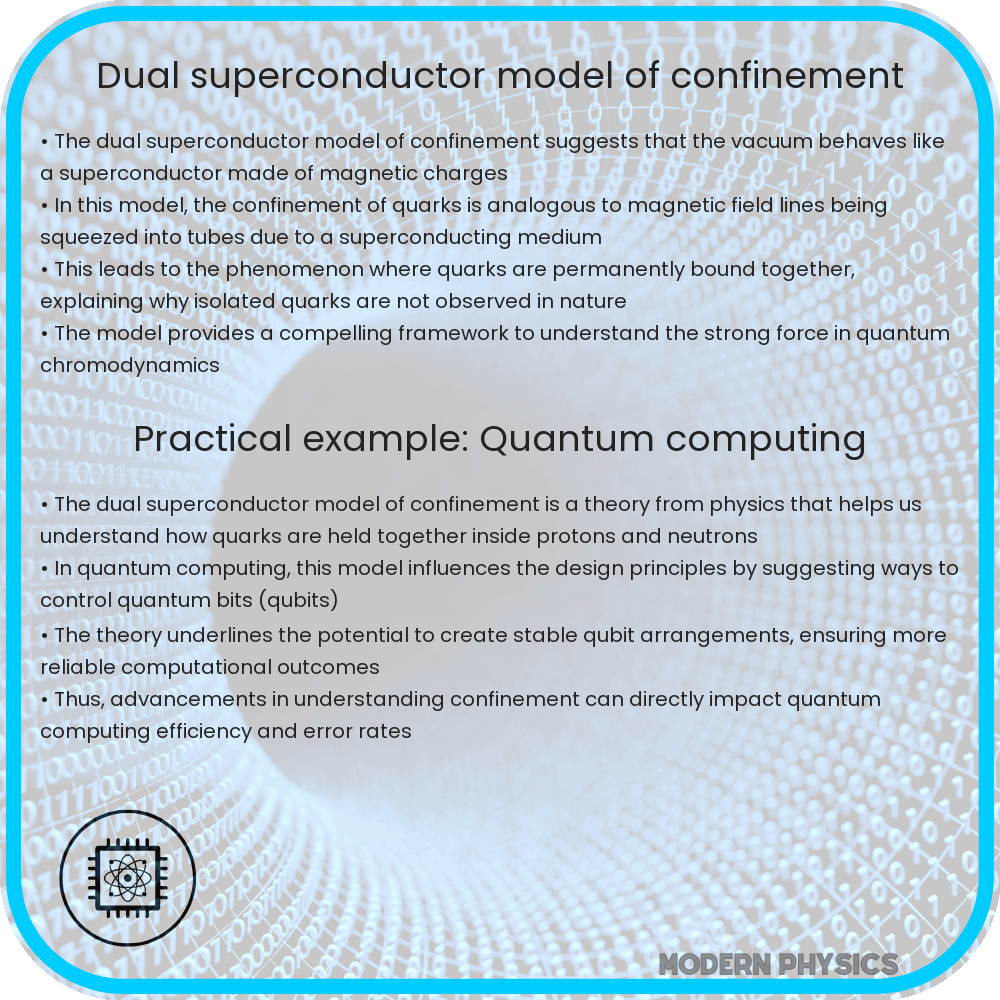
The Dual Superconductor Model is a fascinating concept in theoretical physics, offering a unique perspective on quantum confinement and gauge theories. This model draws a parallel between the confinement of magnetic fields in ordinary superconductors and the confinement of color charge in Quantum Chromodynamics (QCD), the theory that describes the strong nuclear force. This analogy has led to significant insights into how quarks, the fundamental constituents of protons and neutrons, are confined within these particles.
Quantum Confinement in QCD
At the heart of quantum confinement is the enigmatic behavior of quarks. Unlike other elementary particles, quarks are never found in isolation under normal conditions. This phenomenon, known as confinement, implies that the force between quarks does not diminish as they move apart. Instead, it increases, leading to the formation of a “flux tube” of strong force. The Dual Superconductor Model proposes that this tube behaves like a magnetic field line in a superconductor, confined into narrow tubes by the Meissner effect.
Gauge Theories and Color Confinement
Gauge theories are a class of theories in particle physics that are based on the principle of local symmetry. In the context of QCD, this involves the SU(3) gauge group, which is related to the color charge of quarks. According to the Dual Superconductor Model, the vacuum of QCD behaves like a superconductor for the ‘magnetic’ fields dual to the color electric field. This dual behavior results in color confinement, as the color electric field lines are squeezed into thin tubes, much like magnetic field lines in a superconductor.
This confinement is further elucidated through the concept of ‘t Hooft’s order and disorder parameters. The order parameter, akin to the superconducting gap in a conventional superconductor, signifies the phase where the dual superconductor effect is active and quark confinement occurs. Conversely, the disorder parameter reflects the deconfinement phase, where quarks are free from confinement.
The elegance of the Dual Superconductor Model lies in its ability to bridge the gap between the macroscopic phenomenon of superconductivity and the microscopic world of quantum chromodynamics. It provides a compelling framework for understanding the strong nuclear force and the confinement of quarks, offering a deeper insight into the fundamental forces that shape our universe.
The Role of Monopoles in the Dual Superconductor Model
Central to the Dual Superconductor Model is the concept of magnetic monopoles, hypothetical particles postulated to carry a singular magnetic charge. In this model, the confinement of quarks is attributed to the condensation of these monopoles in the QCD vacuum. This condensation creates a medium that confines color electric fields, analogous to how magnetic fields are confined in ordinary superconductors. Theoretical studies suggest that the presence of these monopoles could explain the high degree of stability and the strong binding force observed within hadrons.
Experimental Evidence and Future Perspectives
While the Dual Superconductor Model provides a compelling theoretical framework, its validation relies on experimental evidence. Lattice QCD simulations have offered significant support, showing the formation of flux tubes between quarks and providing insights into the behavior of the QCD vacuum. Future experiments, possibly at facilities like the Large Hadron Collider (LHC), may further illuminate the role of monopoles and the dynamics of quark confinement.
Additionally, advancements in quantum computing and numerical simulations are poised to offer deeper understandings of the non-perturbative aspects of QCD. These developments could lead to more accurate models of the strong force and its role in the universe.
Conclusion
The exploration of the Dual Superconductor Model in the context of quantum confinement and gauge theories represents a significant stride in our understanding of fundamental physics. By drawing parallels between the behavior of magnetic fields in superconductors and the confinement of color charge in quarks, this model offers a novel perspective on the mechanisms governing the strong nuclear force. Theoretical support from lattice QCD and potential experimental validations promise exciting advancements in our comprehension of the subatomic world. As research continues to unravel the complexities of quark confinement and gauge theories, the Dual Superconductor Model stands as a pivotal framework in the quest to decode the mysteries of the quantum universe.