
Dive into the complexities and implications of Doppler Shift in superconductors, exploring its effects on quasi-particles and superconducting properties.
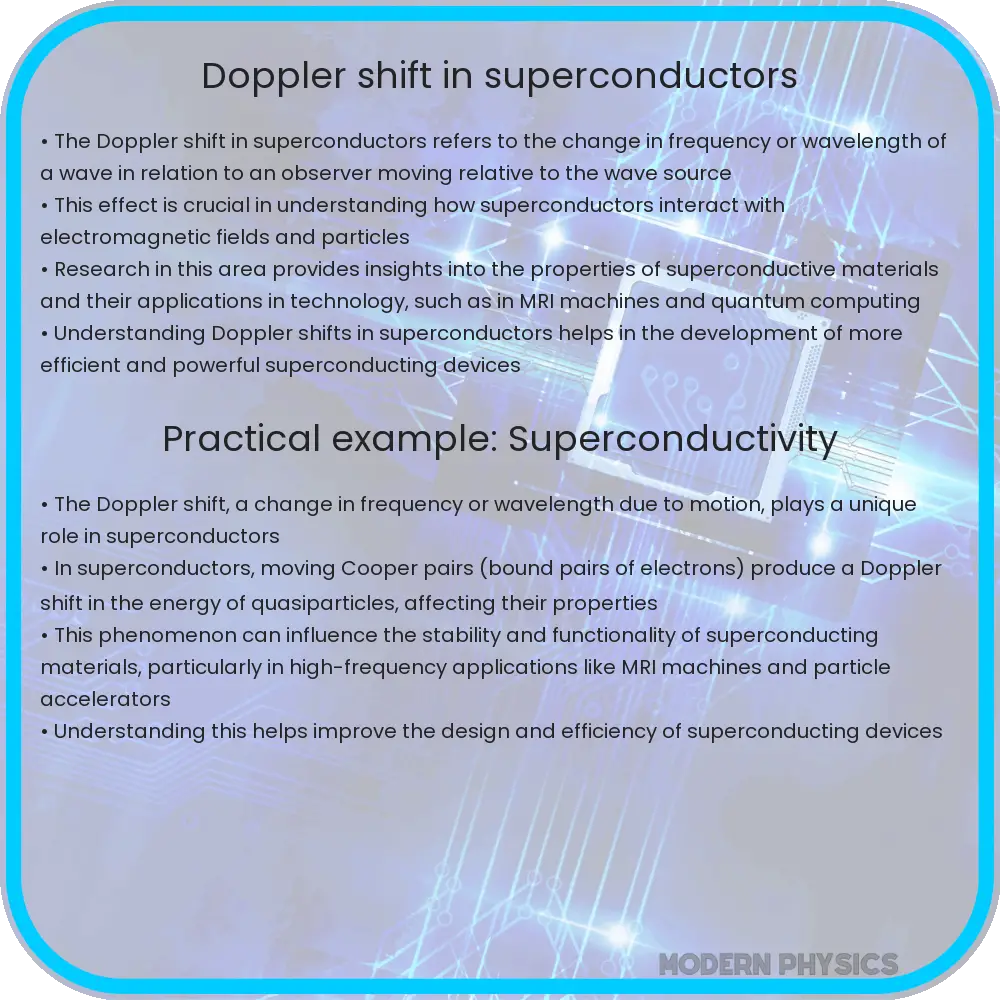
Understanding Doppler Shift in Superconductors
The Doppler Shift, a well-known physical phenomenon, is observed in sound waves and light waves when an observer and a source of waves are in motion relative to one another. This concept also extends to the realm of superconductors, where it can have intriguing implications due to the unique electronic properties of these materials. This article delves into the analysis, applications, and theoretical groundwork of Doppler Shift in superconductors, aiming to provide a deeper understanding of this sophisticated topic.
Theory of Doppler Shift
In general terms, the Doppler Shift refers to the change in frequency or wavelength of a wave in relation to an observer who is moving relative to the wave source. If the observer approaches the source, the wavelength appears shorter and the frequency higher (blue shift); if the observer moves away, the wavelength seems longer and frequency lower (red shift). Mathematically, the Doppler Shift in the frequency observed can be expressed as:
\[f’ = \left(\frac{c ± v_o}{c ± v_s}\right) f\]
Where:
- f’ = observed frequency,
- f = emitted frequency,
- c = speed of the wave in the medium,
- vo = speed of the observer,
- vs = speed of the source.
However, when it comes to superconductors, the situation becomes more complex because of the nature of electronic states and their quantum mechanical properties under conditions of superconductivity.
Doppler Shift in Superconductors
In superconductors, the Doppler Shift can be observed in the context of the energy of the quasi-particles, which are electronic excitations present in these materials. The relevance of the Doppler Shift in superconductors is tied to the behavior of these quasi-particles. It becomes particularly significant under the influence of an applied magnetic field which induces vortices within the superconducting material. These vortices contain currents that effectively move as sources of wave emission, leading to a Doppler Shift in the quasi-particle states surrounding them.
This phenomenon has direct implications on several superconducting properties, such as the stability of the superconducting state and the dynamics of vortices. Scientists use this understanding to manipulate and control the electronic properties of superconductors in applications ranging from quantum computing to magnetic resonance imaging devices.
Analyzing Doppler Shift in Superconductors
The study of Doppler Shift in superconductors typically involves sophisticated techniques like electron tunneling spectroscopy and scanning tunneling microscopy (STM). These methods allow physicists to measure how the energy of quasi-particles shifts as a function of their momentum. This measurement provides critical insight into the microscopic interactions occurring within the superconductor and the influence of external factors such as temperature and magnetic fields.
One of the key areas of interest is the effect of Doppler Shift on the energy gap in superconductors, a fundamental feature that dictates their conducting properties. By analyzing how this energy gap varies under different conditions, researchers can further unravel the complexities of superconductivity and enhance the design of new materials and devices.
Applications of Doppler Shift in Superconductors
The practical applications of understanding Doppler Shift in superconductors are vast and impactful. In the realm of medical technology, for instance, superconducting materials are essential components of MRI machines. Knowledge of the Doppler Shift helps improve the design of MRI scanners to achieve greater image clarity and stability, which is crucial for accurate diagnostics. Similarly, in telecommunications, superconductors are utilized to enhance the efficiency and speed of signal transmission. Here, the Doppler Shift understanding enables engineers to minimize errors and optimize system performance.
Further, in the field of quantum computing, where superconductors play a pivotal role, understanding the Doppler Shift is vital for the development of qubits—the basic units of quantum information. Manipulating the Doppler Shift allows for more precise control over qubit behavior, leading to advancements in quantum coherence and error correction strategies, thereby enhancing computational power and robustness.
Conclusion
In conclusion, the Doppler Shift, while commonly associated with sound and light, plays a significant and sophisticated role in the domain of superconductors. Exploring its influences not only deepens our understanding of fundamental superconducting properties like the energy gap and quasi-particle dynamics but also paves the way for innovative applications across various high-tech industries. From enhancing the precision of MRI scanners to enabling breakthroughs in quantum computing, the insights gained from studying Doppler Shift in superconductors are proving integral to technological advancement.
As research continues and technology evolves, the potential to harness and further understand the Doppler Shift in superconductors remains a thrilling frontier in both physics and engineering. By bridging complex theory with practical applications, scientists and engineers keep unravelling the hidden potentials of superconductivity, drawing us closer to a future where the boundaries of what can be achieved with these materials expand even further.