
Dispersion relations in acoustics describe how sound wave frequency relates to wavenumber, affecting sound propagation through different media.
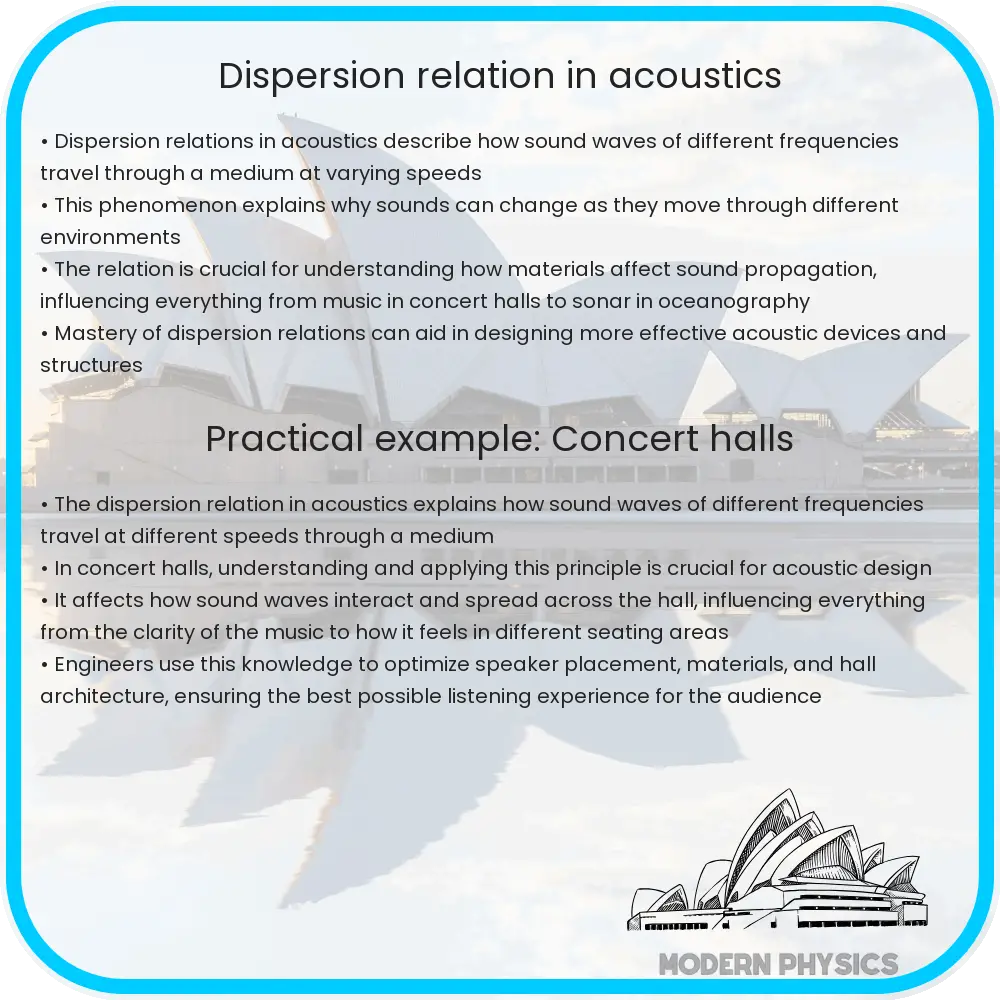
Understanding Dispersion Relations in Acoustics
Dispersion relations in acoustics are fundamental concepts critical to understanding how sound waves behave as they travel through different mediums. These relations play an essential role in various fields, from designing acoustical settings in architectures to developing underwater sonar systems. In this article, we’ll explore the basics of dispersion relations and their implications in sound wave propagation.
What is a Dispersion Relation?
At the core, a dispersion relation is a mathematical description that relates the frequency (ω) of a wave to its wavenumber (k). This relationship is crucial because it defines how waves of different frequencies travel through a material. In the context of acoustics, this relation helps us understand how sound speed varies with frequency, influencing how sound is perceived or detected in different scenarios.
Wave Phenomena in Acoustics
Sound waves are longitudinal waves where the particle displacement is parallel to the direction of wave propagation. As sound waves travel, they obey fundamental physics principles, and one of these is the dispersion relation. Typically, in an ideal non-dispersive medium, the speed of sound is constant, meaning that all sound waves, regardless of their frequency, travel at the same speed. However, most real-world media are dispersive to some extent which leads to a variation in sound speed with frequency.
Analyzing Sound Speed
The speed of sound in a medium is generally given by the equation:
c = sqrt(E / ρ)
where E represents the modulus of elasticity of the medium, and ρ is the density. However, for a more detailed analysis, especially in dispersive media, we need to consider the dispersion relation. For most gases, the relation can be simplified and represented as:
ω = k * c
Here, ω is the angular frequency, k is the wavenumber, and c is the speed of sound. This relationship shows the direct proportionality between the angular frequency and the wavenumber, implying a non-dispersive medium. However, in different fluids or solids, this relationship can become more complex, presenting a frequency-dependent sound speed.
Examples of Dispersion in Practical Acoustics
Dispersion effects are often seen in engineering and environmental applications. For example, in ocean acoustics, the variation in water temperature, salinity, and pressure leads to a dispersive medium where the speed of sound changes with depth and frequencies. This dispersion affects the performance of sonar systems and underwater communication.
In another example, materials used in building acoustics, such as insulation and panels, may exhibit frequency-dependent absorption properties. This necessitates a thorough understanding of the material’s dispersion relation to optimize sound insulation across different frequency bands.
Moreover, in the design of musical instruments, the material properties and their dispersion relations influence the quality of sound produced. Stringed instruments, for instance, must consider the dispersion of waves along the string, affecting the instrument’s tonal qualities.
Understanding these nuances helps in designing better acoustical systems and in improving sound analysis across varied applications. Further intricacies of dispersion in acoustics, including mathematical analysis and its implications in different mediums, continue to fascinate researchers and practitioners alike.
Impact of Dispersion on Signal Processing
Signal processing in acoustics also feels the significant impact of dispersion. In telecommunications, for instance, understanding and managing dispersion is crucial for minimizing signal loss over long distances. Acoustic signals, much like electromagnetic signals, can suffer from dispersion-induced distortion, leading to decreases in clarity and intelligibility. Thus, engineers often need to correct for or compensate these dispersive effects to enhance the quality of the transmitted sound, particularly in complex systems like broadband communications.
Future Directions in Dispersion Research
The ongoing developments in acoustic dispersion research continue to open new avenues for innovation. One such promising area is the use of metamaterials—materials engineered to have properties that are not found in naturally occurring materials. These can be designed to exhibit controlled dispersive characteristics, potentially revolutionizing how we manage sound propagation. Additionally, advancements in computational acoustics enable more precise simulations of dispersive effects, aiding in the design of more efficient acoustical systems in automotive, aerospace, and architectural engineering.
Conclusion
Dispersion relations play a pivotal role in our understanding of sound wave propagation across various mediums. From the fundamental physics that describe wave behavior to complex applications in engineering and technology, these relations provide essential insights that drive innovations and improvements in acoustical design. Whether addressing challenges in underwater communication, enhancing architectural acoustics, or crafting better musical instruments, a thorough grasp of dispersion relations enables professionals to make informed decisions and develop solutions that effectively manage sound quality and propagation. As research continues to unveil more about these fascinating phenomena, the potential for new technological breakthroughs in sound management and manipulation grows, promising a future where sound can be more precisely controlled and utilized.